
Safari uses AI to create custom extensions with Apple Intelligence
For years, Safari maintained its distinct identity as a browser. While Chrome thrived on a vast array of extensions, Apple focused on speed, efficiency, and privacy protection.
With Safari in iOS 27 and macOS 27, the Cupertino giant is now taking an unexpected approach: instead of expanding its extensions store, the company aims to allow everyone to create their own using artificial intelligence.
This feature could prove to be one of the most underrated innovations from Apple Intelligence.
Safari: Describe an Extension Rather Than Searching for One
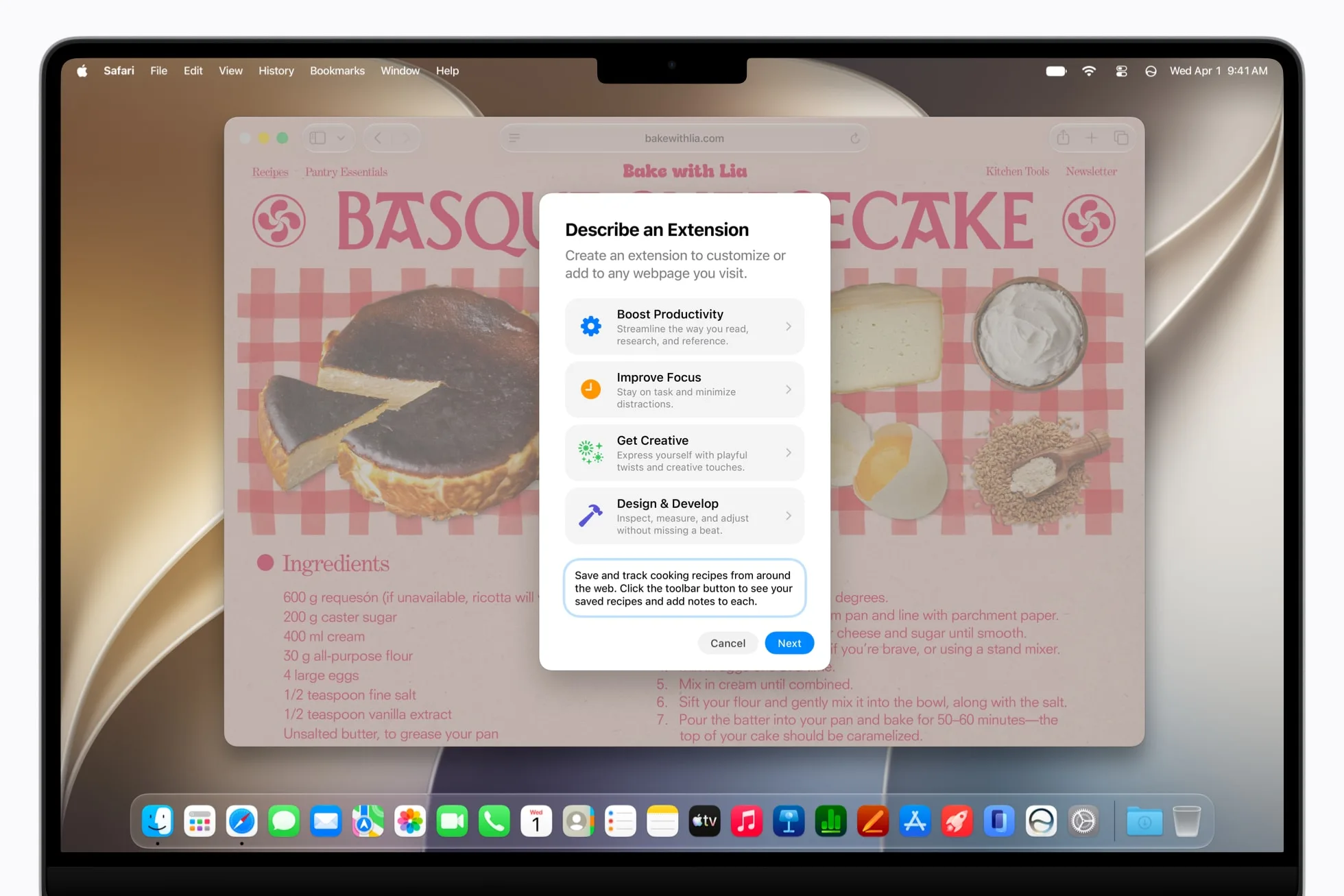
The new “Describe an Extension” feature operates on a simple principle. Instead of sifting through an extensions catalog or searching for a third-party solution, the user describes in natural language what they want to add to Safari.
Apple Intelligence then generates a custom extension capable of modifying a webpage’s behavior, adding shortcuts, or automating specific tasks.
Apple mentioned use cases such as adding a rating system for recipes, simplifying e-commerce pages, creating custom buttons, and automatically saving information for later reference.
The goal is not to directly compete with the thousands of extensions available on Chrome, but to quickly solve small, very specific problems.
A New Philosophy for Extensions
This approach perfectly illustrates Apple’s current vision for AI. Instead of building a massive extensions platform, the company is looking to make their creation almost imperceptible.
In this scenario, an extension is no longer a product downloaded from an app store; it becomes a simple personal tool created on-demand to address a specific need.
This strategy might appeal to users who have never taken the time to install extensions or who hesitate to trust unknown developers.
Safari Becomes Smarter Across the Board
The creation of extensions is just one part of the new features announced. Safari is also introducing a new intelligent tab management system. The browser can now analyze open pages, identify common themes, and automatically group related content into dedicated collections. A travel search, a work project, or a shopping session can thus be organized without manual intervention.
Apple is also introducing “Notify Me,” a feature that monitors a webpage in the background.
Instead of keeping a tab open for hours waiting for a restock or ticket sale, the user can simply ask Safari to monitor the event and receive a notification when a change occurs.
Automation Also Extends to Passwords
Another major new feature concerns security. Thanks to the integration between Safari and the Passwords app, Apple Intelligence can now detect a weak or compromised password and automatically update it.
Safari can navigate to the concerned site, log into the user’s account, generate a new secure password, and make the change without complex intervention.
This is likely one of the most practical applications of AI presented at WWDC 2026.
The Real Challenge Remains Trust
The promise is appealing but also raises several questions. An automatically generated extension potentially has the capability to interact with the content displayed in the browser. Users need to understand precisely which data is accessible, what modifications are made, and how to quickly disable an extension if it does not function as intended.

Apple claims that the new features of Safari are designed to protect browsing data and limit information sharing, even with Apple itself.
It remains to be seen whether this transparency will be sufficiently clear to reassure users.
Apple Reinvents a Historical Weakness of Safari
For years, the lack of extensions has been one of the main arguments users of Chrome cite for not migrating to Safari. With Apple Intelligence, Cupertino is not aiming to copy Google’s strategy. Instead, the company is looking to circumvent the issue.
If AI-generated extensions deliver on their promises, Safari may no longer need a massive library of extensions. A few customized tools, created in seconds and tailored to each user’s precise needs, could suffice to transform the browsing experience.
And in an industry where simplicity often outweighs quantity, this approach may prove to be far more ambitious than it appears.