

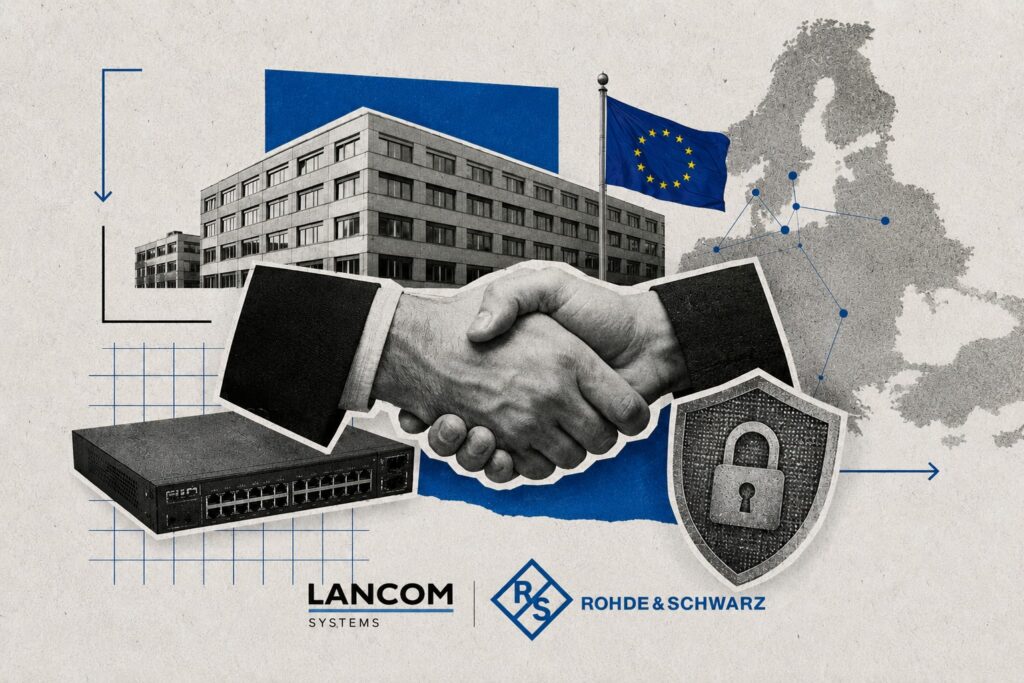
Rohde & Schwarz Merges Lancom Systems and Cybersecurity Units to Enhance Sovereign Digital Offering
German technology group Rohde & Schwarz is set to merge its two subsidiaries, Lancom Systems and Rohde & Schwarz Cybersecurity, into a single entity named Rohde & Schwarz Networks and Cybersecurity, effective July 1, 2026. This strategic move combines a network specialist with an encryption expert certified by Germany’s federal cybersecurity agency, creating a unified sovereign offering that employs roughly 500 employees across six sites in Germany, while retaining the Lancom brand.
The integration arises amidst a growing trend in the European market towards the convergence of networking and security. Solutions like network detection and response, SASE (Secure Access Service Edge), and SSE (Security Service Edge) are now redefining connectivity and protection within a single framework, a departure from the previous scenario where these functions were managed by different providers. This consolidation among European players is being driven by the demand for digital sovereignty, fueled by regulations such as the NIS2 Directive and the European Regulation on the resilience of critical entities.
In this context, Rohde & Schwarz, an independent German tech group, aims to unify its subsidiaries to strengthen its position as a leading sovereign entity. Lancom Systems contributes its expertise in networking, including switches, firewalls, Wi-Fi access points, routers, and SD-WAN services managed via the Lancom Management Cloud. Meanwhile, Rohde & Schwarz Cybersecurity brings high-speed network encryption and zero-trust endpoint security solutions, primarily certified by Germany’s Federal Office for Information Security for its secure data protocols.
Maintaining the Lancom Brand While Centralizing Governance
While the merger unifies the two firms, it ensures the Lancom brand remains intact, having been part of the network product portfolio for a remarkable 24 years. This brand retention is crucial, especially to enhance its market positioning in France. Previously, the standalone name Lancom, which shares similarities with the fragrance brand Lancôme, led to misunderstandings among decision-makers who associated it with a more consumer-oriented identity. Transitioning to the Rohde & Schwarz brand, recognized in defense and governmental markets, repositions the company within a narrative of sovereignty and high security that aligns with its strategic aims.
The leadership structure will continue under the current management team of Lancom. As of July 1, Constantin von Reden and Robert Mallinson will lead Rohde & Schwarz Networks and Cybersecurity as co-CEOs, while Ralf Koenzen, founder of Lancom and current CEO of Rohde & Schwarz Cybersecurity, will serve as an advisor and chairman of the supervisory board. “The reputation and trust in the Rohde & Schwarz brand will give the merged enterprise a significant edge, particularly in international markets,” Koenzen remarked, reaffirming the importance of the Lancom brand within the existing product lineup.
Bridging Networking and Security Under a Sovereign Brand
The rationale behind the merger lies in the complementarity of the two companies’ capabilities. Lancom brings its networking expertise, while Rohde & Schwarz Cybersecurity delivers high-security encryption and sophisticated algorithms, including innovations derived from post-quantum research. “Networking and cybersecurity are intertwined,” asserted Constantin von Reden, future president of the new entity, envisioning the merger as a robust force for the group’s market position. This convergence also reflects broader trends in the European market, as Denis Authier, Vice President of International Sales at Lancom Systems, notes: “We increasingly see platforms becoming interoperable among European players, intentionally closed off from non-European actors, which significantly benefits European clients.”
The technological integration expands the scope of protection available to clients, extending to the encryption of idle optical fibers used in national transport networks and logistics flows. This comprehensive offering, crafted in Germany, is positioned to champion European digital sovereignty in a landscape dominated by non-European competitors.
Four Market Domains with Maintenance of Distribution Model
The newly formed entity will focus its operations across four market domains: private organizations, the public sector, critical infrastructure, and industrial IoT, as well as defense. The public sector and critical infrastructure domains are anticipated to drive the highest demand due to urgent needs for high-security European technology and data transport solutions. Key sectors, including healthcare, education, local governments, and energy production, are expected to have significant requirements that Denis Authier describes as vulnerable and inadequately protected.
The distribution model will remain unchanged. Lancom has historically relied on 100% indirect sales, and the merged company will uphold this strategy. “The channel will continue to be our primary sales avenue going forward. We will expand our ecosystem to include select new specialized partners based on market trends,” stated Robert Mallinson, co-CEO responsible for sales. In France, this aligns with a strategic initiative launched in late 2025 with distributor Kappa Data, aiming to double the active partner network by early 2026. “Even as we industrially merge in a predominantly direct market, we will maintain our indirect approach to effectively navigate the local cultural disparities within these ecosystems,” explained Denis Authier.
The specificity of use cases now favors sovereign providers capable of collaborating with global players based on the sensitivity of workloads. “We may engage an hyperscaler for tasks that require no private or sovereign measures, while opting for a sovereign provider for legally mandated protections,” summarized Authier.
For French decision-makers, the argument for sovereignty is clear. Rohde & Schwarz—an EU group not subject to the U.S. Cloud Act and backed by German certifications—provides verifiable assurances, especially concerning encryption and endpoint protection, right where it matters most.



