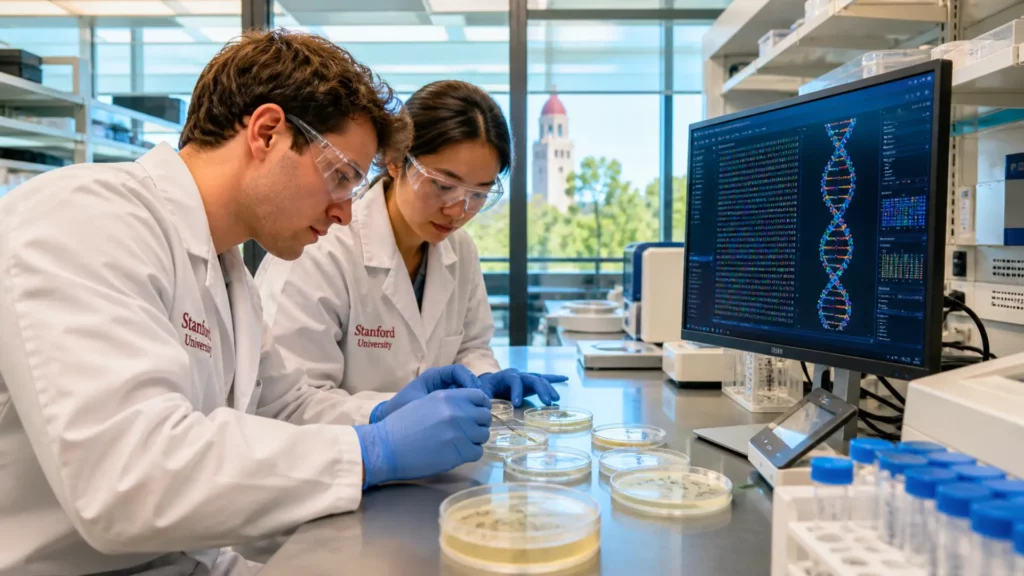
What if an algorithm could create life from simple lines of code? At Stanford, a team of researchers has crossed a fascinating frontier by generating functional viruses using AI. A spectacular advancement, balancing therapeutic hope and ethical vertigo.
At Stanford, An AI Generates Complete Viral Genomes From Genetic Data
In the hushed halls of Stanford University, a team of researchers has embarked on a bold experiment: designing an entirely new virus without ever observing nature directly. According to a preprint research report on bioRxiv, their tool, an artificial intelligence model named Evo 2, functions like a writer… but one specialized in DNA. It generates genetic sequences with unsettling accuracy.
Unlike traditional models that predict protein structures, Evo 2 dives directly into the essence of life. It manipulates millions of base pairs and proposes unprecedented combinations. To test its capabilities, the scientists chose a tiny virus, the phage ΦX174, whose genome consists of only 5,000 bases, making it an ideal playground.
From Synthetic DNA To Viral Particles: Transforming Code Into Functional Viruses
Once the sequences are generated, the real challenge begins. These DNA fragments are synthesized in the lab by specialized companies and then inserted into bacteria. A fascinating mechanism kicks in: if the sequence is viable, it triggers the production of viral proteins that spontaneously assemble.
The result is spectacular. In some cultures, the bacteria disappear, leaving behind a clear liquid. This phenomenon, almost invisible to the naked eye, signifies the presence of active viruses. In total, the researchers have successfully created 16 functional phages, some of which even surpass their natural counterparts in efficacy.
Phage Therapy And AI: Designing Custom Viruses Against Resistant Bacteria
Behind this technological achievement lies a significant challenge. Antibiotic resistance is progressing at an alarming rate. According to several projections, it could cause over 39 million deaths by 2050 if no solutions emerge. In this context, bacteriophages are again drawing attention.
These viruses specifically target bacteria, posing no danger to humans. With the aid of AI, it’s becoming possible to design custom phages capable of precisely attacking given infections. This approach, known as phage therapy, could transform modern medicine and provide a credible alternative to traditional treatments.
Beyond human health, applications extend to agriculture. Optimized phages could protect crops from pathogenic bacteria, reducing the use of pesticides. A perspective that is increasingly appealing to researchers at a time when food security is a global challenge.
Between Promises And Risks: Regulating AI-Generated Virus Creation And Biosafety
Yet, behind the enthusiasm, a concern persists. If an artificial intelligence can design harmless viruses, what would prevent a malicious use? Some experts are already raising alarms about the risks linked to the democratization of these technologies. The debate on biosafety is intensifying.
Researchers at Stanford emphasize the precautions they have taken. The model used is based on controlled data, and the experiments involve only harmless viruses. However, the rapid advancement of AI poses a central question: are the current safeguards sufficient in the face of a rapidly accelerating technology?