

Red Hat, Nvidia, and Palo Alto Networks Forge Alliance for AI-Native Telecommunications
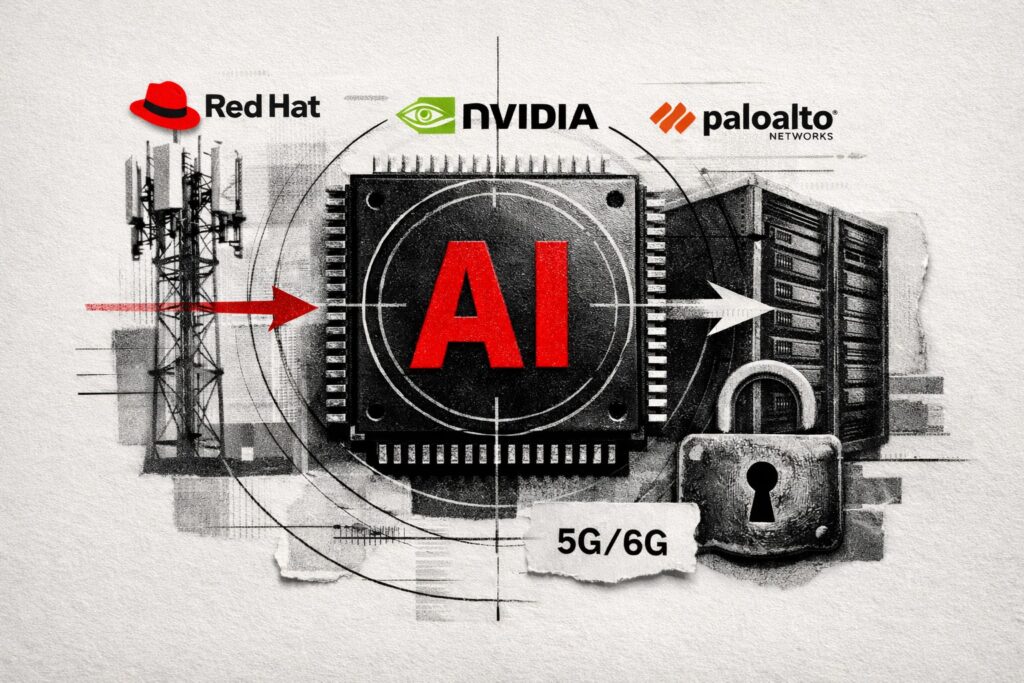
Red Hat, Nvidia, and Palo Alto Networks have announced a strategic partnership aimed at establishing a secure and integrated foundation for AI-native telecommunications. This collaboration seeks to streamline the deployment of artificial intelligence across 5G and 6G networks by merging computing power, software orchestration, and cybersecurity.
This announcement highlights a significant trend within the IT market known as “platformization,” where leading companies in silicon, software, and security unite to dismantle technological silos. By offering a pre-integrated stack, the consortium addresses the increasing complexity of telecommunications infrastructures, which must now accommodate massive AI workloads while ensuring resilience. For operators, the challenge lies in transitioning from reactive infrastructures to proactive architectures capable of real-time self-optimization.
The partnership leverages a multi-layered technological synergy: Red Hat contributes its OpenShift platform for container orchestration, Nvidia supplies its BlueField-3 data processing units (DPUs) and accelerators, while Palo Alto Networks integrates its AI-powered security solutions. This layered approach secures the entire AI lifecycle, from model training to deployment at the edge of the network.
A Hardware and Software Foundation for Sovereign AI
At the heart of this solution is the integration of Nvidia AI Enterprise within Red Hat OpenShift, creating a unified development and execution environment. The utilization of Nvidia BlueField-3 DPUs is critical; these chips offload heavy network and security tasks from central processing units (CPUs), freeing up power for business-critical AI applications. This distributed architecture ensures minimal latency, a non-negotiable requirement for critical services in private 5G systems and Industry 4.0.
With Red Hat’s orchestration, workloads can be effortlessly portable between central data centers and remote sites. This flexibility is vital for operators aiming to deploy inference capabilities as close as possible to end users, thereby reducing data transport costs. By automating the management of GPU and DPU resources, the platform alleviates operational complexity, allowing IT teams to focus on software innovation rather than the maintenance of underlying infrastructure.
Integrated Security by Design
Palo Alto Networks adds a vital layer of trust to this architecture by deploying AI-driven security services directly on the platform. The collaboration enables real-time inspection of network traffic without compromising performance, utilizing the hardware acceleration provided by Nvidia. This capability for immediate detection and response is crucial for safeguarding telecommunications networks against increasingly sophisticated cyberattacks targeting critical infrastructure.
Here, security is treated not as an additional layer but as an inherent component of the technological foundation. Palo Alto Networks’ solutions gain visibility into data flows between microservices, enabling the isolation of threats and the prevention of data exfiltration. This security-by-design approach is essential for organizations subject to stringent data protection regulations, particularly in governmental and financial sectors.
Orchestration as a Driver of Energy Efficiency
Beyond performance and security, this partnership emphasizes digital sobriety. The optimization of data flows through DPUs and intelligent resource management via OpenShift significantly reduces the energy consumption of data centers. By consolidating network and security functions on specialized chips, operators can lower the physical footprint of their facilities while enhancing processing capabilities. This energy efficiency is a vital lever for achieving decarbonization goals in the telecommunications sector.
The collaboration between Red Hat, Nvidia, and Palo Alto Networks signals a glimpse into the future of digital infrastructures: hybrid, multi-vendor, and fully integrated platforms. The success of this model will depend on the ability of the three partners to maintain seamless interoperability amid the rapid evolution of AI models and network standards. For technology decision-makers, the adoption of such integrated architectures is imperative for navigating the complexities of the AI-native era.



