

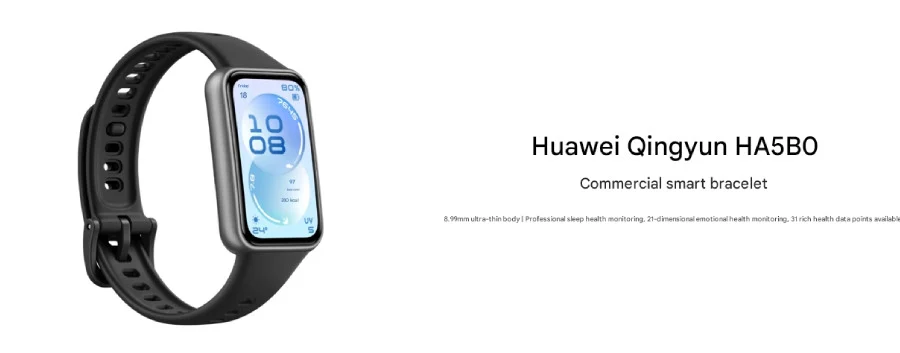
Qingyun HA5B0: Huawei launches a customizable fitness tracker for professionals
Huawei is quietly expanding its professional catalog with a new wearable device that occupies a unique position in the market. Named Qingyun HA5B0, this fitness tracker is designed not only for the general public but also for businesses, with a clear promise: to combine health monitoring, robust battery life, and extensive customization options.
Qingyun HA5B0: A slim, bright device close to premium standards
In terms of design, the Huawei Qingyun HA5B0 emphasizes simplicity. The device features a thickness of 8.99 mm and a 1.62-inch AMOLED display with a resolution of 286 × 482 pixels, a refresh rate of 60 Hz, and a peak brightness of 1,500 nits.
In short, Huawei aims to provide a discreet format that is still easy to read for everyday use, including in outdoor settings.
Health as the central focus
Where the HA5B0 seeks to stand out is in biometric monitoring. Huawei highlights professional sleep analysis, multidimensional emotional health tracking, and more ambitious features typical of this product category, such as Atrial Fibrillation alerts based on pulse waves and notifications of premature beats.
The tracker can also assess the risk of sleep apnea, monitor heart rate variability throughout the day, and display essential indicators like heart rate and blood oxygen levels. However, Huawei emphasizes that such alerts are not a substitute for clinical diagnosis; rather, they are meant as screening and prevention tools.
Over 100 sports modes, but ambitions remain software-based
In terms of physical activity, the device supports over 100 sports modes, including yoga, weightlifting, running, and jump rope. On paper, Huawei thus keeps pace with the segment’s top contenders. Yet, as is often the case with such devices, the real difference will not lie in the number of available profiles but rather in the quality of the algorithms, the accuracy of measurements, and the software’s ability to convert this data into useful advice.

Why Huawei refers to it as a “commercial” bracelet?
The most intriguing aspect is perhaps that Huawei presents the Qingyun HA5B0 as a product aimed at professional and institutional use. The brand states that its partners can customize the boot logo, watch faces, packaging, as well as aesthetic aspects such as the color or markings on the band.
In other words, this wearable can become a fleet object, a branded accessory, or a health terminal deployed at an organizational level. It is this B2B aspect that differentiates it from a simple fitness tracker available off the shelf.
A coherent technical sheet without unnecessary frills
The Qingyun HA5B0 features a 9-axis inertial sensor—comprising an accelerometer, gyroscope, and magnetometer—a heart rate optical sensor, and an ambient light sensor. It charges magnetically, supports Bluetooth 6.0, has a water resistance rating of 5 ATM, and lacks NFC functionality.
Huawei claims up to 14 days of battery life in maximum usage scenarios, and it is compatible with both Android and iOS. This is a pragmatic technical specification, designed for reliability and wide deployment rather than to showcase an array of flashy features.
A strategy reflective of the wearables market
With this model, Huawei is not merely looking to launch an additional bracelet. The company appears to be exploring a broader approach: transforming the wearable into a platform for business services, bridging wellness, brand identity, and the management of connected devices. In a saturated market focused on consumer goods, this pivot makes sense. It allows Huawei to step away from the straightforward price wars against Xiaomi, Honor, or Amazfit, providing the bracelet with a more structured value of use.
The Qingyun HA5B0 may not possess the allure of a premium smartwatch, but it conveys something more compelling: the rise of wearables as lightweight infrastructure tools for organizations. This evolution underscores how technology is increasingly integrating into even the most everyday professional practices.



