

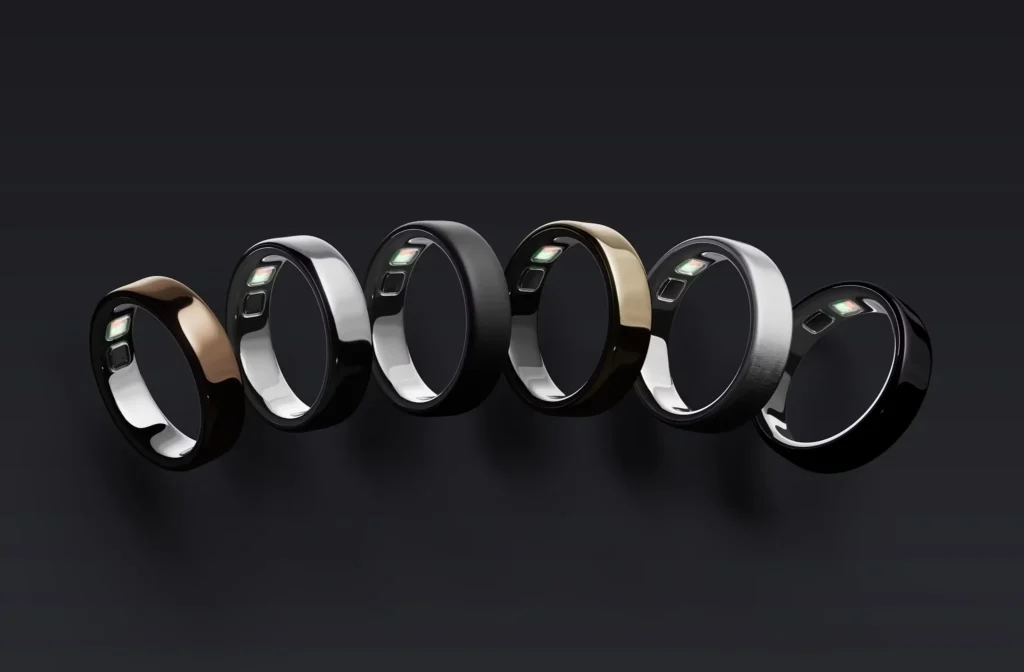
Oura Ring 5: A More Slim Connected Ring with Advanced Health Tracking
Oura is ramping up its efforts in the health-focused connected devices sector. Just a year and a half after the launch of the previous generation, the company unveils the Oura Ring 5, a more compact and precise version that is clearly designed to transform the connected ring into a full-fledged health tracking platform.
According to the brand, the Oura Ring 5 is 40% smaller, not only refining its design but also adding a suite of new software features that monitor blood pressure, respiratory patterns, live physical activities, and even brain health.
This evolution showcases how the smart ring market has entered a much more mature—and competitive—phase.
Oura Ring 5: A More Discreet Ring to Attract a Broader Audience
The most noticeable change in this fifth generation is its size. According to Maz Brumand, Oura has reduced the ring’s width by about two millimeters and its thickness by around 30%. The clear goal is to eliminate the sometimes bulky look of earlier smart ring generations.

The brand explains that they have completely rethought the mechanical architecture, electronic components, optical sensors, battery, and biometric detection system.
The end result is a ring that aims to look more like a classic piece of jewelry than a technological gadget.
This repositioning is significant. Until now, Oura dominated the smart ring market. However, with the emergence of competitors like RingConn and Ultrahuman, often without a monthly subscription, the brand is now pressured to speed up its innovation cycle.

Improved Battery Life and More Accurate Sensors
The Oura Ring 5 now promises between 6 and 9 days of battery life, compared to 5 to 8 days before. However, the real focus is on the sensors.
Oura claims to have enhanced skin contact and integrated stronger LEDs for more reliable measurements, especially across a wider variety of finger sizes and skin tones.

This is a critical point in the wearable health realm. Optical sensors are often sensitive to physiological variations and differences in skin, which can affect the accuracy of collected data.
Oura Aims to Become a Preventive Health Platform
The hardware is only part of the announcement. Oura’s true ambition lies in its new software layer. The company is launching “Health Radar,” a system designed to continuously monitor multiple biometrics to detect potential anomalies.
Two initial features are already planned: Blood Pressure Signals and Nighttime Breathing.

Monitoring Blood Pressure During Sleep
With Blood Pressure Signals, Oura aims to identify early signs of cardiovascular stress by analyzing physiological variations during the night. The concept is based on a well-known medical principle: blood pressure naturally decreases during sleep. When it remains abnormally high, it can indicate certain cardiovascular risks.

Users will also be able to directly import their readings from conventional blood pressure monitors into the app.
While Oura obviously does not replace a certified medical device, this approach highlights a major trend in the industry: transforming wearables into continuous health prevention tools.
Medical AI Enters the Oura Ecosystem
Another significant evolution concerns the services provided. Oura is partnering with Counsel Health to integrate health consultations directly into its app. This service combines artificial intelligence and licensed physicians to address users’ medical questions in the U.S.
Subscribers will be able to ask health questions, receive personalized recommendations, or connect with doctors. This service will be charged in addition to the current monthly subscription at $5.99.
This development increasingly positions Oura as a comprehensive digital health platform rather than just a connected accessory.
Oura Now Tackles Brain Health
The most ambitious announcement concerns a future study on cognitive health. For the first time, Oura aims to explore the links between daily habits, physical recovery, and cognitive performance.
Eligible users will be able to participate in a Brain Health Study that analyzes correlations between short cognitive exercises integrated within the app and observed physiological trends over time.
This direction is particularly indicative of the current evolution in wearables: following sleep, stress, and exercise, manufacturers are now seeking to quantify mental and cognitive health.
A Strategic Smart Ring Market
The Oura Ring 5 starts at €429, up from €399 for the previous generation. Premium finishes reach up to €529. This higher price point reflects Oura’s intention to position itself not just as a fitness gadget but as a premium player in the connected health space.
As smartwatches reach a certain maturity, connected rings are gradually becoming one of the most coveted new arenas in wearable tech.
More discreet, more stylish, and capable of continuously collecting biometric data, these devices could very well become the next permanent health interface.
Oura appears determined to get ahead of the game before giants like Apple or Samsung intensify their presence in this segment.



