

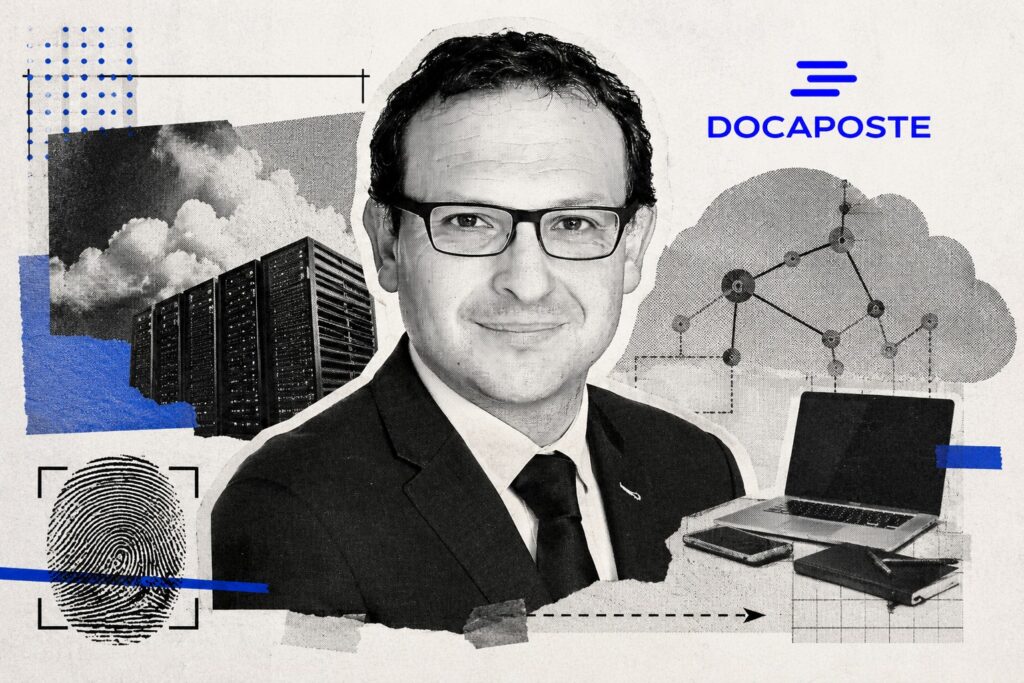

Docaposte, La Poste’s digital subsidiary, has established its credibility as a trusted third party in identity, electronic signatures, and archival solutions rooted in eIDAS regulations. However, the rise of artificial intelligence (AI) is transforming its business landscape. AI reduces the cost of code production to the point where a single developer can now deliver what previously required entire teams. It challenges the dominant office suites, 90% of which belong to Microsoft, and shifts the reliance on foreign suppliers into a daily concern. Thierry Borgel, CTO of Docaposte’s public sector division, discusses how the company is reshaping its offerings around identity verification, hybrid cloud services, workplace solutions, and digital resilience.
IT Social: Can you introduce yourself and describe Docaposte’s overall strategy beyond just the office suite?
Thierry Borgel: I joined Docaposte about two years ago as the CTO for the public sector. I am responsible for aligning all our offerings with the needs of public institutions. We operate as a publisher, integrator, and consultancy, maintaining strong expertise in back-office operations and document processing, particularly in light of AI innovations. Our solutions revolve around eIDAS but also tackle HR and financial themes since we also function as a bank and a certified platform. On the integration side, we’re building trusted platforms from applications to infrastructure and evolving into a multicloud service provider.
IT Social: Specifically concerning workplace solutions, how do you position yourself against the office suite market?
Thierry Borgel: Our starting position is heavily rooted in Microsoft, prevalent across both small and large organizations. The office suite market in France is valued at around €3 billion, with Microsoft commanding 90% and Google about 10%, leaving a sliver for French and open-source players. We do not offer a proprietary office suite; our goal is to foster champions in this space.
IT Social: What actions are you taking to achieve this?
Thierry Borgel: At VivaTech, we announced a partnership with Linagora, which provides an open-source suite called Twake. Together, we have responded to one of the significant public calls for proposals regarding sovereign collaborative environments, whose catalog is publicly accessible. Our aim is to support the deployment of Twake in various companies and local authorities.
IT Social: Is AI already impacting workplace usage?
Thierry Borgel: I stopped using Word a year ago due to sovereignty concerns, switching to LibreOffice before ultimately choosing WordPad. I now import AI-generated texts in web-formatted .txt files. However, I consider myself an early adopter; the broader public transition will take time. When an American vendor can restrict access to their services overnight, digital reliance becomes a tangible risk rather than a theoretical concern.
IT Social: How do you structure your partnership strategy?
Thierry Borgel: For our traditional areas, such as identity, our strategy aims at organic growth; we have over nine million clients and a team of around 15 to 20 specialists working with Keycloak. In areas where we lack historical presence, such as data management, we establish partnerships with companies like Suadéo, Databricks, and DigDash. In the cloud segment, we have approximately one hundred consultants trained on AWS, collaborating with NumSpot, Outscale, and OVH for hybrid solutions. Our main sectors remain public services, healthcare, and insurance, reinforced by a cybersecurity package in partnership with Wimi, aimed at small municipalities and SMEs.
IT Social: What is Docaposte’s current status regarding SecNumCloud certification?
Thierry Borgel: We aren’t a cloud provider, so the SecNumCloud label, which is specific to hosting companies, does not directly apply to us. Our partners, NumSpot, OVH, and Outscale, either hold this certification or are working towards it. Our internal platforms operate on an unverified cloud, as we are both the manager and sole client; this dual role complicates certification. Nonetheless, we remain committed to adhering to SecNumCloud’s requirements whenever applicable.
IT Social: For a company like Docaposte, isn’t the orchestration layer also a business layer?
Thierry Borgel: Absolutely, it’s a strategic layer. An engineer with a computer and a cloud subscription can now produce in two or three weeks what once required dozens of people and months of effort. We see this transformation reflected in our agent factory projects, which follow a methodology we call Ilex. Our ambition is to become a trusted multicloud operator capable of routing data based on sensitivity. We’re not fully there yet; NumSpot is ahead in this domain, focusing strongly on data and AI in line with Article 31 of the SREN Law.
IT Social: How is digital resilience organized at Docaposte?
Thierry Borgel: We have established a center of excellence for digital resilience within our consultancy unit. We are a design partner for the digital resilience index from aDRI, among the early participants in an accreditation process that is expected to yield a label by September. We have already measured our own resilience index across various entities and are providing support to external clients. The resilience market could represent a third to half of the scale identified in the study conducted by Cigref and Asterès regarding the flow of data sent to the United States.
IT Social: Can you provide examples of clients that exemplify this dynamic?
Thierry Borgel: Identity remains our solid foundation, with over nine million clients. In collaborative solutions, the momentum is more recent, with the partnership with Linagora announced at VivaTech; the first cases will emerge alongside the rollout of Twake.
IT Social: AI also seems to be redefining the role of IT teams themselves?
Thierry Borgel: AI is causing an identity crisis. We’ve never had to define ourselves in relation to HR software, but with AI, we must recalibrate. Users haven’t yet grasped that they are no longer mere executors but rather organizers who initiate and refine AI-generated work. For IT executives, architectural roles will increasingly emphasize where to deploy APIs and what security measures to accept.
IT Social: How do you envision Docaposte in one or two years?
Thierry Borgel: Our aim is to be recognized as a key player in supporting our clients’ resilience and IT transformation. Docaposte’s DNA carries a public service ethos that has never left the company. We have not faced a failed project that made headlines, and I believe that will set us apart. People trust Docaposte almost instinctively; I myself have submitted my driver’s license, ID card, and passport through their services.



