

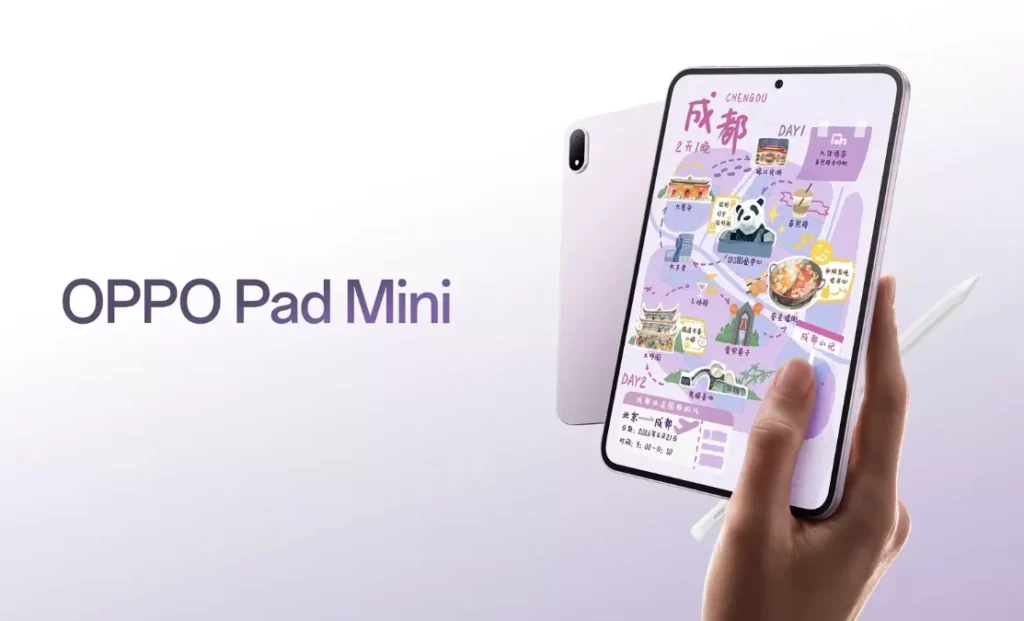
OPPO Pad Mini: The Small Tablet That Aims to Compete with the Big Players
In the wave of announcements surrounding the Find X9, the OPPO Pad Mini could have easily gone unnoticed. That would be a mistake. With its compact 8.8-inch format, OPPO is clearly looking to occupy an increasingly coveted space: that of the premium tablet that is lightweight, powerful, and serious enough to surpass the role of just a secondary display.
OPPO Pad Mini: A Compact Format but Ambitious Specs
The OPPO Pad Mini features an AMOLED display of 8.8 inches in a 3:2 aspect ratio, with a resolution of 2520 x 1680 pixels and an adaptive refresh rate ranging from 60 to 144 Hz. The peak brightness is reported to reach 1,600 nits, a high level for this category, clearly positioning the product in the premium rather than mid-range segment.
Under the hood, OPPO has chosen the Snapdragon 8 Gen 5 platform, complemented by LPDDR5X memory and UFS 4.1 storage. In other words, the brand does not treat this model as a “budget mini-tablet” but rather as a compact device with high performance.
ColorOS 16 rounds out the package with productivity-oriented tools, such as PC-level WPS functions, enhanced file management, and inter-device collaboration.
A Tablet Designed for Mobility over the Couch
This is where the Pad Mini becomes particularly interesting. Prior leaks pointed to a chassis thickness of about 5.39 mm and a weight around 279 grams, making it particularly thin and lightweight for its class. The launch text also mentions a very slim format, “just over 5.3 mm.”
While these numbers still require confirmation from a complete global official specification, the product direction is clear: OPPO aims to provide a tablet that fits seamlessly into mobile use, almost between a large smartphone and a work tablet.
The 8,000 mAh battery, paired with 67W fast charging, aligns with this idea. It’s a coherent compromise for a compact device: sufficient endurance to carry through a mobile day, without turning the tablet into an overly heavy block. Oppo adds to this with Wi-Fi 7, USB-C, stereo speakers, and a dual-camera setup of 13 megapixels and 8 megapixels, designed more for video conferencing and versatile use than for serious photography endeavors.

OPPO Refines its Tablet Strategy in 2026
The most intriguing aspect might not be the raw specifications, but the positioning of this product within the lineup. On its global website, OPPO is already highlighting several tablets, including the Pad 5 Matte Display Edition, the Pad 3 Pro, and the Pad SE. This indicates that the brand is seeking to establish a comprehensive portfolio in this segment. The arrival of a premium OPPO Pad Mini shows that OPPO is no longer satisfied with just the classic large formats; it now aims to cover the niche of high-performing compact tablets, a space still relatively underexploited in the Android market.
This positioning might also extend beyond China. There are already rumors hinting at a potential link with the upcoming OnePlus Pad 4, expected in India, possibly in the form of a rebranding.
At this stage, nothing officially confirms this, so the hypothesis should be treated with caution. However, the idea is not illogical, given the increasingly frequent overlaps between the OPPO and OnePlus catalogs.
Price: A True Premium Positioning, Not a Cheap “Mini” Tablet
The communicated prices place the OPPO Pad Mini at 3,199 yuan for the 8GB + 256GB version, 3,499 yuan for the 12GB + 256GB model, and 3,999 yuan for the 12GB + 512GB variant. The announced finishes are Mint Green, Monet Purple, and Space Grey. At this price point, OPPO is clearly not targeting the entry-level market; the brand is selling a premium mobile product, closer to a compact productivity tool than a mere family tablet.
Ultimately, this OPPO Pad Mini reflects the evolution of the market. Compact devices are making a comeback, but only if they are taken seriously. More powerful, thinner, more refined, and credible enough to serve both work and entertainment needs. The remaining question is: Will OPPO keep this small tablet exclusive to China, or will it become a true global showcase for its ambitions on Android? At this stage, international availability has yet to be clarified.



