

Opera Neon: Why Your Browser Is Becoming a Slave to Your AI?
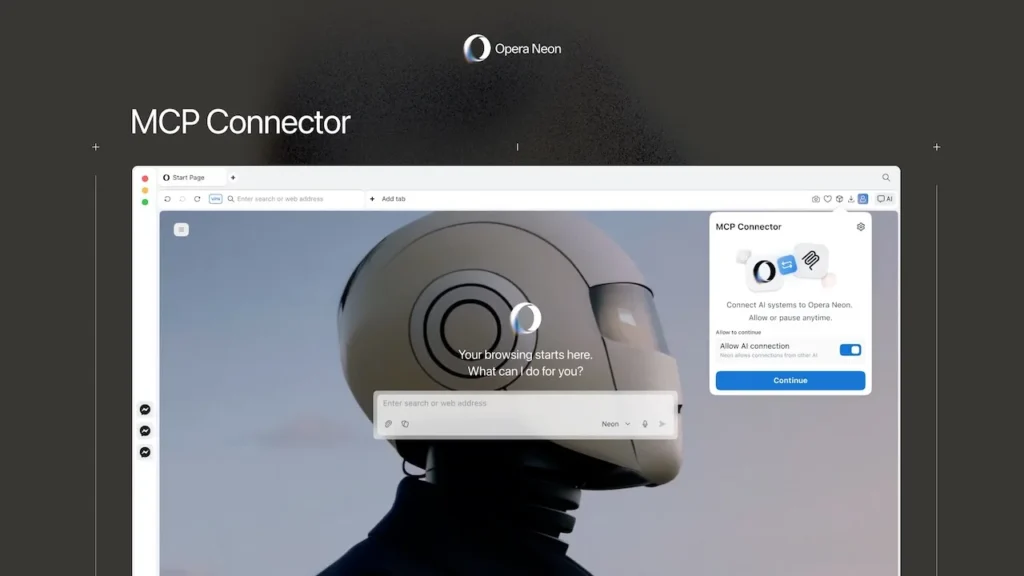
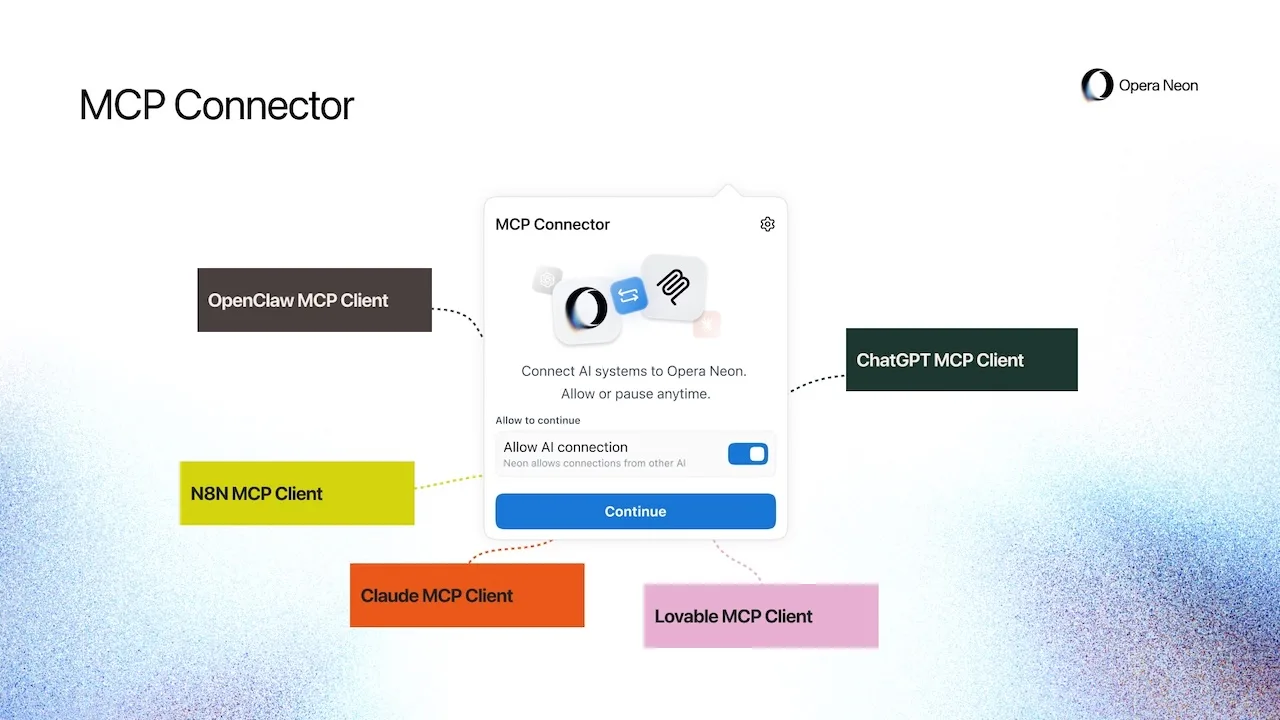
Opera is making significant strides in the world of intelligent browsers. The Norwegian company has just announced the MCP Connector for Opera Neon, a new feature that allows third-party assistants like ChatGPT, Claude, Lovable, n8n, and OpenClaw to connect directly to the browser, accessing the current web context and performing actions within it.
This functionality is now available for paying subscribers of Opera Neon, with a simplified version planned for other Opera browsers in the future.
At its core, this is not just another AI integration. It represents a role reversal. Until now, browsers added assistants capable of summarizing, explaining, or suggesting content. With MCP Connector, Opera introduces a different approach: the AI no longer only comments on your actions in the browser; it can now act directly within the browser itself.
MCP, the Protocol That Finally Allows AIs to Communicate with Tools Without Custom Integration
To understand this shift, we must look at MCP, which stands for Model Context Protocol. Anthropic has introduced it as an open standard that connects AI applications to data sources, tools, and external services through a common interface without the need for specific integrations every time. The protocol’s official documentation describes it as a standardized way to expose context and capabilities to AI systems.
In other words, MCP serves as a kind of universal port for agents. Once a tool exposes an MCP server, any compatible client can, in theory, interact with it immediately. This is precisely what Opera is implementing with Opera Neon: the browser itself becomes a tool that can be accessed by external AIs.
Opera Neon Becomes an Entry Point for Third-Party Agents
Opera notes that Neon could already function as an intelligent browser with its own native capabilities. The new feature is that this layer of action is no longer limited to the in-house system. With MCP Connector, external AI clients can now list tabs, read displayed content, browse, open pages, and perform actions directly within the browser.
The promise is very tangible. You can ask an AI to search for information, open multiple pages, switch between tabs, follow a multi-step workflow, or interact with web elements based on the context already visible on the screen.
The company clearly depicts Opera Neon as a browser “designed to act,” understanding user intent and working on their tasks.
It’s No Longer “AI in the Browser,” but the Browser Becomes a Tool for AI
This is where the announcement becomes strategically interesting. The industry initially integrated AI into browsers as small side assistants. Then, browsers natively designed around agents emerged, starting with Opera Neon, which was opened to the public in an experimental phase at the end of 2025. Opera had already presented Neon as an intelligent browser capable of interpreting the web, managing tabs, and acting on command.
With MCP Connector, the logic shifts even further. The browser is no longer just the place where AI appears; it becomes an execution layer that different AIs can utilize.
Opera Is Already Preparing for Life After Neon
For now, this capability is limited to Opera Neon and its subscribers. However, Opera also indicates its intention to introduce a simpler version of MCP support to its other browsers, including Opera One and Opera GX.
This detail carries significant weight. It suggests that Opera does not view MCP Connector as a marginal experiment exclusive to its most cutting-edge browser but as the beginning of a product standard. If this extension occurs, the concept of a browser controllable by external agents might quickly transition from a curiosity to a foundational aspect of the web experience.
A Step Towards a Web Where Users Delegate More Than They Click
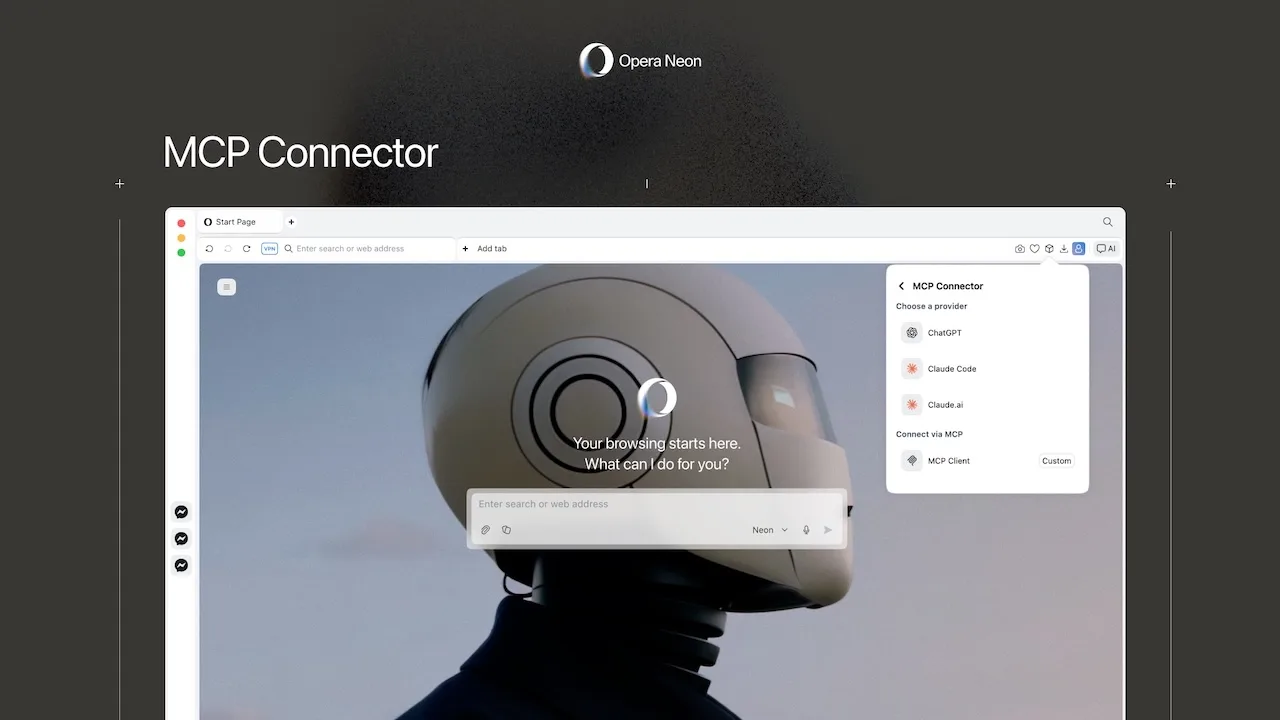
Essentially, Opera formalizes a broader change. The browser has long been the tool through which users sought information. Then, it evolved into a space for organization, synchronization, and recommendations. Now, it is starting to transform into an environment where agents can act on your behalf.
This is a fascinating evolution, but one filled with consequences. The more the AI “sees” what’s on the screen and the more it can intervene in the actual flow of the web, the more the browser becomes a central territory for personal automation. Opera seems poised to lead in this domain, not by relying on a closed assistant but by creating an open gateway between its browser and the growing ecosystem of MCP-compatible agents.



