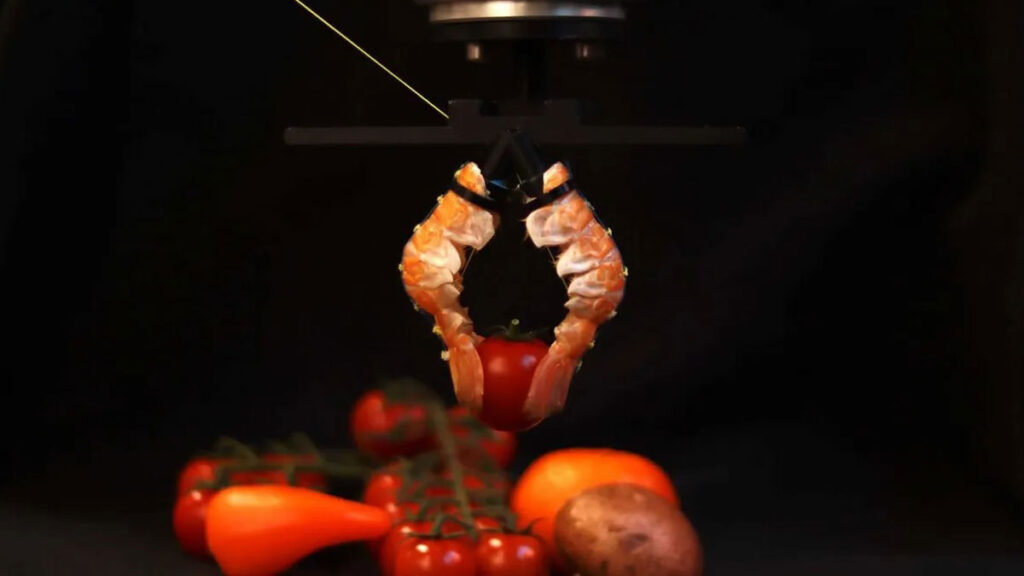
A team from the École Polytechnique Fédérale de Lausanne (EPFL) has made a breakthrough in the field of “necrobotics” by using crustacean remains to develop remarkably efficient robots.
Macabre Machines
To create their macabre machines, researchers turned to shrimp tails that would otherwise have been discarded. Composed of chitin, these organic structures shaped by millions of years of natural selection are extraordinarily durable, capable of complex movements, and degrade slowly over time.
“Their exoskeletons combine mineralized shells and joint membranes, providing a balance between rigidity and flexibility that allows their segments to move independently,” details the new study published in the journal Advanced Science. “We propose a sustainable cyclic design process, based on the recycling and adaptation of materials to new tasks.”
Specifically, the approach involved coupling these remains with elastic components acting like tendons, along with a motorized base. The result: crustacean remains functioned like real muscles.
In experiments, an experimental bio-robotic claw was able to deftly grasp objects weighing up to 500 grams, from a thin pen to a juicy tomato, without damaging them. Transformed into flippers, the shrimp tails also enabled a necrobot to move through water at a speed of 11 centimeters per second.
A Real Potential
According to the team, this is the first work to demonstrate the potential of food waste as an alternative to conventional plastic and metal components used in robotics.
“While nature may not always provide the optimal shape, it surpasses many artificial systems,” remind the researchers.
Previously, Texas scientists had transformed spider carcasses into necrobots, which could be used for tasks such as assembling electronic components.