

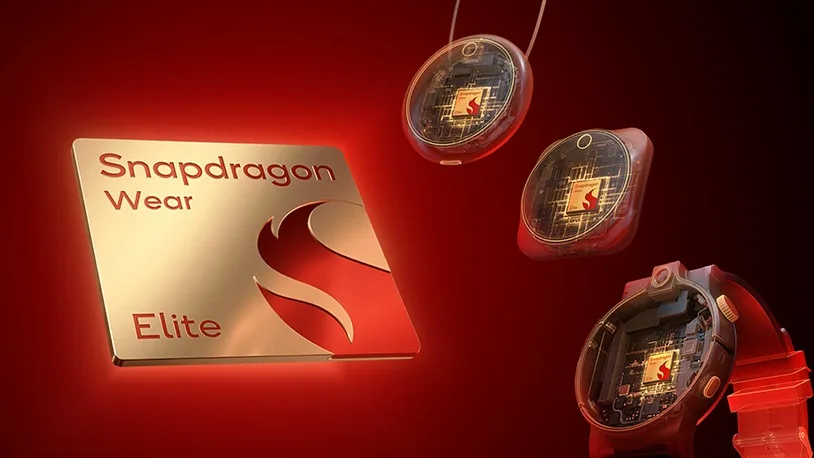
MWC 2026: Snapdragon Wear Elite, The New Brain of AI Objects
At MWC 2026, Qualcomm has not just updated a chip for smartwatches. With the Snapdragon Wear Elite, the founder officially introduces a new internal category — a chip designed to go beyond the wrist and power a generation of more discreet AI objects: pins, pendants, and even glasses without screens.
The idea is clear: if the “AI gadget” has yet to find its iPhone moment, Qualcomm wants to be ready for that day.
A “Plus” That Doesn’t Replace the W5 Plus: Qualcomm Expands the Range Rather Than Replacing
The first point to note: the Snapdragon Wear Elite does not replace the W5 Plus. Qualcomm positions it as a parallel chip, aimed at manufacturers looking for more power, enhanced embedded AI, and greater connectivity without necessarily targeting the classic Wear OS smartwatch.
This distinction is strategic: the wearable market is fragmented (watches, trackers, rings, glasses, clips, health devices) and Qualcomm is clearly looking to cover multiple price points and use cases rather than relying on a single “universal SoC.”
3 nm, Dual AI Engine: Snapdragon Wear Elite Aims to Make “Always-On” AI Viable
On the technical side, Qualcomm highlights three key components:
- 3 nm Process Technology (promising energy efficiency and thermal margins).
- An eNPU (energy-efficient AI) for background tasks, such as activity detection or keyword recognition.
- A more powerful Hexagon NPU for heavy tasks, with a notable announcement: up to 2 billion parameters locally and 10 tokens per second.
In other words, Qualcomm wants to make the idea of a personal AI assistant that listens, understands, summarizes, and transcribes credible — without constantly relying on the cloud.
Battery Life: More Than Just a “Gain,” It’s a Condition of Existence
AI wearables face a structural problem: their usefulness depends on their availability. An AI pendant that needs to be charged every night instantly loses its promise of being a “permanent companion.”
Qualcomm claims to have achieved improved efficiency, such as a 40% reduction in GPS consumption, a 9V charging capability that can reach 50% in around 10 minutes, and +30% of “days of use” (a deliberately vague term, but one that suggests a longer interval between charges). These are “platform” announcements: they do not guarantee the reality of a final product, but they indicate that Qualcomm understands the crux of the issue.
Hexa Connectivity: The Wearable Becomes a Full Network Terminal
The Snapdragon Wear Elite adds a very revealing layer: satellite, 5G, UWB, and Bluetooth 6.0 (in addition to standard Wi-Fi/GNSS according to implementations).
Why is this important? Because “contextual” AI requires signals: location, proximity, surrounding objects, and continuous connectivity. Additionally, certain formats (pins, pendants, glasses) may target a “companion” use case without a smartphone always connected or, at least, with greater network autonomy.

Performance: 5× CPU, GPU for 1080p/60 Animations — The Wearable Becomes an “Interface”
Qualcomm reports about 5× more CPU performance and a GPU capable of handling animations up to 1080p at 60 fps.
At first glance, this looks like a numbers game. But in an AI wearable, it serves primarily two purposes:
- Reduce latency (more immediate responses, smoother local processing),
- Enable richer interfaces… even when the device doesn’t “really have a screen” (think minimal visual feedback, overlays, micro-displays, or remote rendering).
Linux Alongside Android/Wear OS: A Direct Nod to Startups
The most “revealing” detail in the announcement is the support for Linux in addition to Android and Wear OS, explicitly presented as an accelerator for young players wanting proprietary products (pins/pendants, personal hubs, prototypes).
It’s a way of saying: “We provide the silicon and the AI building blocks; you invent the format.”
Is Qualcomm Signaling the Return of AI Pins… or Their Transformation?
Pins and pendants haven’t yet achieved massive success. However, Qualcomm is investing in a platform that seems almost dedicated to them: it’s a signal of demand (at the very least among manufacturers) and a bet on market maturation.
Two scenarios emerge:
- Scenario A: Wearable AI becomes invisible. Not a “star product,” but a family of contextual objects (lightweight glasses, health clips, connected jewelry) integrated into broader ecosystems. On this front, Google is pushing Android XR and its glasses partnerships, which may create an opening for “always-on” smarter chips.
- Scenario B: Wearable AI becomes a true terminal. An autonomous, connected object that captures voice, summarizes, translates, alerts — and eventually becomes as normalized as earbuds. In this case, the Elite resembles a building block ready for the second wave.
In both cases, Qualcomm plays the same card: equipping the market so that the next attempt is not limited to a good idea poorly supported.



