

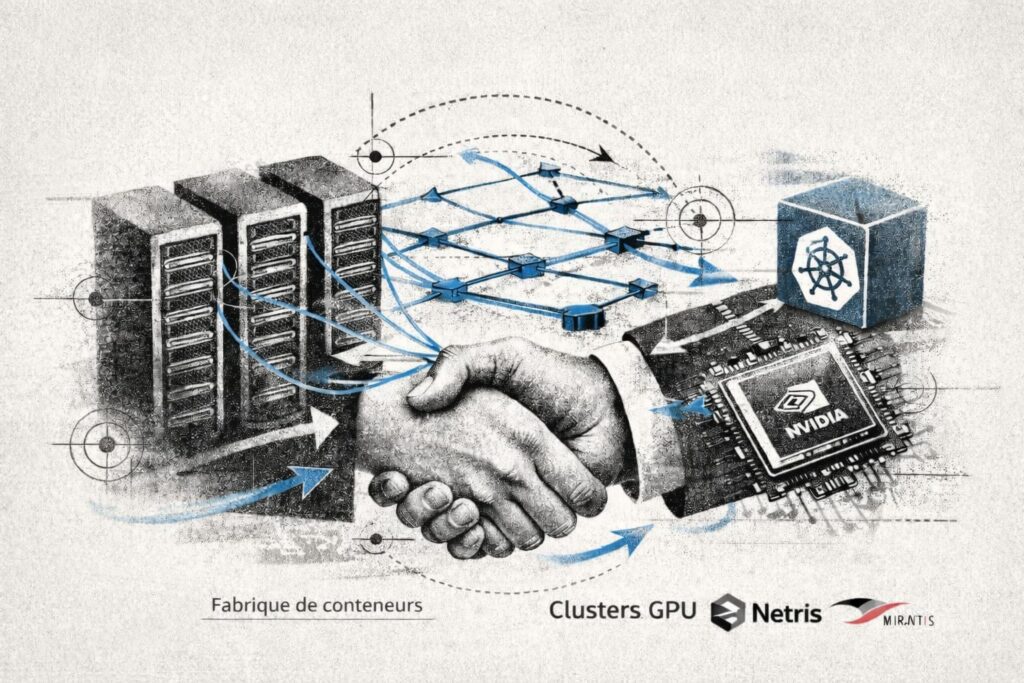
Mirantis and Netris Team Up to Transform GPU Clusters into Multi-Tenant AI Clouds
Mirantis and Netris have announced a strategic integration of their respective platforms that aims to revolutionize the deployment of GPU clusters into reproducible, multi-tenant AI clouds. This collaboration addresses two major bottlenecks: the lack of standardized processes for deploying clusters and the still largely manual and fragmented approaches to network provisioning.
Traditionally, networking was an afterthought in Kubernetes cluster deployment, configured manually and fragmented based on available hardware. This operational friction not only extended time-to-deployment but also increased operational costs and limited the number of tenants that could be effectively supported per infrastructure. Mirantis oversees the Kubernetes lifecycle, while Netris automates network provisioning, abstraction, and multi-tenancy at the hardware level, ensuring that both layers work seamlessly together from the moment the cluster is deployed.
A key differentiator of this integration is how tenant isolation is implemented. In current AI cloud architectures, tenant separation relies on software mechanisms, such as network virtualization and application security policies, which consume CPU resources and create larger attack surfaces. Netris shifts this isolation to the hardware level, leveraging Nvidia’s BlueField data processing units (DPUs) embedded within the data center’s network fabric. To date, Netris is the first commercial network orchestration platform to integrate BlueField DPUs into datacenter infrastructures.
Automated Management of East-West and North-South GPU Traffic
The practical implications of this architecture include enforced isolation, fault tolerance, and data security at the switch and DPU levels. This reduces reliance on CPU cores for network functions, thereby increasing the number of tenants that can efficiently operate within each cluster. For operators handling regulated or sovereign workloads—such as those in finance, healthcare, defense, and public administration—this architecture meets stringent separation requirements that purely software-based solutions cannot demonstrably satisfy. Shaun O’Meara, CTO of Mirantis, succinctly stated, “In AI infrastructure deployment, network complexity is one of the major challenges. The integration with Netris for network layer management enables dynamic network orchestration and multi-tenancy across the entire stack.”
The integration supports two key categories of network traffic that contemporary AI architectures need to manage simultaneously. East-west traffic—inter-GPU communications within a cluster—critical for distributed training tasks, is automated via Nvidia’s Quantum-X InfiniBand and RoCE (RDMA over Converged Ethernet) architectures, which provide low latency and high bandwidth for massive tensor exchanges among accelerators. North-south traffic—data entering and exiting the data center—is managed to ensure predictable performance for production inference workloads, which rely more on throughput consistency than raw latency.
This comprehensive, automated management of both traffic types, devoid of residual manual provisioning, empowers operators to offer a reproducible AI cloud product to their customers. Alex Saroyan, Managing Director and Co-founder of Netris, points out the pivotal nature of this solution: “All AI cloud operators face the same ceiling: a manually provisioned, fragmented network that can’t keep pace with computation. Netris removes this bottleneck by automating Ethernet, InfiniBand, NVLink, and BlueField DPU fabrics.” For a cloud provider or telecom operator, the commercial stakes are high. The ability to deliver an operational GPU cluster in days rather than weeks directly impacts revenue generation capabilities on bare-metal infrastructure.
Transforming Bare-Metal Infrastructure into Revenue Streams On-Demand
The economic rationale behind the Mirantis-Netris integration hinges on reducing the time from acquiring GPU hardware to commercially deploying the infrastructure. The AI neo-cloud market—companies building alternative GPU clouds to compete with hyperscalers—faces a structural challenge: hardware investments tie up capital, and profitability is contingent upon how quickly it can be made available to paying tenants. A standardized cluster delivery model, with automated networking and native multi-tenancy, shortens this unproductive immobilization period.
Netris anticipates a staggering 622% growth in annual recurring revenue (ARR) by 2025, driven by robust demand for alternative GPU infrastructure to U.S. hyperscalers, underscoring the scale of unmet needs in existing solutions. Telecom operators represent a particularly relevant segment; they possess distributed data center infrastructure and significant network capabilities but have historically lacked the orchestration tools necessary to pivot into competitive AI cloud offerings. The Mirantis-Netris integration, along with Mirantis’s k0rdent AI solution, provides a comprehensive stack—computing, networking, and cluster lifecycle management—without the integration development hurdles that previously hindered market entry.
In a landscape where the demand for AI infrastructure vastly exceeds available capacity, and where data sovereignty compels European organizations to diversify their computing sources, the ability to deploy secure, multi-tenant AI clouds from existing bare-metal infrastructure offers a direct competitive advantage for operators willing to act swiftly.



