

Microsoft Project Solara: An Android OS for Future AI Devices
Among the most surprising announcements at Microsoft Build 2026 is Project Solara, a new software platform specifically designed for a generation of AI-centered devices.
However, it’s not just its purpose that captures attention; it’s its technological choice: Microsoft has opted to build Solara on Android instead of Windows. This is a significant signal indicating how the company envisions the future of AI hardware.
A system designed for ‘agent-first’ devices
Microsoft describes Project Solara as a platform built from the ground up for experiences driven by intelligent agents. In contrast to traditional PCs or smartphones, these devices are designed around a permanent AI assistant capable of acting, observing its environment, and interacting naturally with the user.
The goal shifts from launching applications to communicating with an agent capable of executing tasks across different services.
Two concepts unveiled at Build 2026
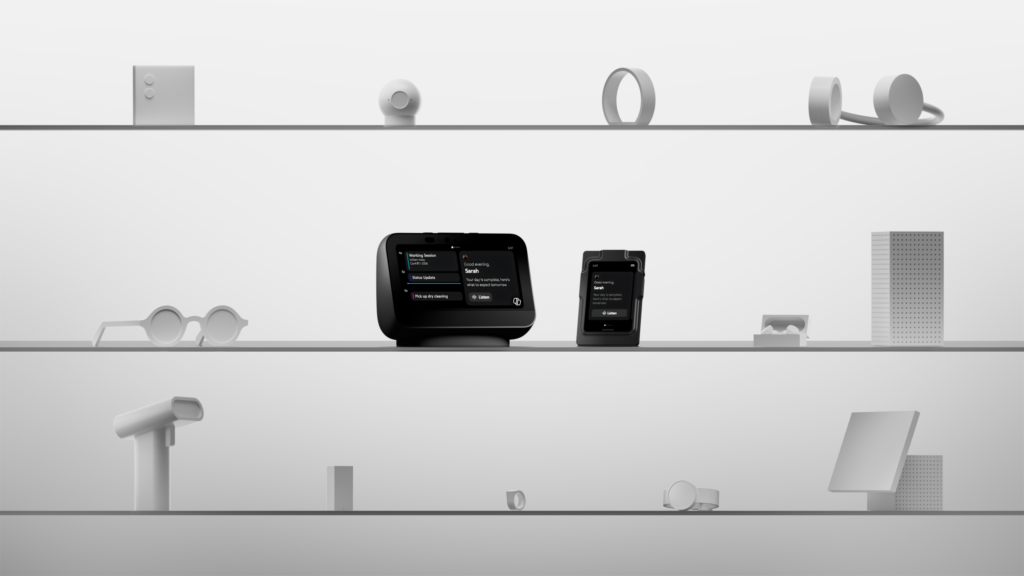
To illustrate its vision, Microsoft showcased two reference devices.
Desk Concept

The first resembles a connected screen similar to the Amazon Echo Show. Equipped with a touchscreen and facial recognition system, it serves as a constant access point for AI agents.
The device can automatically identify its user and provide information or perform actions based on the context.
Badge Concept

The second prototype is more unique. It takes the form of a connected badge similar to those used in companies for building access. The device features a camera, a fingerprint sensor, a microphone, and an instant activation system for an AI agent.
Microsoft demonstrated the ability to record a conversation and obtain a real-time transcription. The camera also allows the agent to see what the user sees, paving the way for much more advanced contextual interactions.
Android over Windows
One of the most notable announcements pertains to its software foundation. Instead of using Windows, Microsoft has chosen a version of Android integrated into its platform Microsoft Device Ecosystem Platform.
This decision addresses several constraints:
- Reduced energy consumption
- Execution on compact devices
- Fast startup
- Simplified resource management
- Compatibility with enterprise security tools

Microsoft believes that while Windows remains relevant for traditional PCs, it is less suited for this new category of ultra-light AI devices.
A platform meant for manufacturers
Microsoft does not plan to directly market the two concepts presented. The devices serve as reference designs intended for industrial partners. Several companies are already participating in initial pilot projects: AccuWeather, Best Buy, CVS Health, and Target.
The aim is to enable manufacturers to create their own products based on the technical foundations of Solara.
Microsoft prepares for a post-smartphone era
With Project Solara, Microsoft appears to be learning from decades of computing evolution. The company is not looking to build a new smartphone or a new PC. Instead, it is betting on the emergence of a completely new category: devices primarily designed to host AI agents.
The choice of Android is particularly telling. For years, Microsoft has tried to advocate for Windows across all types of devices. Today, the company seems to favor the best technical platform for each use case rather than an approach solely centered on its own operating system.
More broadly, Solara indicates that the AI battle will not be confined to models or software but will also involve the hardware that accompanies users in their daily lives.
With Microsoft’s ambitions, OpenAI’s hardware projects with Jony Ive, Meta’s work on connected glasses, and Google’s initiatives, a new generation of AI devices could emerge in the coming years.
This time, Microsoft’s future may well rely more on Android than on Windows.



