

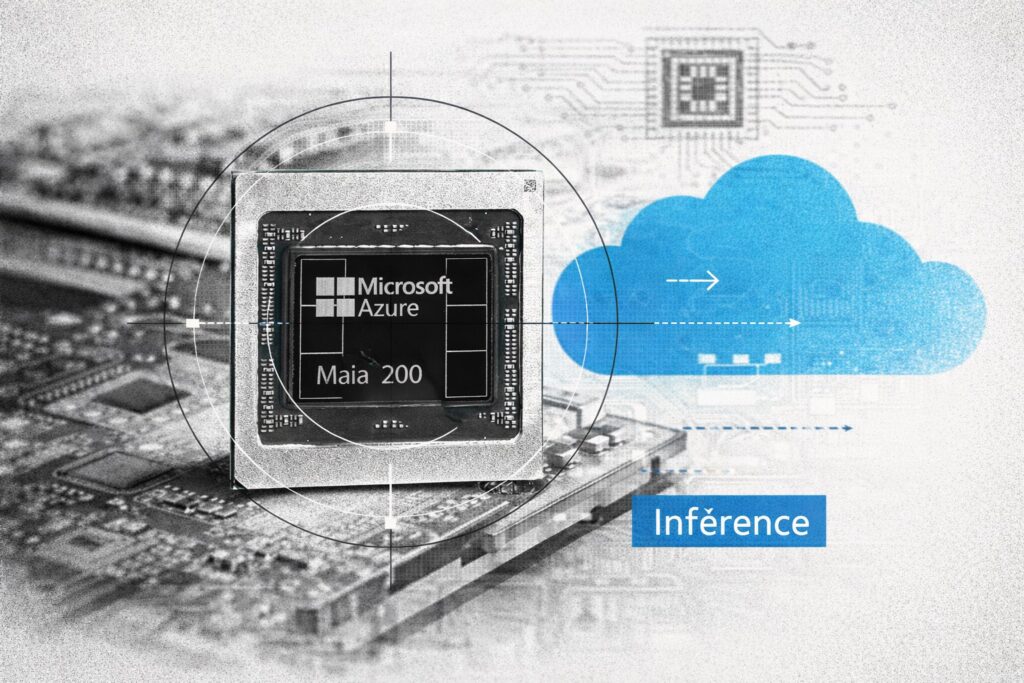
Microsoft Unveils Maia 200: A Dedicated AI Inference Chip for Azure Data Centers
Microsoft has officially launched Maia 200, a specialized AI inference chip designed to enhance performance for artificial intelligence applications within its Azure data centers. This introduction marks a significant step in the company’s strategy to align itself with the vertical integration approaches adopted by competitors such as Google and AWS, by developing custom silicon that seamlessly integrates with its cloud services.
As the race for supremacy in AI technology intensifies globally, control over silicon production has become a strategic focus. Major cloud providers are evolving their infrastructures toward fully integrated platforms capable of supporting large-scale inference workloads at lower costs. With the Maia 200, Microsoft is making a strong move in this direction, continuing a trend started by Google and AWS, which have already deployed their own proprietary accelerators at the core of their cloud offerings. This shift demonstrates the industry’s intent to regain control over performance, costs, and flexibility for AI services, while reducing dependence on suppliers like Nvidia.
The Maia 200 chip is built using a 3nm manufacturing process and is packed with 105 billion transistors and 192 GB of HBM3e memory, boasting a bandwidth of 5 Tbps. The architecture, coupled with 128 MB of SRAM, targets memory bottlenecks in executing large models and accelerates token processing. Its specialized FP4/FP8 cores focus on energy efficiency and speed for generative workloads. The chip is deployed on PCIe cards, supporting a configuration of up to eight cards per Azure server.
Microsoft Aligns with Google and AWS
Microsoft claims that the Maia 200 delivers triple the performance for FP4 calculations and boasts a 30% improvement in performance-to-cost ratio compared to existing Azure accelerators. The chip comes equipped with a software development kit (SDK) that supports PyTorch and Triton, streamlining model optimization and migration to the Azure infrastructure.
With the launch of Maia 200, Microsoft joins the ranks of Google and AWS, both of which have established their dominance in the AI sector through proprietary hardware solutions (TPU, Inferentia, Trainium) and a fully integrated approach. Mastery over silicon is becoming a key differentiator, not only for securing supply chains but also for offering a cohesive platform that spans from hardware to managed services. This strategy aims to attract high-demand projects that require cost management, power optimization, and flexibility while mitigating reliance on Nvidia.
The effectiveness of Maia 200 will hinge on its ability to integrate within Microsoft’s software ecosystem, support openness to standards (such as Triton), and deliver measurable advantages in production for inference tasks. The true test of this differentiation will come through adoption by developers and industry partners.
Making Inference More Cost-Effective
Microsoft’s focus on a chip dedicated solely to inference reflects its commitment to addressing the largest expense associated with large-scale AI deployments: recurring operational costs. The chip’s performance-to-energy optimization, reduced latency, and native integration with Azure aim to enhance profitability for industrial applications, from Copilot to customized generative applications.
The Maia 200 architecture sets itself apart from competitors through its ultra-fast HBM3e memory, optimized token flow management, and granular integration capabilities (up to eight cards per server, cluster deployment). This technical positioning meets the rising demand from businesses, government agencies, and service providers for AI infrastructures that can industrialize the use of generative models while keeping costs in check.
Vertical Integration and Standard Openness
The battle for AI platforms is shifting from straightforward hardware competition to the ability to offer an open, performant, and economically viable environment. The Maia 200 fits into this trend with its support for Triton, compatibility with major frameworks, and optimization of DevOps and MLOps workflows, all crucial criteria for IT decision-makers.
Microsoft now faces the challenge of proving that the synergy between its silicon, development tools, and cloud services constitutes a sustainable competitive advantage against Google, AWS, and Nvidia. The success of Maia 200 will depend on customer adoption, developer support within the Azure software ecosystem, and the ability to deliver measurable gains in cost, performance, and flexibility.



