

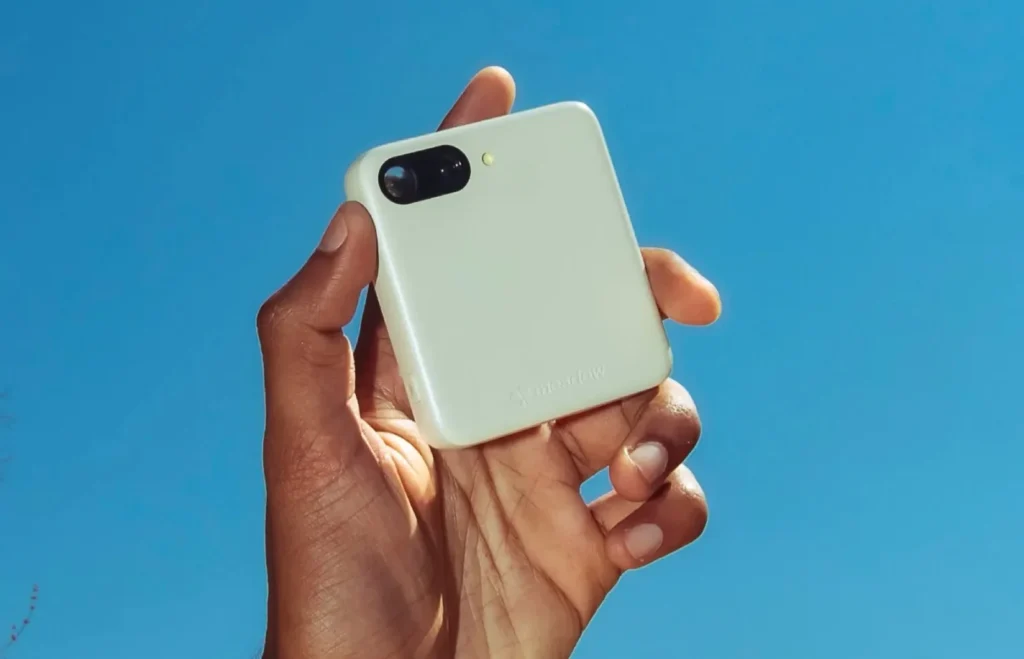
Meadow: The $399 phone that wants to cure your smartphone addiction
The minimalist phone market thrives on bold promises: fewer apps, less noise, and fewer distractions. However, it often suffers from excessive austerity.
A young American brand adopts a more balanced approach. Meadow does not aim to replace the smartphone but to lighten it. This device is designed as a secondary phone for moments when you want to stay connected, be mobile, listen to music, or take photos, without falling back into the trap of endless scrolling.
Pre-orders are open at $399, with the first deliveries expected in June 2026.
Meadow: An object that doesn’t seek to be your only phone
This is perhaps what distinguishes Meadow the most from the wave of new-generation “dumb phones.” The brand does not sell an absolute anti-smartphone but a deliberately limited companion.
The phone shares the same number as your primary smartphone, with calls initially directed to the latter before being transferred to Meadow if it is turned off. Simultaneously, an automatic message can inform certain contacts that you are “out with your Meadow.” This logic reinforces the product’s positioning: a digital breathing device, not a complete replacement.
On its website, Meadow emphasizes this idea of a “private line” and control over interactions. The phone allows you to add up to 12 contacts, and only those contacts can reach you. According to the brand, this eliminates unwanted calls and texts at the source. It’s appealing in theory, but it also makes the device very specific in its use: excellent for filtering but potentially frustrating for unexpected communications.
Minimalism, yes — but with Uber, Spotify, and Maps
The charm of Meadow lies precisely in its balance between simplicity and utility. The device comes equipped with a limited selection of applications, lacking an app store, social media, web browsers, and email, according to Meadow’s published information. However, it retains essential features: calls and texts, camera, maps, notes, weather, podcasts, and audiobooks, as well as Spotify, Apple Music, Strava, and Uber.

This editorial choice is arguably more interesting than the hardware itself. Meadow seems to understand that a “calm” phone does not have to be frustrating. It simply needs to cut out what distracts attention without eliminating what makes mobile devices truly practical.

A modest technical specification that aligns with the promise
In terms of hardware, Meadow does not aim to impress. The phone features a square 3-inch TFT LCD screen, 6GB of RAM, 128GB of storage, a 13-megapixel ultra-wide rear camera (without a front camera), as well as 4G, Wi-Fi, Bluetooth, and NFC capabilities. It promises 1 to 2 days of battery life with fast charging. The exact processor details are not publicly specified in the sources consulted.
The dimensions also contribute fully to the product narrative. Meadow boasts an extremely compact size weighing around 115 grams, with a casing made from recycled polycarbonate.
In other words, the phone is designed to be a light, discreet, almost accessory-like object, far removed from the symbolic bulk of contemporary large smartphones.
An expensive price for a deliberately limited product
The gamble becomes more challenging once you consider the economic equation. Meadow is priced at $399 for pre-orders, with a retail price set at $449 after launch. This price includes nine months of a subscription that covers calls, texts, photo storage, and other services, according to the brand. After that, a monthly fee of ten dollars applies. At launch, the 4G cellular capabilities are certified only for the United States.

This is undoubtedly the crux of the product. Meadow is not marketed as a budget smartphone but as a digital discipline tool. However, this discipline comes with a price — and even an extra cost, given that it is a secondary device that adds to your primary phone and its own plan. This interpretation is grounded in the announced pricing structure.
A more conceptual phone than a universal one
One should avoid misunderstanding. Meadow is likely not the small smartphone that everyone expects. It is a niche object, designed for users who precisely know why they want fewer screens, fewer interruptions, and fewer temptations at certain moments of their day. Liliputing articulates this quite clearly: the product will likely have limited appeal, particularly because it costs as much as a mid-range device while offering significantly fewer features.
Yet this is also what makes it intriguing. While other mobile minimalism players veer into pure asceticism, Meadow attempts a more contemporary version of “less, but enough.” A phone for going out, exercising, hailing an Uber, listening to an album, responding to a few close friends — without mindlessly reopening TikTok or Instagram every five minutes.
Meadow sells less of a phone and more of a usage context
Ultimately, the most interesting aspect is not the technical specification. It’s the scenario. Meadow does not demand you abandon your smartphone. It invites you to choose the moments in which you allow it to disappear. This is likely why the device seems more intelligent than many past “anti-distraction” phones: it does not deny modern needs; it seeks to contain them.
In summary, Meadow will not be for everyone. But for those who seek to reclaim some digital silence without losing essential daily functions, the concept is calibrated enough to intrigue. And in a market saturated with smartphones that strive to do ever more, this little square device finally dares to ask another question: how much do we really need?



