

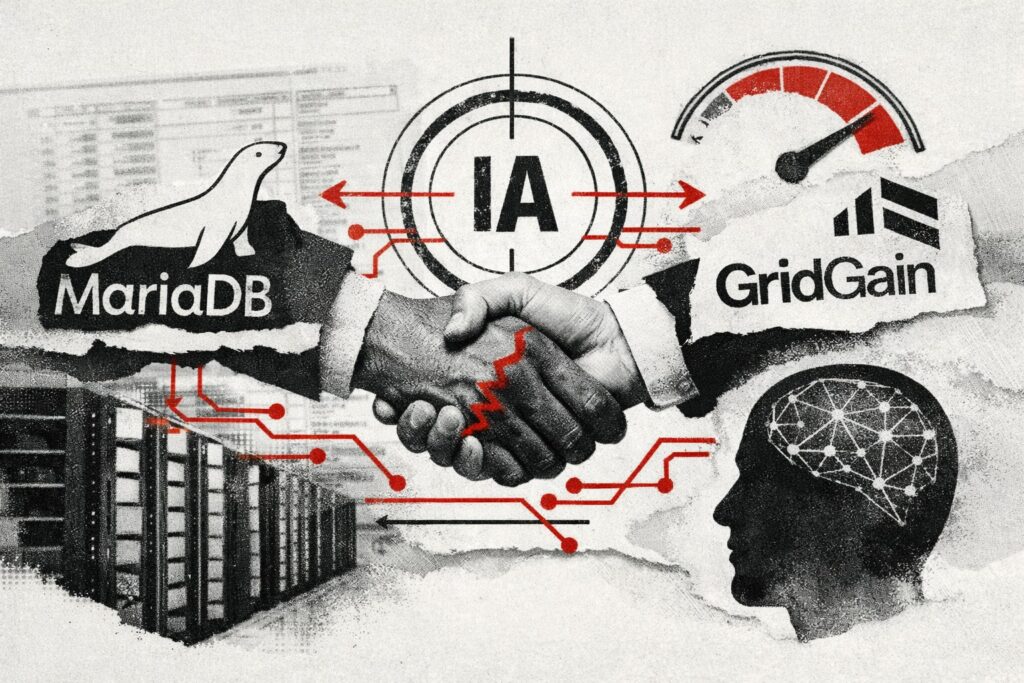
MariaDB Acquires GridGain Systems to Enhance In-Memory Processing Capabilities
MariaDB has announced its acquisition of GridGain Systems, a specialist in in-memory computing, aimed at equipping MariaDB with sub-millisecond latency processing necessary for agent-based AI architectures that require frequent database calls within autonomous workflows.
Founded in 2010 as a fork of MySQL by Michael Widenius following Oracle’s acquisition of Sun Microsystems, MariaDB has been on an acquisition spree since its purchase by K1 Investment Management in 2024. Recent additions include Codership, which provided high availability through Galera Cluster, and SkySQL, a service deployment solution. In October 2025, the company formed a strategic alliance with Exasol for high-performance analytics. The integration of GridGain continues this trajectory, seeking to build a comprehensive stack that covers transactional, analytical, and real-time processing, thereby removing the need for separate layers offered by hyperscalers. Financial details of the acquisition have not been disclosed.
GridGain, established in 2007 and headquartered in California, is known for Apache Ignite, a distributed platform for in-memory processing and storage that provides rapid data access for large-scale workloads. Its architecture leverages RAM for data storage instead of traditional disk-based systems, eliminating the I/O latency commonly associated with conventional databases. The company has raised $33.4 million across five funding rounds.
The technical justification for this acquisition is rooted in the nature of agent-based workloads. Unlike conversational applications that issue isolated queries, an autonomous AI agent performs multiple database calls during a single reasoning cycle, including planning, context retrieval, action execution, and status checking. This intensive querying regime makes response times measured in tens of milliseconds—typical for disk-based architectures—potentially obstructive. The in-memory computing market is projected to grow from $16.72 billion in 2026 to $40.80 billion by 2034, representing a compound annual growth rate of 11.8%, according to Fortune Business Insights.
A Consolidation Trend in HTAP Beyond MariaDB
This acquisition aligns with a broader industry trend where general-purpose database providers are integrating real-time capabilities instead of relying on independent specialists. Redis recently acquired Decodable, a real-time streaming platform, while SingleStore—formed from the merger of MemSQL and an analytical engine—adopts the same unification approach. The fragmentation of the tech stack—OLTP on one side, in-memory caching on another, and streaming as a third layer—has become a competitive argument against hyperscalers, whose offerings separate these three functionalities into distinct services that users must assemble.
MariaDB aims to integrate transactional ACID queries, semantic search on embeddings, and state current access with sub-millisecond latency—requirements crucial for operational AI agents—within a single platform. However, the technical integration of MariaDB’s disk engine with GridGain’s in-memory grid remains to be demonstrated. Historical evidence suggests that marketing unification often precedes effective architectural integration by several years, a point that the still-to-be-published product roadmap will need to clarify.
A Unified Platform for SQL, Key-Value, and Streaming Access
The anticipated integration aims to create a platform that simultaneously supports transactional SQL queries, high-velocity key-value access, and streaming analytics in a hybrid on-premise and cloud environment. Rohit De Souza, CEO of MariaDB, articulated the competitive landscape by stating, “By uniting our platform with GridGain’s in-memory data grid, we are changing the game. This enables us to provide a high-performance, scalable, and open alternative to Oracle’s proprietary lock-in and the fragmented complexities of hyperscalers.” Lalit Ahuja, CTO of GridGain Systems, emphasized the need to eliminate architectural fragmentation, remarking, “Businesses can no longer afford the latency associated with siloed architectures.”
The combined entity inherits an extensive customer base in sectors that demand high availability and speed. In the financial sector, clients include American Express, Barclays, BNP Paribas, Citi, Deutsche Bank, RBC, and State Street Corporation. The telecommunications sector is represented by Nokia, Verizon, Virgin Media O2, Reliance Jio, and Telecom Italia. Key players in logistics include American Airlines, UPS, and XPO Logistics.
This sector concentration aligns with Apache Ignite’s historical positioning, as financial institutions and telecom operators were among its early adopters due to their requirements for low-latency transactional processing and continuous availability. For CIOs in these sectors, the central concern will revolve around the integration roadmap between the two engines, particularly regarding the timeline for making a unified operational platform available in existing production environments.



