

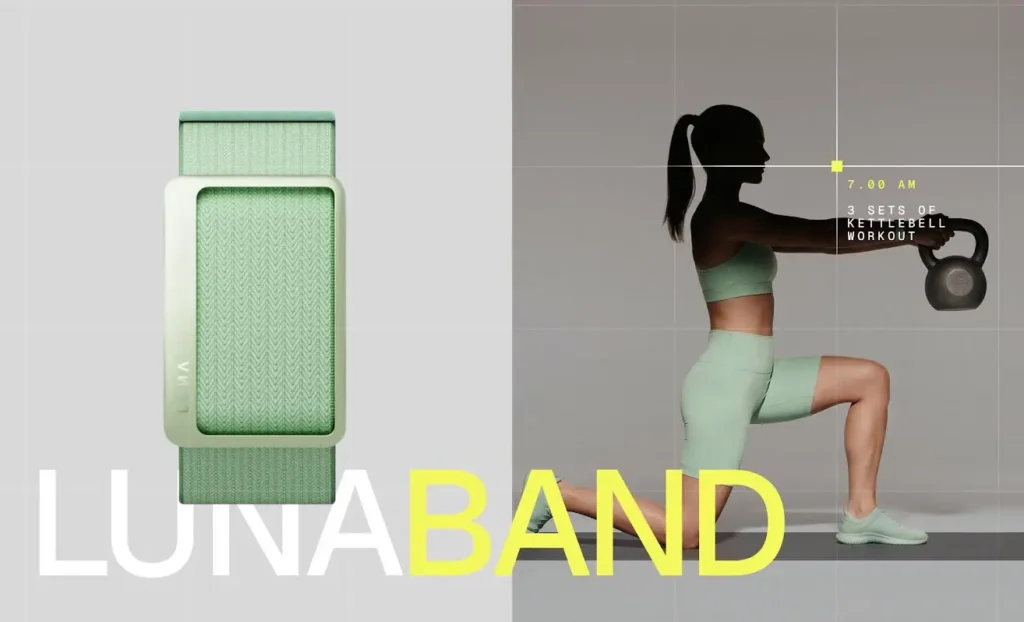
Luna Band: the fitness bracelet without a screen at 149 euros looking to compete with Whoop
The screenless wearable market has a new contender. Unveiled at CES 2026 and later available for pre-order this summer, Luna Band is now available internationally, featuring an approach reminiscent of Whoop or Fitbit’s latest minimalist trackers: continuously collecting health and workout data without adding a new screen to the wrist.
However, Luna aims to differentiate itself in two key areas. The bracelet relies heavily on its LifeOS platform and voice interaction to contextualize data, while its core functions remain accessible without a recurring subscription. Priced at 149 euros in Europe, this strategy could potentially be one of its most compelling selling points.
A 24-Gram Bracelet Designed to Disappear on the Wrist
Luna Band intentionally adopts a minimalist approach. With no screen and weighing only 24 grams, its 27 mm case is designed to be worn continuously, including during sleep.
This absence of a display aligns with a well-established philosophy in this segment: a health tracker doesn’t need to constantly engage the user with notifications. Instead, it can record data in the background and later translate it into trends or recommendations through the app.
This approach also promotes discretion. In contrast to increasingly larger and feature-rich smartwatches, screenless bracelets aim to be unobtrusive while still providing essential physiological monitoring.
Luna offers four color options: Aloe Green, Onyx Black, Desert Beige, and Atlantic Blue, adding some personality to an otherwise understated device.
Heart Rate, SpO₂, and Skin Temperature on the Agenda
The bracelet features multiple sensors for monitoring health and daily activity. It tracks heart rate, skin temperature, and blood oxygen saturation, using an accelerometer and gyroscope to analyze movements.
Luna Band supports over 60 activity types, although automatic tracking is limited to five activities. The system also calculates metrics such as workout load and VO2 Max, extending beyond mere step or calorie counting.
With a water resistance rating of 5 ATM, it can accompany users during swimming and in any activity where the bracelet is frequently exposed to water.
As always with this type of wearable, its true value will depend not just on the number of metrics it offers, but on the accuracy of its sensors and how Luna interprets these measurements into coherent recommendations.
LifeOS Aims to Provide Context to Data
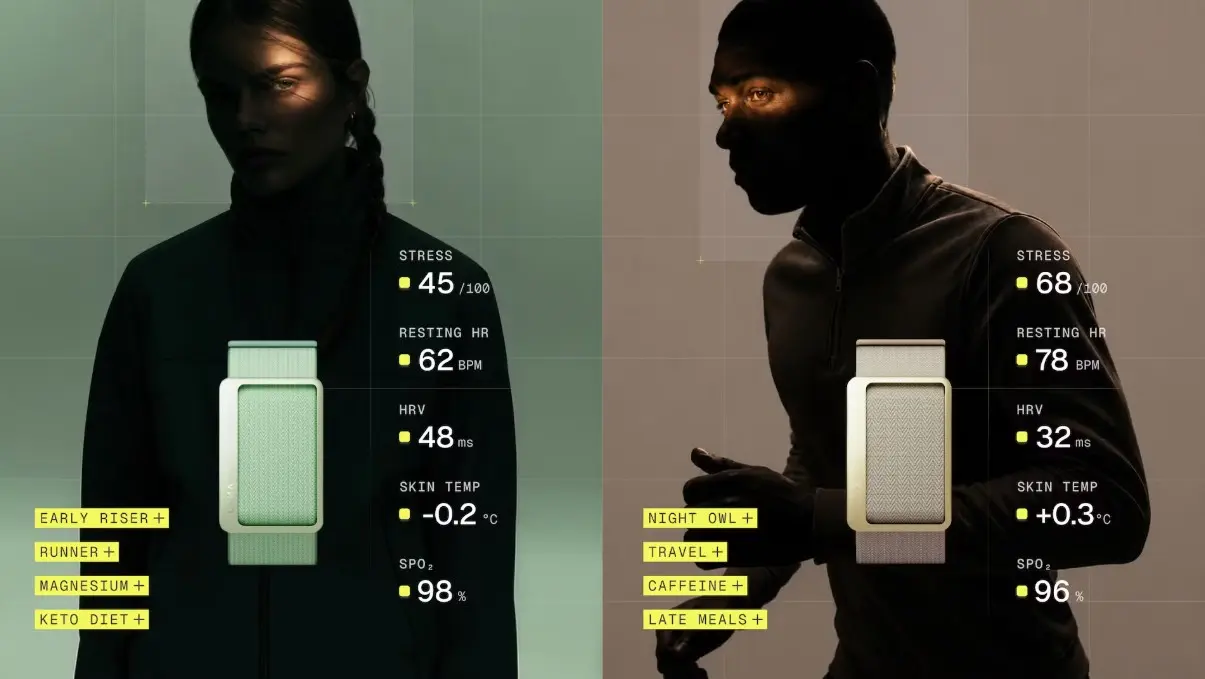
Luna presents LifeOS as the true core of the experience. The platform analyzes sleep, stress, workout data, and some fertility parameters to produce personalized recommendations. The aim is not merely to present a series of graphs but to help users understand how various factors interact.
The system also allows the addition of laboratory reports to supplement data collected by the bracelet. Luna claims it can use this information to further tailor its recommendations to the user’s personal goals.
This capability is ambitious but naturally warrants caution. Data from wearables or insights produced by a wellness platform do not replace medical interpretation, especially when it comes to biological analyses.
The value of LifeOS will hinge on its ability to provide context without presenting correlations as diagnoses.
Voice Replaces the Screen in Part
The lack of a screen does not mean the user must always open the app to log information. Luna relies on voice commands to manually input certain elements into LifeOS. For instance, users can verbally indicate a meal or supplement intake rather than navigating through several menus.
This interaction is particularly suited for data that a bracelet cannot independently detect. While sensors can measure heart rate or movement, they cannot precisely identify what the user just ate or what supplement was taken.
By facilitating this input, Luna aims to create a more comprehensive picture of daily habits and provide more contextualized analyses. The challenge will be minimizing friction; if entering each piece of information requires lengthy or overly structured interaction, users may quickly abandon manual entry.
Micro Apps to Enhance Recommendations
LifeOS also features a Micro Apps system designed to gradually enrich the bracelet’s functions without altering its hardware. These modules can focus on themes like hydration, circadian rhythms, fitness age, caffeine, or dietary supplements. They use the data already collected to offer more specific recommendations for particular goals.
This approach is appealing as it transforms the Luna Band into a platform rather than a static product. Luna can introduce new software use cases without waiting for a new generation of the bracelet.
The company also emphasizes personalization. Recommendations should evolve with each user’s profile and habits rather than remain uniform across all users.
This is precisely where wearables are increasingly differentiating themselves. Sensors are becoming relatively similar from one product to another; the real competition is shifting toward data interpretation.
No Mandatory Subscription: A Key Argument Against Whoop
The Luna Band is priced at 149 euros in Europe. However, its main economic advantage may stem from the lack of a subscription needed to access core functions. This model contrasts sharply with Whoop’s, where hardware and service are closely linked to a recurring formula, as well as with some competitors who reserve their most advanced analyses for a premium offer.
Over the years, this difference could become significant. A bracelet sold for 149 euros with no obligatory additional costs can ultimately be far less expensive than a device that initially seems affordable but depends on a permanent subscription.
This does, however, present Luna with another challenge: to finance LifeOS, storage, updates, and AI functions over time without heavily relying on recurring revenue.
A Wearable Market Rediscovering the Absence of Screens
The Luna Band enters an increasingly competitive category. After years of smartwatches seeking to integrate more and more functions and brighter displays, a portion of the market is now returning to intentionally simpler devices.
Whoop has demonstrated that a display-less device can appeal to athletes by focusing on recovery and training load. Connected rings follow a similar philosophy by collecting data without constantly diverting attention.
Luna aims to combine these two ideas: the discretion of a screenless wearable with a sufficiently rich software layer to provide a comprehensive view of daily health. This format may appeal to users who wish to keep a traditional watch, avoid additional notifications, or simply wear a lighter device during the night.
LifeOS Must Prove Its Recommendations Are Worth More Than Its Sensors
On paper, the Luna Band includes the expected components: heart rate, SpO₂, temperature, sleep tracking, VO2 Max, physical activity, and water resistance. However, none of these factors are sufficient to create a sustainable advantage in a market already saturated with similar sensors.
The real difference will therefore depend on LifeOS.
If the platform can intelligently correlate sleep, training, stress, diet, and lifestyle habits, the bracelet could offer a more valuable experience than a mere fitness dashboard. Conversely, if the recommendations remain generic, the lack of a screen and the attractive price may not be enough to convince users in the face of established competitors.
At 149 euros and without a mandatory subscription, Luna has an intriguing positioning. The Band is not attempting to become just another smartwatch but aims to reduce visible technology to focus the experience on what it can learn from the user.
And this may be precisely what a segment of the public is seeking today: less screen on the wrist, but more meaning behind the collected data.



