LLW DRAM: The Technology That Could Solve The Main Problem of AI on Smartphones
Smartphone manufacturers are racing to integrate artificial intelligence. The latest mobile processors are now capable of running increasingly sophisticated language models locally, reducing dependence on the cloud and enhancing data privacy.
However, a significant technical challenge is emerging: memory.
While mobile chips are advancing rapidly, current memory technologies struggle to keep pace with the demands of modern AI models. A new solution called LLW DRAM (Low Latency Wide DRAM) may have been designed to address this challenge.
If initial reports are confirmed, this technology could represent one of the most important developments in the mobile market in the coming years.
Artificial Intelligence Is Pressuring Memory
For years, smartphone performance has primarily depended on processor power. However, the rise of generative AI is altering this equation. Language models require not only computing power but also an extremely fast capacity to transfer significant volumes of data between memory and the processor.
This is precisely where the limitations of current LPDDR memory standards become evident.
Even the best generations of LPDDR are slowly becoming inadequate to effectively support the most advanced AI models. This issue is already well-known in data centers, where AI giants heavily utilize HBM (High Bandwidth Memory) to enhance their infrastructures.
A Technology Inspired by HBM Memory
According to several industry leaks, the upcoming LLW DRAM will draw directly from the principles that underpin HBM’s success. HBM memory relies on an architecture that significantly increases bandwidth through extremely wide connections between the memory and processor.
The result is remarkable: throughput can be ten to fifteen times greater than that of current LPDDR solutions. However, this technology comes with a significant drawback.
HBM modules require complex integration methods and advanced cooling solutions that are incompatible with the physical constraints of smartphones.
This is the exact problem that LLW DRAM aims to solve.
Enhanced Performance Without Thermal Constraints
LLW DRAM seeks to provide significantly higher bandwidth while maintaining a format suitable for mobile devices. According to initial information, the technology could also reduce latency, a crucial factor for AI-related processing.
Potential benefits include:
- Faster execution of local AI models.
- Improved responsiveness of smart assistants.
- Reduced model loading times.
- Increased energy efficiency.
In summary, memory could become one of the key drivers of mobile AI evolution in the coming years.
Energy Efficiency That Could Change The Game
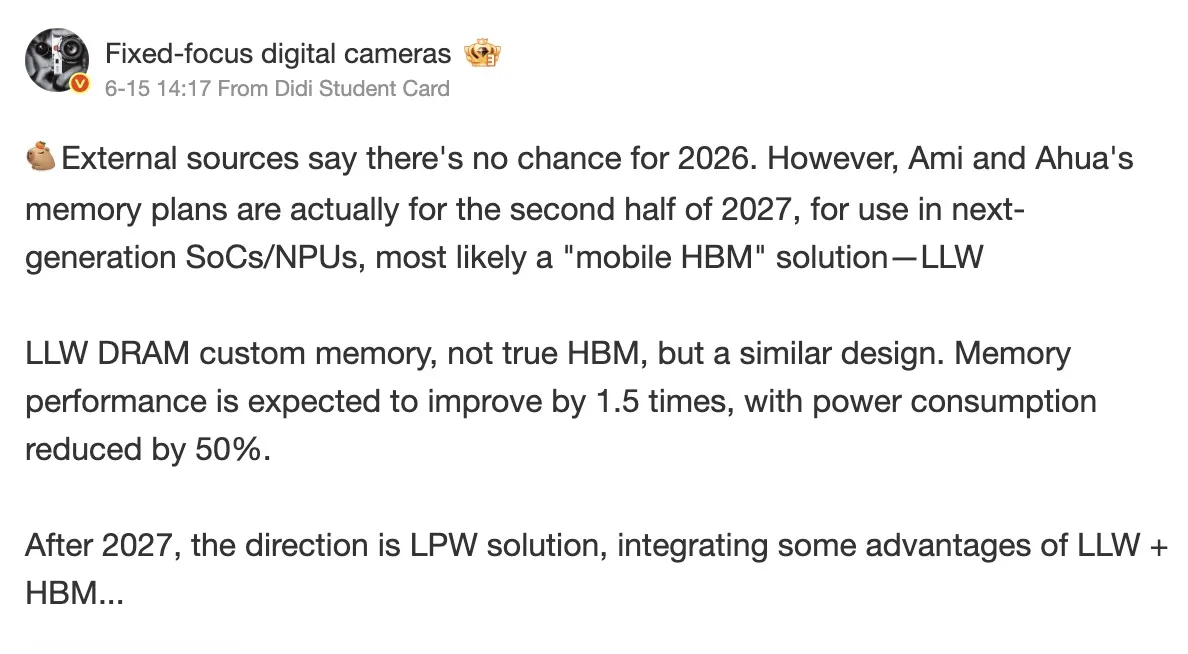
One of the most exciting aspects is energy consumption. According to leaker Fixed Focus Digital, LLW DRAM could reduce energy consumption by around 50% while increasing performance by approximately 1.5 times compared to current solutions. While these figures should be taken with caution until officially confirmed, they perfectly illustrate the strategic importance of this technology.
Battery life is currently one of the main challenges associated with embedded artificial intelligence. Language models consume vast amounts of resources, exerting increasing pressure on smartphone batteries.
Any significant improvement in this area could therefore have a major impact on user experience.
Xiaomi and Huawei Could Lead The Way
Initial rumors already suggest several manufacturers likely to quickly adopt this new generation of memory. Xiaomi and Huawei are among the most probable candidates.
This hypothesis is not surprising, as both companies have been heavily investing in embedded artificial intelligence and seek to differentiate their future devices through hardware innovations.
However, neither brand has officially confirmed its work on LLW technology at this stage.
A Distant Arrival
Nevertheless, users should not expect to see this technology arrive immediately. According to the currently available information, mass production will not begin until the second half of 2027.
This timeframe aligns with many analysts’ projections for the next generation of AI-centric smartphones. Until then, manufacturers are likely to continue enhancing existing LPDDR technologies to meet the increasing demand for power.
The Next Revolution In Mobile AI Could Be Driven By Memory
The industry often focuses on processors, NPUs, or the AI models themselves. However, the future of embedded AI is equally dependent on devices’ ability to quickly move the necessary data for these processes.
LLW DRAM perfectly illustrates this reality.
If the promises of performance, energy efficiency, and bandwidth materialize, this technology could become for smartphones what HBM has become for data centers: an essential infrastructure for the next generation of artificial intelligence.
And in a market where every manufacturer is vying to run increasingly powerful models directly on the device, the battle for AI may ultimately hinge as much on memory as on processors themselves.