

iPhone Fold: Why Is Apple Waiting Until September to Revolutionize Foldables?
After years of rumors, the first foldable iPhone, also known as iPhone Fold or iPhone Ultra according to recent leaks, finally appears to be emerging from the fog. According to Mark Gurman at Bloomberg, the device remains on track for a presentation in September 2026, despite a competing report from Nikkei Asia mentioning engineering difficulties that could disrupt the industrial timeline.
iPhone Fold: A September Launch Remains Credible
The most solid interpretation at this point is: Apple still targets an announcement of its iPhone Fold during the September window, alongside the iPhone 18 Pro and iPhone 18 Pro Max. However, the exact availability date remains somewhat less certain.
Mark Gurman indicates that availability may be around the same time or shortly after the Pro models, leaving open the possibility of a slight delay between the announcement and the initial deliveries.
The Real Pain Point Is Volume
This is where things get interesting. Recent rumors suggest that Apple is facing engineering snags during the testing phase, potentially jeopardizing mass production and the initial shipping cadence.
In other words, even if the September keynote takes place, stock levels could be very tight at launch, especially for a first-generation foldable product from Apple that is inherently complex.
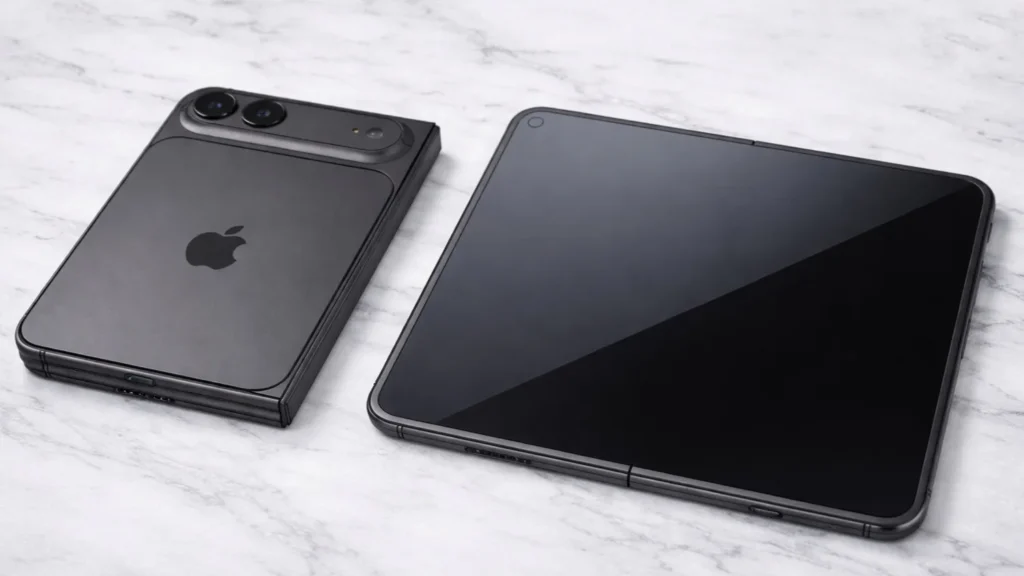
Regarding the product itself, most leaks remain relatively consistent: Apple is reportedly working on a book-style model with an external display of around 5.5 inches and an internal display of approximately 7.8 inches, in a wider format closer to a mini iPad than to some narrower Android foldables. Several sources also mention a 4:3 aspect ratio, specifically to reinforce the impression of a foldable mini iPad.
Apple Primarily Aims for Perceived Quality
The most distinguishing factor may be the screen. Apple aims for a minimal crease, if not almost invisible, using new materials and an expensive approach to the flexible panel. Other leaks also suggest a very thin chassis and a device designed to look more “mature” than spectacular.
This aligns with Apple’s strategy: for a niche product priced over $2,000, the goal is not just to exist, but to immediately convey a sense of superior craftsmanship.
As for the name, nothing is confirmed. Rumors continue to oscillate between iPhone Fold and iPhone Ultra, the latter option fitting into a possible expansion of the “Ultra” label for Apple’s most premium products. However, at this stage, the name remains more speculative than the timeline itself.
Apple Cannot Afford a Clumsy Launch
The most critical point is not whether Apple will deliver its foldable exactly a week after the announcement or a few weeks later. The real issue lies elsewhere: Apple needs to succeed in its symbolic entry into the foldable smartphone market. Samsung, Google, and Honor have already established a presence. Apple arrives late, so it will need to compensate with better perceived execution: cleaner screens, more convincing formats, better-adapted software, and especially credible availability to avoid the “unattainable luxury concept” effect.
In short, September 2026 remains the most credible scenario for the announcement. But regarding everything else—volumes, delivery speed, final name—Apple is still walking a fine line.



