

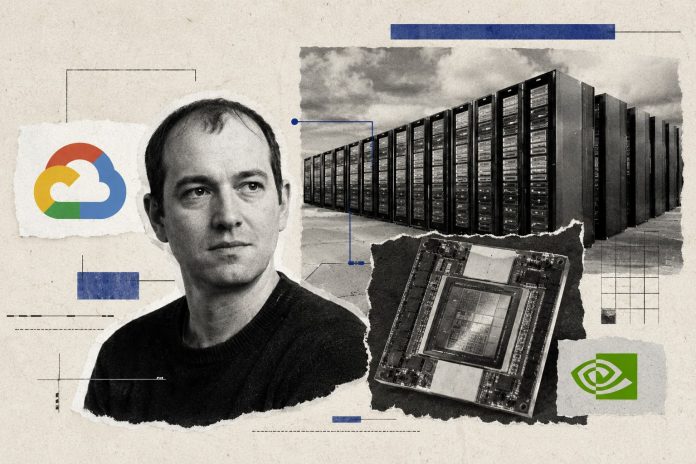
Google Cloud has partnered with Ineffable Intelligence, a London-based AI laboratory founded by David Silver, co-creator of AlphaGo. With an impressive seed funding of $1.1 billion, the lab will deploy one of the largest A5X instance collections from the hyperscaler, powered by Nvidia’s Vera Rubin GPUs. This announcement highlights the increasing reliance of frontier AI laboratories on the infrastructure of major American cloud providers.
In a prelude to its London summit, Google Cloud revealed that it has been selected as the preferred infrastructure provider for Ineffable Intelligence. Founded by David Silver, who gained prominence for his role in developing AlphaGo— the AI that defeated a world champion in Go in 2016—the lab is backed by a substantial seed round that positions it among the few organizations capable of mobilizing significant computational resources.
Ineffable Intelligence distinguishes its research approach from traditional large language models trained on static datasets. Its “Superlearner” initiative aims at creating systems that learn from their own experiences rather than relying solely on existing human-generated data, utilizing reinforcement learning techniques. This method draws a parallel with AlphaGo, which advanced its capabilities by playing against itself, placing the project squarely in the domain of fundamental research rather than immediate business applications.
A Hardware Commitment Beyond GPU Leasing
The laboratory is set to roll out one of the largest collections of Google Cloud’s A5X instances, powered by Nvidia’s Vera Rubin accelerators. Importantly, it has opted for an integrated architecture that Google Cloud markets as AI Hypercomputer, rather than merely leasing raw computing capacity. This integrated approach combines computation, networking, and storage into a configuration specifically designed for reinforcement learning workloads, which demand a different kind of infrastructure than classic training on static datasets.
The distinction between renting GPUs and adopting an integrated architecture is not merely a contractual detail. It commits the lab to the entire technology stack of the provider, from hardware to software orchestration layers. For a research entity, such loyalty can dictate the future portability of its projects and the costs associated with changing providers—an issue that, while currently hypothetical for a nascent laboratory, is significant nonetheless.
The Concentration of Frontier Infrastructure
This development underscores a trend observable since the emergence of leading AI laboratories: the most computationally demanding research is increasingly taking place on the infrastructures of a small number of American hyperscalers. Organizations like OpenAI rely on Microsoft, while Anthropic collaborates with both Google and Amazon. Ineffable now joins this trend by entrusting its total seed capacity to Google Cloud. The computational requirements for training advanced models far exceed what an independent infrastructure can typically support within the necessary timelines for delivering results.
This concentration of resources is particularly relevant for European policymakers. A British laboratory backed by an American hyperscaler serves as a reminder that the quest for sovereign cloud solutions remains more of an aspiration than a reality. Sovereign computing isn’t limited to the geographic location of data centers; it’s also about mastering the hardware and software supply chains. The computational needs of cutting-edge model training exceed what independent infrastructures can offer within the critical timeframe for achieving results, naturally steering these labs toward providers with pre-existing capabilities.
For IT leaders assessing their own AI infrastructure options, a crucial trade-off emerges between the immediately available power offered by hyperscalers and the dependencies that this choice creates. The lingering question remains whether European infrastructure initiatives—ranging from AI Factories to Gigafactories backed by the Commission—will provide continental labs with an alternative to this dependence. This scenario mirrors efforts like OVHcloud’s trusted hyperscaler strategy, yet whether the race for computational power will continue to direct labs toward American providers is uncertain. For decision-makers, monitoring the location of frontier AI laboratories is akin to forecasting the technological dependencies that will shape the entire sector.



