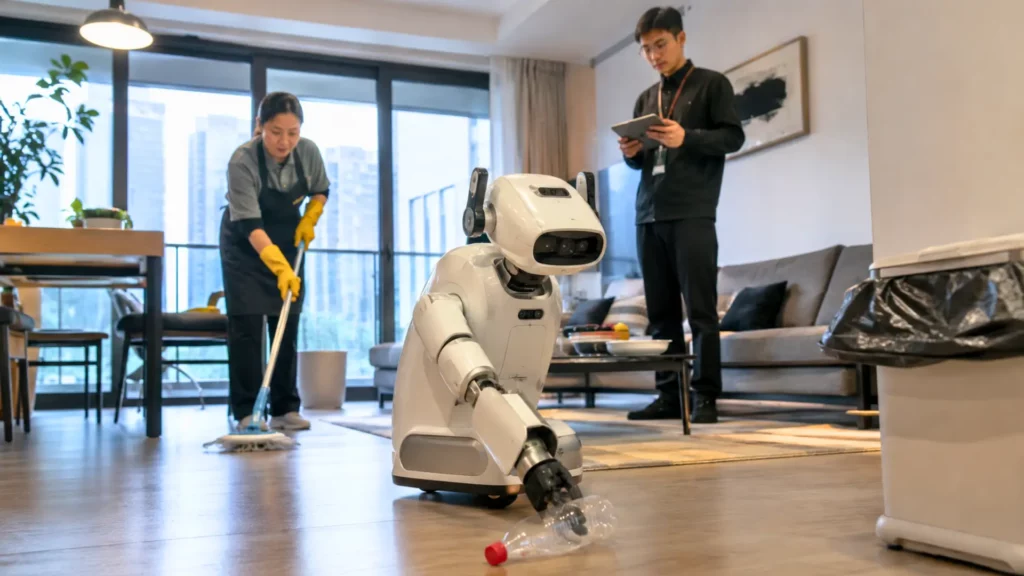
In Beijing and Shenzhen, robots are now entering real apartments to fold pants, pick up trash, or spot disorder. Behind this seemingly mundane scene lies a much broader experiment: the unfolding of a domestic future, piece by piece.
In Beijing and Shenzhen, domestic help becomes a laboratory scene
In some residences in Beijing and Shenzhen, the scene initially appears ordinary, then decidedly futuristic. A human housekeeper cleans the floor. Next to her, a white-and-silver robot rolls along, picks up an empty bottle, identifies a trash can, and tidies up the living room.
Specifically, the service, launched by 58.com in partnership with the robotics firm X Square, costs 149 yuan for three hours, approximately 19 euros. The Quanta X1 Pro robot does not yet replace humans. However, it already handles simple tasks, like picking up objects or folding clothes, always under the watchful eye of an engineer.
What stands out is not its speed but its almost methodical approach. When it handles a pair of pants left on a sofa, its movements resemble those of a very focused child rather than an ultra-efficient assistant. This moment of learning is precisely what companies find most intriguing.
Behind everyday help lies a crucial data collection for robots
In reality, behind the practical argument lies a far more strategic battle. These robots require real-world data to improve. Unlike large language models fed by vast amounts of online text, domestic machines must learn in unpredictable, cluttered, and ever-changing environments. In short, they need to learn in real life, and quickly.
As noted by Christoforos Mavrogiannis, a researcher at the University of Michigan, cited by AFP, observing a robot in a real apartment would be more instructive than keeping it in a lab indefinitely. A moved chair, dim lighting, a misplaced garment, or a slippery floor becomes a valuable lesson for its artificial intelligence.
So far, around 200 households have tested this service since March. For some clients, curiosity outweighs efficiency. Booking a session feels almost like attending a rehearsal for the future. Today, users are not only paying for assisted cleaning; they are also unwittingly participating in a vast technological training exercise.
Despite spectacular demonstrations, real life still resists robots
While China has already showcased robots capable of dancing, practicing martial arts, or moving with spectacular fluidity, there remains a significant gap between a stage demonstration and a cluttered apartment. In a living room, the robot must recognize objects, avoid obstacles, gauge its strength, and sometimes improvise.
At this stage, the capabilities of these assistants remain very limited. Folding clothes is slow, their manipulation lacks finesse, and human presence remains essential. Even the designers acknowledge this. Future versions are expected to respond to voice commands, engage in conversation, and act with greater autonomy. However, that stage is not yet part of ordinary daily life.
Despite this, investments continue to accelerate. According to the ITjuzi database, over 57.7 billion yuan has already been invested in 2026 in the Chinese AI applied to robotics sector. In other words, this sum already exceeds the total from the entire previous year. Thus, the hesitant movements of today already hold significant value for tomorrow.
Privacy, safety, and accountability: the real challenge begins at home
As robots progress, another question is becoming increasingly important: what exactly do they see, and where does that information go? In an apartment, a robot does not merely observe dust or objects to move. It also captures habits, faces, lifestyles, and sometimes the most ordinary aspects of intimacy.
In this context, researchers like Valeria Alessandra Macalupu Chira and Yang Jianfei remind us that regulations remain unclear. Customer safety, emergency stop functions, data access, and accountability in case of errors are all still up for debate. While these robots promise to ease daily life, they also blur the line between domestic help and home surveillance.