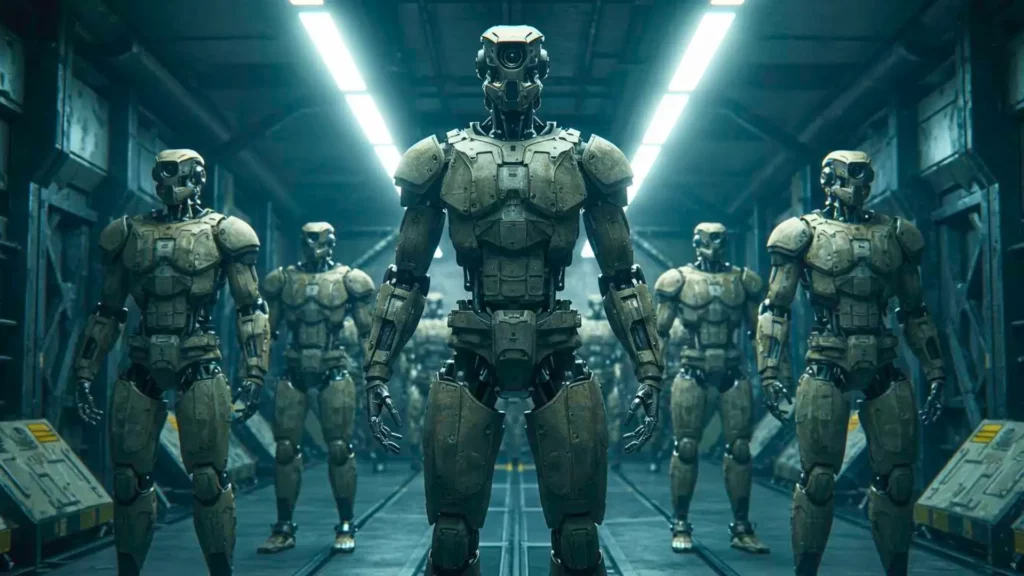
China is conducting large-scale experiments with humanoid robots to monitor one of its most sensitive crossing points. At the Vietnam border, these machines assist human agents. This technological advancement is both fascinating and raises concerns, both in substance and form.
A bustling border: constant flows and urgent need for modernization
Have you heard of Fangchenggang? It’s a city in southern Guangxi, right next to Vietnam. It’s not Beijing or Shanghai, but here, it’s a bustling crossroads. Every day, dozens of trucks, buses, and travelers cross the border in a constant flow. This creates a logistical headache for customs agents who must inspect, manage queues, answer questions, and maintain a semblance of order.
So, what is China doing? It plays an unexpected card: humanoid robots to support human agents. A bold, even risky move, it is part of a broader strategy to make machines a central component of national security and human flow management.
Robots capable of guiding, monitoring, and interacting with travelers
The chosen model is the Walker S2, developed by Chinese company Ubtech Robotics. Imagine a robot the size of an adult, capable of walking, moving its arms, answering your questions… and monitoring your actions with its sensors and cameras. We are no longer in the realm of science fiction.
Their roles are quite varied: managing traveler flows, directing passersby, reporting anomalies, patrolling halls, and even checking containers in freight areas. In other words, they are there to assist, but also to observe. If all goes well, China could quickly expand this model to the train stations, airports, and ports of the country.
A 37 million euro operation to test the future of automated security
The contract between Ubtech and local authorities is estimated at over 37 million euros. A hefty sum, but justified by the program’s ambitions. If the results are convincing, it could transform how China conceives its public infrastructure.
For Ubtech, this is a pivotal moment: it is either a worldwide technological showcase or a crash test with heavy consequences. One thing is certain: these robots are not just for show. They will have to prove that they can take on certain human tasks without creating more problems than they solve.
China is not alone in this race: other countries, such as South Korea and Japan, are closely monitoring this deployment. If successful, Fangchenggang could become an exportable model, a prototype to follow for decades in terms of robotized border security.
Between technological fascination and societal unease: robots that don’t win unanimous approval
Let’s be honest: seeing a humanoid robot ask you for your papers is impressive… but also somewhat unsettling. It’s not just a matter of efficiency; it also involves perception, acceptance, and trust. Who is responsible if the robot makes a mistake? What happens in case of a dispute?
And what about the customs officers? Some see these machines as a welcome aid. Others view them as a threat to their role, even to their authority. Training an agent to interact with an intelligent machine is no small task. The balance between automation and human presence remains delicate.