

Huawei Mate XT 2: The Tri-Fold Smartphone Will Be Unveiled on September 7 with HarmonyOS 7
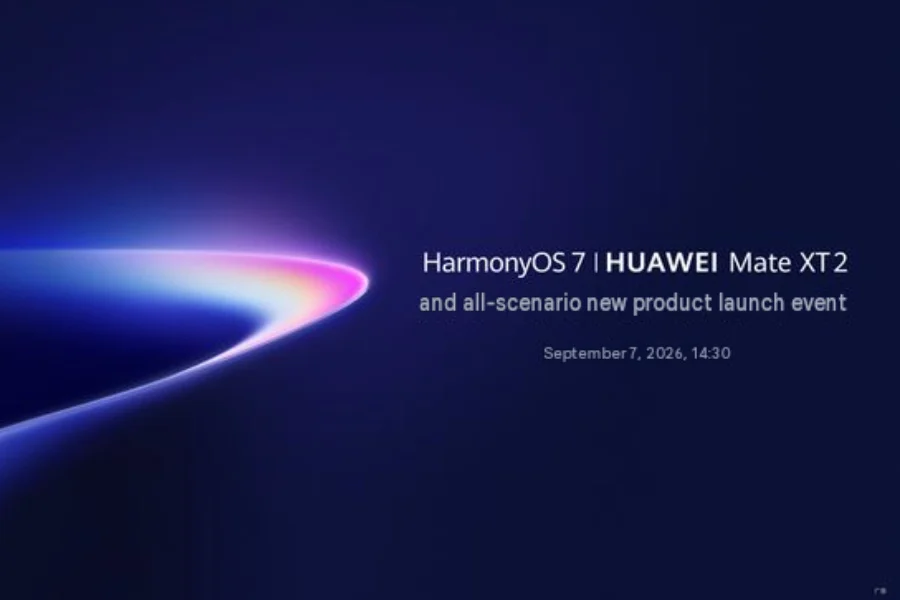
Huawei is set to embark on a new chapter in the battle of foldable smartphones. The Chinese manufacturer has scheduled September 7, 2026 as the date for its next major event, where it will showcase both the Huawei Mate XT 2 and HarmonyOS 7.
This dual announcement encapsulates the brand’s current strategy: pushing the boundaries of hardware while developing a software ecosystem that can genuinely leverage its capabilities.
Huawei sets September 7 for its new tri-fold smartphone
The event, announced in China as a conference dedicated to HarmonyOS 7, the Mate XT 2, and new “all-scenario” products, will take place on September 7 at 2:30 PM local time. Huawei has yet to reveal a complete technical sheet or a detailed preview of the design of its upcoming triple-screen smartphone.
However, the date is not entirely surprising. For several months, various leaks had hinted at a launch for the new tri-fold in early September. At the end of July, leaker Digital Chat Station suggested that Huawei was planning a separate event for its foldable smartphone before later presenting its other Mate flagship devices.
The Mate XT 2 will primarily succeed a device that had already set a high bar in terms of design. The original Mate XT can deploy a 10.2-inch OLED screen in full configuration, compared to 7.9 inches with two sections and 6.4 inches when used in the most compact form. Once fully opened, certain parts of the chassis measure only 3.6 mm in thickness.
Huawei successfully turned a technological demonstration into a commercial product, integrating three screen formats into a single device. The challenge for the Mate XT 2 will now be less about proving that the concept works and more about making it more robust, more efficient, and above all, more user-friendly for daily use.
Kirin 9050 Pro, New Hinge, and Reinforced Screen: What the Leaks Suggest
Huawei remains silent on the technical specifications for the Mate XT 2. Nevertheless, several pieces of information suggest a significant evolution in its hardware platform.
According to leaks attributed mainly to Digital Chat Station, the smartphone may feature a Kirin 9050 Pro, a next-generation chip that focuses more on performance and local artificial intelligence processing. Rumors also mention a battery exceeding 6,000 mAh, along with various improvements to the foldable mechanism’s design. None of this has been officially confirmed by Huawei.
The hinge is set to be one of the most closely watched features. On a tri-fold smartphone, the challenge is not only to operate a flexible screen but to control two folding zones, maintain an extremely thin chassis, and minimize the mechanical stress on a screen larger than ten inches.
Some leaks suggest a redesigned hinge aimed at reducing the visibility of the central crease and enhancing the device’s overall durability. Huawei may also evolve the screen protection structure with a new flexible glass solution. Again, these details should be considered provisional until the company officially details its product.
This evolution would be particularly intriguing, as the original Mate XT already relied on a complex architecture combining flexible materials and UTG glass to support the stresses of both inward and outward folding. Huawei notably claimed a reinforced structure designed specifically for this unusual configuration.
Several color options are also mentioned, including Mystic Black, Auspicious Red, Crimson Purple, and Bright White, though these have yet to receive official confirmation.
Additionally, the original Mate XT reportedly sold over 400,000 units, according to information reported by GizmoChina. This number, while modest in the context of the global smartphone market, is significant for an experimental device positioned in an extremely high price category. However, Huawei has not officially disclosed this figure.
HarmonyOS 7 Could Be as Important as the Mate XT 2 Itself
However, the hardware will represent only half of the equation. Huawei introduced the developer beta of HarmonyOS 7 on June 12, 2026, during its HDC conference. This new generation notably marks a shift towards an architecture more focused on intelligent agents, with a new version of the HarmonyOS Intelligent Agent framework and deeper integration of AI into system interactions.
The stakes are particularly high for a tri-fold smartphone. A device like the Mate XT 2 must function successively as a traditional smartphone, an intermediary device close to a typical foldable, and as a small tablet exceeding ten inches.
Therefore, the system must be capable of evolving the interface seamlessly: resizing applications, redistributing windows, preserving the state of a task when the screen changes configuration, and intelligently utilizing the additional space.
Huawei is preparing HarmonyOS 7 for these uses. Its developer documentation specifically mentions new column display options for large screens, with ratios of 1:1:1, 1:2, or 2:1, as well as improvements regarding floating windows and adaptive interfaces. These enhancements take on a much more concrete significance with a tri-fold.
In other words, the success of the Mate XT 2 will not rely solely on the finesse of its hinge or the power of its processor. It will also depend on HarmonyOS’s ability to mask the physical complexity of the device.
Huawei Aims to Turn Its Industrial Lead into a Software Advantage
The original Mate XT mainly impressed by its very existence. Producing at scale a smartphone with two joints and a flexible screen capable of folding in two directions was already a demonstration of expertise.
With its new generation, Huawei must take an additional step: transforming the tri-fold from a spectacular object into a functional device.
This is precisely where the combination of Mate XT 2 and HarmonyOS 7 becomes strategic. As the screen surface area increases, the quality of the operating system becomes crucial. The true advantage of a ten-inch screen lies not in its size but in what the software allows you to do: display multiple applications simultaneously, swiftly transfer content between windows, or assign certain actions to AI agents capable of understanding the user’s context.
Huawei appears to be aiming to merge two trajectories often presented separately: that of the foldable smartphone and that of embedded artificial intelligence.
On September 7, the specifications of the Mate XT 2 will undoubtedly capture attention. However, the real test will be elsewhere: determining whether Huawei can transform one of the most complex mobile architectures in the market into a sufficiently smooth experience for users to eventually overlook all this complexity.
After demonstrating that a smartphone can fold twice, the next challenge is to prove there are compelling reasons to do so.



