

Honor 600 Pro: instead of talking autonomy, Honor showcases it with a remote-controlled car race
To highlight the endurance of a smartphone, brands typically rely on the same arguments: screen-on hours, lab tests, and claims of rapid charging. This time, Honor has opted for a more visual demonstration — and a cleverer marketing strategy.
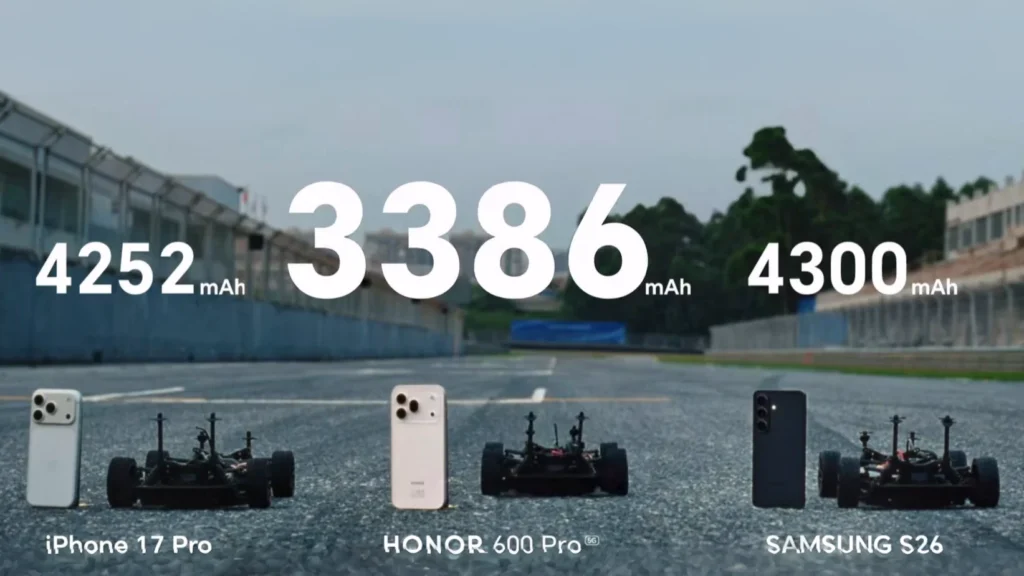
To promote the launch of the Honor 600 and Honor 600 Pro, the company staged a small race of remote-controlled cars powered by the batteries of three smartphones, with a clear objective: to show, at a glance, how a more generous battery can make a difference.
A simple demonstration designed to make an impression
The principle is almost childlike, yet immediately effective. Honor removed the batteries from three devices — an Honor 600 Pro, an iPhone 17 Pro, and a Galaxy S26 as described in the setup — to power three small remote-controlled cars. The expected outcome: the car powered by the Honor battery continues to run after the other two have stopped.
The iPhone stops first, followed by the Galaxy, which lasts a bit longer before eventually giving up. The tone is evidently light-hearted, with an almost teasing narrative.
Of course, this comparison shouldn’t be misconstrued as a “scientific” battery life test. A smartphone battery’s capability doesn’t solely hinge on its nominal capacity; software optimization, screen efficiency, thermal management, and chip performance play huge roles in real-world usage.
However, this isn’t the focus of the demo. Honor isn’t trying to establish universal superiority under all circumstances; instead, they want to illustrate a very specific point: their battery is significantly larger. And in this regard, the visuals speak volumes.
A battery that clearly exceeds high-end standards
Honor’s narrative is built on a solid hardware foundation. The Asian versions of the Honor 600 and 600 Pro feature a 7,000 mAh silicon-carbon battery, while the models launched in Europe drop to 6,400 mAh. Even with this European version, Honor surpasses what Apple or Samsung typically offer in their recent flagship models.
This is what makes this campaign intriguing: it transforms technical specifications into product storytelling. Rather than drowning audiences in numbers, Honor makes the disparity tangible. In a market where premium smartphones are increasingly indistinguishable, the ability to communicate a specification clearly becomes almost as crucial as the specification itself.
The Honor 600 Pro doesn’t just rely on endurance
This marketing strategy wouldn’t be as effective if the phone only featured a large battery. Fortunately, the Honor 600 Pro comes packed with an ambitious technical sheet. Honor boasts a Snapdragon 8 Elite, a bright 6.57-inch AMOLED display, said to reach up to 8,000 nits, and a decidedly premium positioning. The French version of the device also confirms a 6,400 mAh battery for Europe, with 80 W wired charging and 50 W wireless charging on the Pro model.
On the photography front, the brand promotes a 200-megapixel main sensor, accompanied by a 12-megapixel ultra-wide angle and, for the Pro model, a 50-megapixel telephoto lens with 3.5x optical zoom, while the front camera also boasts 50 megapixels according to launch reports. Honor further promises six years of Android and security updates for the 600 series, an important point to bolster its long-term credibility.
A design clearly inspired by Apple
It’s hard to overlook the aesthetic resemblance. Various media outlets have noted that the new Honor 600 series, especially the 600 Pro, borrows elements of visual design from the iPhone, particularly in some finishing choices and a very refined treatment of the edges.
However, this doesn’t preclude the device from having its distinct personality. With its thin, symmetrical edges, above-average battery life, and an overall premium technical profile, the Honor 600 Pro aims not merely to imitate but to reassure: it adopts familiar premium codes while combining them with a tangible advantage for many users: endurance.
Honor recognizes that in 2026, battery life becomes an emotional argument
The most fascinating aspect of this story isn’t the remote-controlled car itself. It reveals a lot about the current smartphone market landscape. For years, the industry has sold gains in power, AI, or computational photography. Here, Honor is bringing back a more basic — yet crucial — need to the forefront: lasting power.
And the brand is intuitively hitting the mark. Battery life is a universal topic but often hard to articulate. By turning it into a playful demonstration, Honor makes the promise concrete and nearly memorable. This isn’t a benchmark test, nor a lab trial, and it isn’t meant to be. It’s a communication campaign that essentially says: “our battery is so powerful that we can showcase it as an energy source in its own right.”
In a universe where Apple and Samsung remain cultural benchmarks of premium, Honor is choosing a different path: not just comparing smartphones, but comparing what they can power. For a brand aiming to establish itself as a credible alternative, this approach is a clever way to shift the debate.



