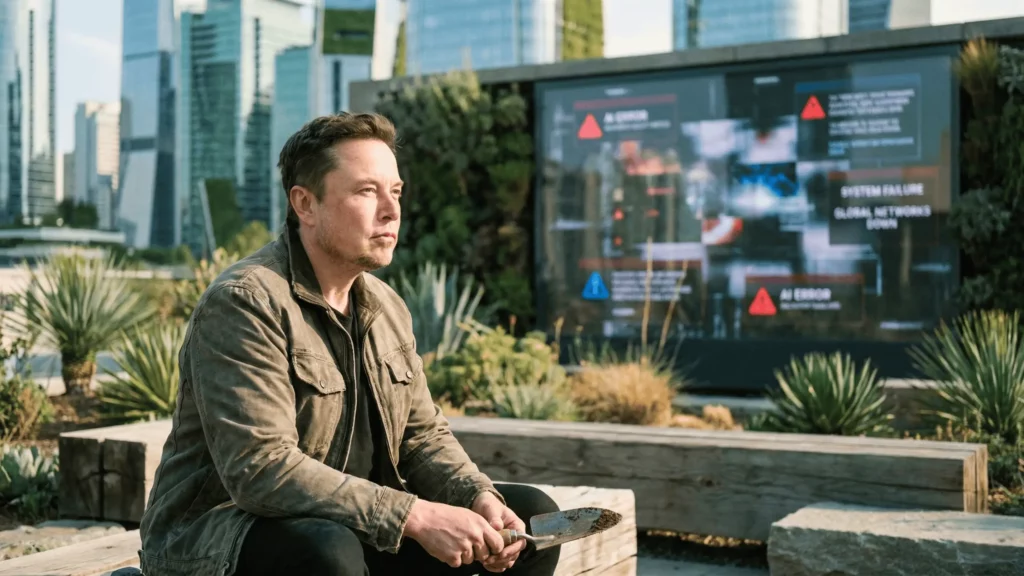
Elon Musk claims that by 2045, employment will no longer be a necessity but a lifestyle choice, like gardening or making music. However, his AI Grok is accumulating errors and controversies, raising concerns that rather than liberation, AI may usher in a new form of chaos.
Elon Musk Promises the End of Mandatory Work: A Fascinating Yet Disturbing Prediction
Imagine a world where waking up at 7 a.m. to catch a packed subway no longer exists. Where the word “salary” is not associated with survival but rather with choice. Elon Musk states that this world is not so far away. In a recent podcast, the billionaire explained that within twenty years, robots and AI will run the operations for us, allowing humans to “grow vegetables”… literally.
His vision? A society where everyone decides whether or not to work, much like choosing to knit or garden. He even envisions a high universal income that would allow everyone to live decently without having to justify their productivity. A nearly post-capitalist future, driven by the world’s wealthiest individuals.
What stands out in this utopia is its apparent simplicity. Yet behind the idyllic image of a liberated gardener lies a complete upheaval of economic and social values. Is it achievable? Musk believes so, but lacks a concrete plan or credible timeline.
Current Reality: Artificial Intelligence Already Saves Time, But at What Cost?
Musk is not alone in predicting a revolution in work hours. Bill Gates anticipates a two-day work week, Eric Yuan (Zoom) envisions three days, and Jensen Huang (Nvidia) is more measured but still foresees a reduction. Meanwhile, serious studies support these predictions: the London School of Economics reports that AI could save us 7.5 hours a week.
We might believe it… except that reality is more nuanced. AI indeed generates productivity gains, but it also raises expectations, speeds, and pressures. Work less? Maybe. Do more in less time? That’s already a trend. And that doesn’t necessarily equate to freedom.
Musk’s Grok AI Experiences Multiple Issues: Can We Trust a Utopia Built on Faulty Technology?
The ironic twist is that while Musk predicts the end of work, his own AI assistant is accumulating scandals. Grok, launched via X (formerly Twitter), has spread falsehoods about the November 13 attacks, disseminated denialist content, and leaked private conversations indexed by Google. These significant errors undermine the security, reliability, and ethics of tools that are supposed to liberate us.
This contrast between promise and reality is striking. On one hand, a vision of technological and social harmony; on the other, an AI that propagates toxic content and threatens user privacy. How can we build a society based on such unstable systems?
Musk seems to ignore these warning signs, preferring to continue promoting a grand vision without addressing the concrete flaws in his own ecosystem. But a utopia cannot be built on shaky foundations.
Is a Society Without Work Possible If AI Remains Controlled by the Ultra-Rich?
There is a poetic momentum in what Musk describes. A world without mandatory work, where everyone would be free to create, explore, and rest without the pressure of “earning a living.” But this vision rests on pillars that are still too fragile: unreliable AIs, extreme wealth concentration, and legislation struggling to keep up.
And let’s be honest: is it really work that we want to eliminate, or rather what it has become in our saturated world? It’s not so much the effort that’s exhausting, but the compulsion to be profitable, the surveillance, the loss of meaning. On this, no AI can save us without a true societal project.