

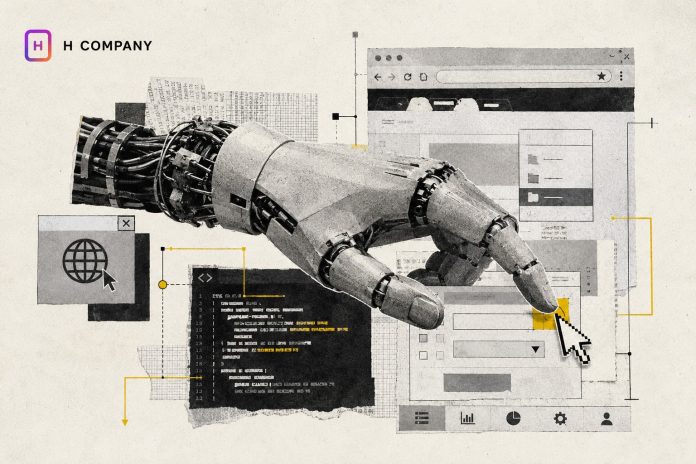
H Company has launched its Computer Use Agent API, providing developers with access to an agent model capable of web navigation and interface manipulation akin to human operators. This innovative French startup offers the model, execution infrastructure, and a catalogue of preconfigured agents, starting with browser automation.
The new Computer Use Agent API is aimed at developers, product teams, and entrepreneurs, enabling them to utilize an agent that can navigate the web, fill out forms, extract data, and transition between screens, much like a human would. H Company is targeting users who wish to integrate such agents into their applications without the need to design or maintain the underlying models, infrastructure, and orchestration frameworks required for their operation.
Founded in 2023 in Paris by Laurent Sifre and Charles Kantor, along with former researchers from Google DeepMind, H Company has quickly emerged as one of Europe’s most well-funded startups. By 2024, it secured an impressive $220 million in its seed funding round, marking the largest seed investment in Europe for an AI company. Notable investors include Eric Schmidt, former CEO of Google, alongside Amazon, Accel, Samsung, Bernard Arnault, and Xavier Niel. This substantial backing has allowed H Company to focus on making software agents the core of its technology rather than a peripheral feature added onto conversational models.
What the API Offers
The API combines three key components that users previously had to assemble on their own. H Company provides an optimized machine-use model for enterprises, fully managed cloud infrastructure for executing agents, and a catalogue of preconfigured agents that teams can customize to fit their needs. Developers maintain control over their applications and business logic, while the intelligence layer and execution remain managed by H Company. This role division characterizes the service as a demand-rented agent capacity rather than a product requiring internal installation and administration.
The API’s utility lies in its ability to relieve users from various responsibilities. Creating a custom agent typically requires selecting a model, hosting it, developing an orchestration framework, managing memory and error catching, and maintaining all components as underlying models evolve. By consolidating these tasks into a single interface, the API significantly lowers the technical barriers and speeds up the deployment timeline for teams lacking machine learning specialists. The focus on browser automation in this initial release reflects the maturity of this use case, as web navigation is currently the most well-understood form of interface control.
The API’s Position in the AI Stack
The technical architecture of AI consists of three layers: foundation models at the base, business applications at the top, and an intermediary agent layer that translates intentions into concrete actions on software. H Company positions itself in this middle layer with its proprietary machine-use model, rather than as an overlay on third-party models. The company presented its Runner H model at the end of 2024, followed by an open-source model named Holo-1 in the summer of 2025, and a navigation agent that boasts a claimed accuracy of 92.2% on a recognized public test bench.
This positioning places H Company in direct competition with OpenAI and its Operator agent, as well as with Anthropic’s screen control capabilities. The company asserts that its model offers the best performance-to-cost ratio compared to large generalist models, a claim that needs validation from actual client workload, given the lack of supporting public test results. H Company’s roadmap aims to expand its scope beyond web browsers, incorporating desktop environments, a development kit, a server operating under the Model Context Protocol, and gateways to automation platforms like n8n or Make. Each additional component broadens usage possibilities and increases dependency on the system.
Key Considerations
This service not only shifts responsibilities but also redistributes workloads. Developers will no longer manage the model and infrastructure; instead, they will rely on H Company’s platform for agent execution. Sensitive actions initiated by the agent, as well as the credentials it interacts with and the data it processes, will go through a third party, raising concerns about oversight and logging for IT management. An agent acting on behalf of a company across real interfaces necessitates detailed tracking of its actions, a prerequisite for thorough auditing in the event of an incident.
Reversibility also warrants equal scrutiny alongside security. An agent designed for proprietary interfaces is challenging to replicate elsewhere without rewriting, particularly as the agent catalogue and Model Context Protocol server gradually limit integrations to a single provider. For a company emphasizing technological sovereignty, clarity regarding the location of execution servers and the applicable legal framework for controlled data is essential. These answers will weigh heavily against model performance in the decision-making processes of French IT departments.
The launch comes at a time when IT departments are eager to industrialize agents without proliferating homegrown components. H Company’s offering responds to this need, provided that clients are mindful of what they are outsourcing alongside the benefits gained. The next twelve months will reveal whether the company can fulfill its promise against American platforms and whether localization assurances will align with its sovereignty commitments.



