

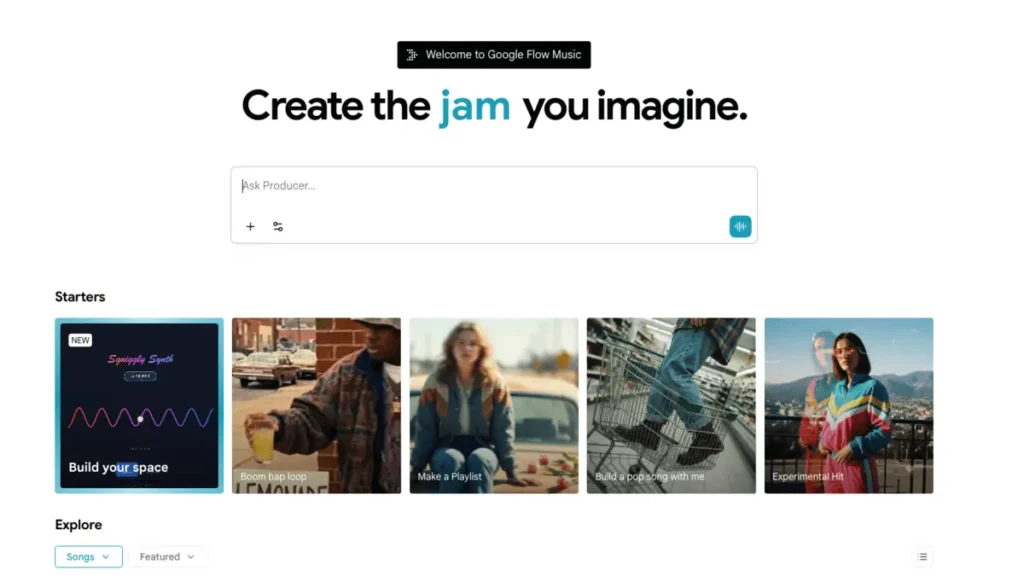
Google transforms Flow Music Spaces into an AI-Enhanced Creative Studio
Google is continuing to develop its ecosystem geared towards AI-assisted music creation. The company has recently announced a significant update to Flow Music Spaces, its collaborative environment that now integrates a series of AI tools allowing users to compose, modify, and enhance projects without leaving the same workspace.
With this evolution, Google is not just offering a simple collaborative tool: Flow Music Spaces is gradually becoming a comprehensive creative production platform where music, visuals, and videos converge in a unified workflow.
Flow Music Spaces Becomes a True Creative Studio
Previously, users often had to switch between different tools to modify a track, generate an illustration, or create a promotional video. The new version of Flow Music Spaces eliminates this fragmentation.
Creators can now generate new songs using AI, modify tracks with Cover, Replace, and Extend tools, automatically separate audio stems to isolate vocals or instruments, generate lyrics, create images, and produce AI-generated videos—all directly within the same collaborative space.
All these tasks can now be performed without leaving the ongoing project.
A Much Smoother Workflow
The main advantage of this update lies in the continuity of the creative process. A musician can, for instance, compose an initial version of a track, replace a verse, extend the track, isolate the vocals, create album art, write corresponding lyrics, and generate a video for social media, all from the same interface.
This approach minimizes interruptions caused by switching applications, facilitating creative back-and-forth—an essential aspect during composition or collaboration phases.
By centralizing all project resources, Google also aims to simplify organization and tracking.
Spaces, our vibe coding tool for building any custom instrument or music app, just got a massive upgrade. 🚀
You can now do it all right inside Spaces:
🎵 Generate & edit songs (cover, replace, extend)
🎛️ Split stems
🖼️ Generate images
✍️ Generate lyrics
🎥 Generate videos— Google Flow Music (@googleflowmusic) July 24, 2026
A Platform That Goes Beyond Simple Collaboration
With this update, Flow Music Spaces evolves into a true hub for AI-assisted music creation. While not intending to replace professional audio workstations (DAWs), the platform is becoming significantly more relevant for songwriters, independent producers, amateur creators, and developers designing interactive music experiences.
The native integration of multiple creative tools enables much of the production cycle to be managed from a single interface, thereby reducing workflow complexity.
What Is Google Flow Music?
To recap, Google Flow Music is an AI-powered music creation platform that allows users to generate pieces from various inputs: text instructions, images, audio snippets, and voice commands.
Users can also remix existing tracks, modify their compositions, publish their creations, and collaborate through Spaces, shared workspaces intended for both music projects and the development of applications or virtual instruments.
The novelty is that most of these operations can now be performed directly within the same collaborative space, without the need to juggle multiple tools or sessions.
Google Accelerates the Convergence Between Generative AI and Multimedia Creation
For several months, Google has been progressively enriching Flow Music to make it an increasingly comprehensive platform for creators. This latest update illustrates a broader trend within the AI industry: providing unified environments where the generation of music, images, text, and videos occurs without interruptions in the creative process.
Beyond mere ergonomic improvement, this evolution reflects Google’s intention to position Flow Music as a true creative production space enhanced by AI. In a competitive landscape increasingly active in assisted creation tools, the ability to integrate multiple disciplines within a single interface could become a major strategic advantage in attracting independent musicians, content creators, and digital professionals.



