

Google Translate adopts real-time voice translation with Gemini 2.5
Google has reached a new milestone in AI-assisted translation. The Mountain View giant is rolling out a significant update to its Gemini audio models, bringing Google Translate a real-time voice translation feature, designed primarily for use with headphones.
At the core of this advancement is the new Gemini 2.5 Flash Native Audio, a model optimized for complex voice interactions. This breakthrough could transform how we communicate abroad — or simply with people who don’t speak our language.
Google Translate: Hear the world… translated live
This new experience, currently in beta, allows users to literally listen to their environment translated in real-time through their headphones. The goal is clear: to eliminate the language barrier without interrupting conversations or pulling out your phone for every sentence.
Two distinct modes are offered, each catering to a specific use case.
Two Modes for Two Distinct Uses
1. Continuous Listening
Ideal for conferences, meetings, or group discussions, this mode allows the AI to listen to multiple languages simultaneously and translate them into a single language chosen by the user.
In practical terms, users simply need to wear their headphones: Gemini identifies the spoken languages around you and instantly conveys them in your chosen language.
2. Bidirectional Conversation
This second mode is designed for face-to-face exchanges. The AI handles real-time translation between two languages, automatically switching direction based on the speaker.
For example: you speak English, your conversation partner speaks Hindi; you hear the English translation in your headphones, and when you reply, your phone broadcasts the Hindi translation aloud.
All of this occurs without manual adjustments or constant settings changes.
The Detail That Changes Everything: Style Transfer
What truly sets this feature apart from traditional voice translations is the vocal style transfer. Gemini doesn’t just translate words: it replicates the rhythm, intonation, and dynamics of the original voice.
The result is a less robotic, more natural translation, and above all, a translation that reflects the speaker’s intent more accurately.
Additionally, a highly effective ambient noise filtering system ensures fluid conversations even in loud environments, whether outdoors or in transit.
Extensive Language Coverage
Google reports compatibility with over 70 languages and around 2,000 language pairs. This breadth is made possible through the audio capabilities of Gemini and the vast linguistic database of Google Translate.
Another key feature is automatic multilingual detection. The app can recognize multiple languages during a single session without the user having to specify which is being spoken. The AI identifies the language and initiates translation autonomously.
Beneath the Surface: A Faster, More Coherent Gemini
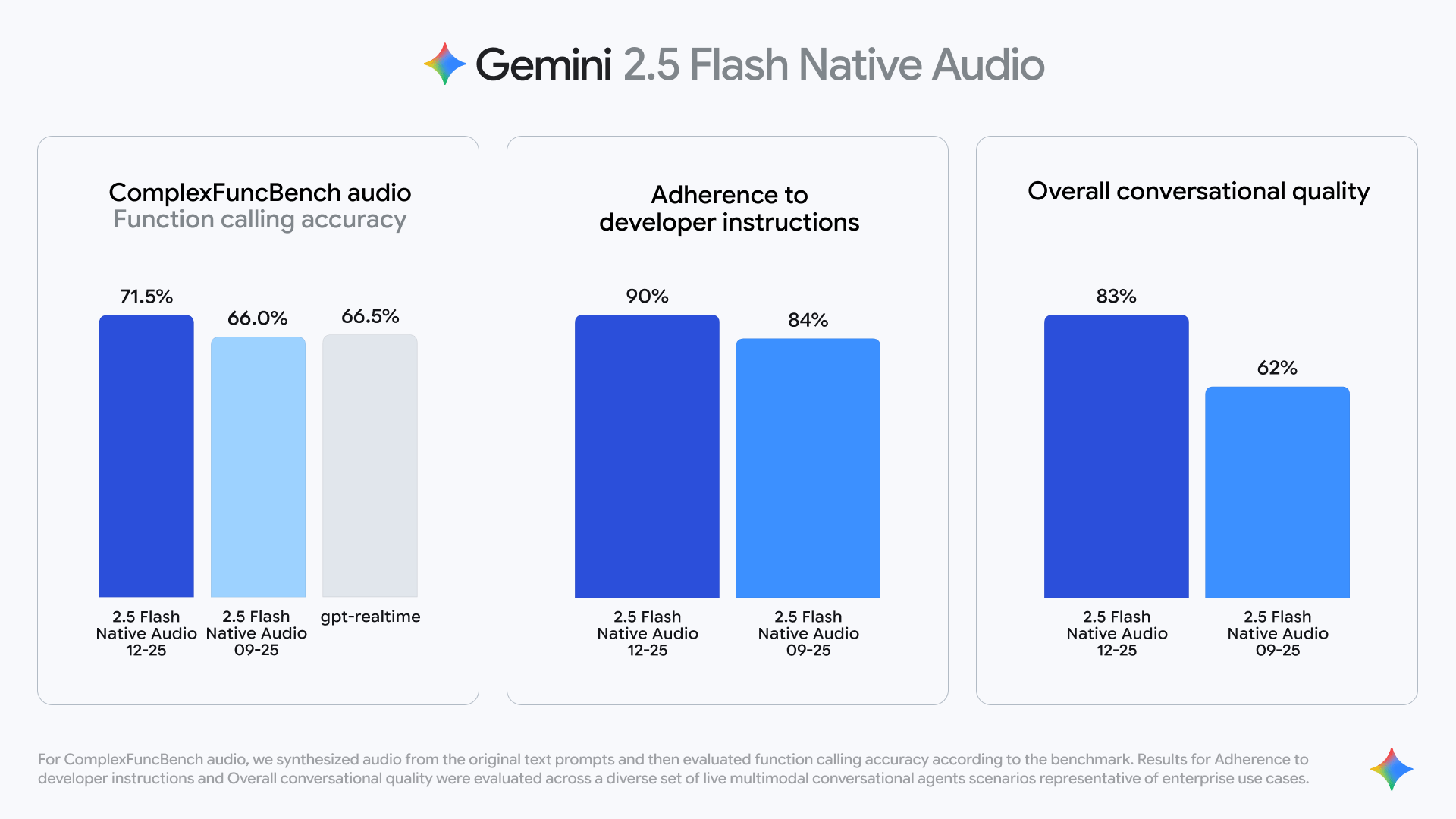
This innovation relies entirely on Gemini 2.5 Flash Native Audio, which benefits from several major technical enhancements.
The model is now more efficient at interacting with external services in real-time (live data, contextual tools) without interrupting the conversation. Google claims a compliance rate with developer guidelines of 90%, up from 84% previously.
Gemini also better retains the context of previous exchanges, significantly improving the quality of multi-turn conversations. This is a crucial development for any credible and stable voice assistant.
A Key Component of the Google Ecosystem
These enhancements do not stop with Google Translate. The Gemini 2.5 Flash Native Audio model is also deployed in Gemini Live, Search Live, Google AI Studio, and Vertex AI.
Users can thus expect smoother voice interactions, whether for translation, live search, or contextual assistance.
Availability
Real-time voice translation is being rolled out starting today within the Google Translate app.
- Platform: Android
- Countries: United States, Mexico, India
- Usage: via headphones, “Live translate” option
Google notes that iOS support and additional regions will be coming soon.



