

Google Maps integrates Gemini: Navigation Becomes Conversational
Google continues to infuse artificial intelligence into its flagship products, and today Google Maps is evolving into one of its smartest tools.
After rolling out the immersive view last year, Google is now introducing Gemini, its conversational AI, directly into Google Maps, enhancing navigation, route planning, and local recommendations.
A Navigation “Smart Co-Pilot”
During a press briefing, Amanda Moore, product director for Google Maps, discussed the vision behind this update: “We have always envisioned navigation with Maps as an all-knowing co-pilot — providing you with exactly the information you need, when you need it.”

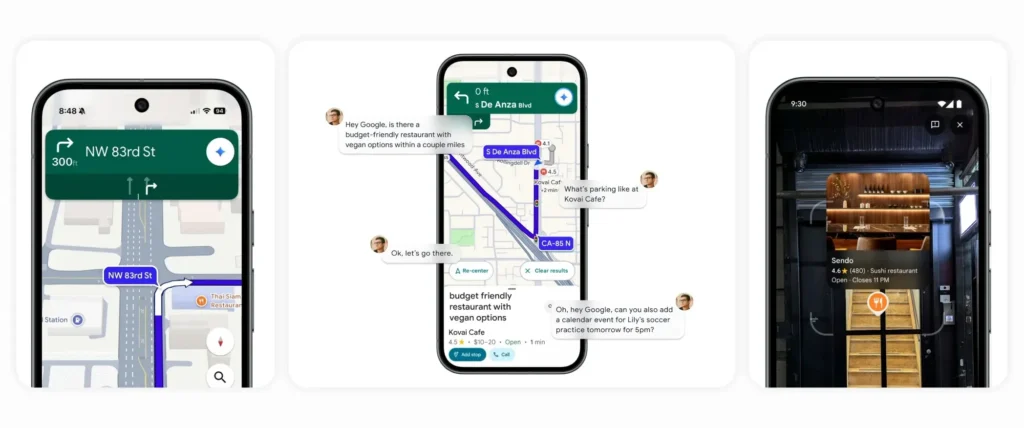
Thanks to Gemini, users can now ask natural, open-ended questions directly within Google Maps, whether walking or driving.
Examples of possible interactions include:
- “Find me an Italian restaurant on my route.”
- “Adjust my route to pass by a well-rated café.”
- “Is there an accident on my usual route?”
- “Summarize the news during my morning commute.”
The AI combines geographical data from Google Maps, community reviews, and information from the web to provide contextualized and actionable responses.
Gemini is activated by saying “Hey Google” or by tapping the Gemini icon at the top right of the screen.
More Human Instructions with Visual Landmarks
One of the most intriguing new features is improved voice instructions. Instead of simple distance-based directions (e.g., “Turn right in 200 meters”), Google Maps now utilizes recognizable visual landmarks, such as:
- “Turn left after the Shell gas station.”
- “Take the exit just after Starbucks.”
This feature relies on Gemini’s ability to analyze billions of Street View images and cross-reference them with a database of 250 million already listed locations in Google Maps.
The result is a navigation experience that feels more natural, intuitive, and connected to the real world.
Proactive Traffic Alerts
Another major addition is the Proactive Traffic Alerts. Gemini now monitors your regular routes in the background, even when you haven’t opened Google Maps.
If it detects an accident, construction, or road closure, you’ll receive an early alert to adjust your route before wasting time.
A true peace-of-mind feature for daily commutes.
Integration with Other Google Applications
Gemini isn’t limited to Google Maps; it can also interact with other Google services.
For instance, while chatting with the AI, you can add an event reminder to your Google Calendar, check your agenda, or even review your recent emails while on the go.
All this can be done without leaving Maps.
“It’s like having a local friend in the passenger seat,” explains Vishal Dutta, product lead at Google Maps.
Google Lens + Gemini: Real-Time Identification
Users can now use Google Lens within Google Maps to identify buildings, landmarks, or shops around them.
Simply point the camera at a location, and Gemini will instantly provide contextual information:
- Name of the place,
- Opening hours,
- Google reviews,
- Photos,
- History or local anecdotes.
Google Promises No “Hallucinations”
In response to concerns about the reliability of generative AI, Google assures that Gemini in Google Maps is “grounded in reality”.
“We have worked to link every response to verified data from real locations, so there should be no hallucinations regarding places or routes,” Amanda Moore asserts.
Responses are generated from certifiable databases within Google Maps, not speculative information.
Deployment and Availability
The new features of Google Maps + Gemini will be free, accessible to all logged-in users, and will roll out gradually on Android, iOS, and later on vehicles equipped with Google integration (Android Automotive).
With the integration of Gemini, Google Maps transcends its role as a mere navigation app: it becomes an intelligent contextual assistant capable of anticipating, explaining, and facilitating everyday journeys.
By combining conversational AI, precise geolocation, and visual recognition, Google is redefining smart navigation—a significant step closer to the perfect digital co-pilot.



