


Google launches the Universal Commerce Protocol: Gemini integrates checkout and accelerates the AI shopping war
At NRF 2026, Google didn’t just showcase a new feature; it unveiled a strategy. On one hand, Gemini and the AI Mode of Search are gearing up to incorporate a native checkout.
On the other hand, Google is promoting an open-source standard, the Universal Commerce Protocol (UCP), co-developed with Shopify, Walmart, Target, Wayfair, and Etsy to effectively connect AI agents to commerce systems. In other words: create a “common language” that turns a conversation into a purchase without navigating through ten tabs.
The AI shopping war is now centered on transactions, not search
AI agents have already shifted the focus of e-commerce: discovering, comparing, deciding… and now, paying. OpenAI paved the way with Instant Checkout in ChatGPT (official announcement in September 2025).
Microsoft followed suit in early January 2026 with Copilot Checkout, touted as a “non-redirect” shopping experience. Perplexity also reports on an integrated shopping experience through a payment partnership.
In this context, Google could not remain confined to the role of a funnel (“I show you products, you figure out the rest”). The risk is apparent: letting others own the most profitable moment of the chain — conversion.
UCP: What Google and its partners aim to standardize
Google presents UCP as an open-source standard covering the entire journey : discovery → purchase → post-purchase support. The goal is to make the integration “agent ↔ retailer ↔ payment” less artisanal and, above all, less fragmented.
Shopify confirms this ambition: UCP is co-developed with Google, the specification is public, and the aim is to connect “any merchant” with “every AI conversation” at scale.
The immediate promise is a checkout directly in AI Mode (Search) and in Gemini, at least for eligible listings and, at launch, initially in the United States. Payment will go through Google Pay and recorded shipping information, with PayPal announced to be “coming soon” to the platform.
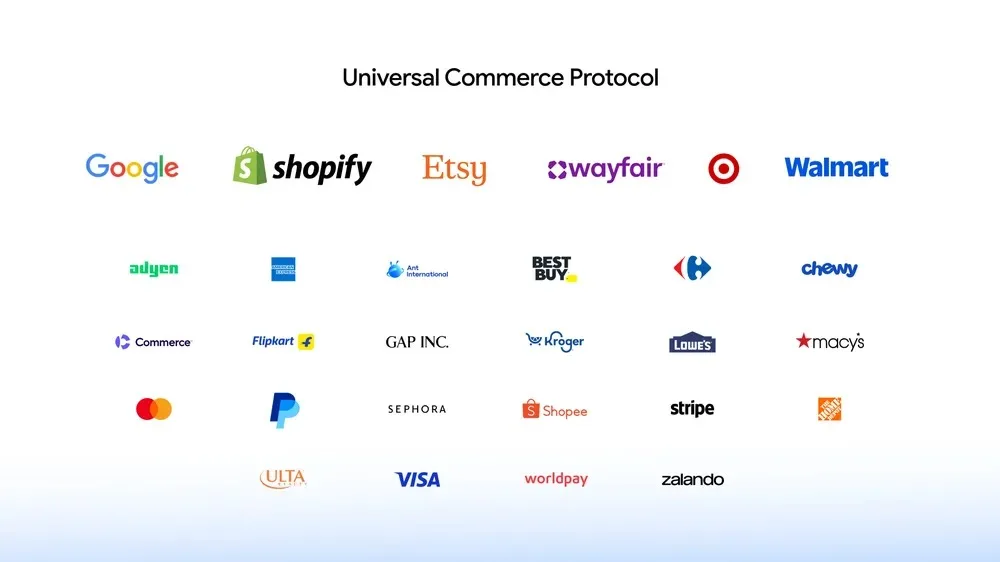
Retailers are already detailing the “how”: Walmart explains that the experience will be available in Gemini via UCP, with benefits such as personalization and cart continuity (Walmart/Sam’s Club) if the user links their accounts. Target is also announcing a “direct” search and purchase experience through Gemini and AI Mode.
Google is not “shopping”; it’s locking in a new layer of the internet
UCP is a typical Google move: standardizing the interface between two realms — here, AI agents and e-commerce — to become the essential infrastructure.
For retailers, this is an opportunity: to appear in conversational pathways where intent is high, without relying solely on traditional SEO. For Google, this is even more valuable: keeping users within its surfaces (Search/Gemini), thus ultimately protecting the discovery economy… and ads.
Moreover, Google is not satisfied with just a protocol: its official blog post also mentions tools like Business Agent (a form of “virtual seller” on behalf of brands) and enhancements on the Merchant Center/advertising offers to adapt to the era of agent shopping.
The downside, however, arises with fluidity: control, consent, transparency. When an agent “takes the path” for you, who mediates? Who is responsible if the purchase isn’t as intended? And how can we prevent AI shopping from turning into a tunnel of “nudges” and privileged placements? This is precisely where the implementation modalities will matter as much as the protocol.



