

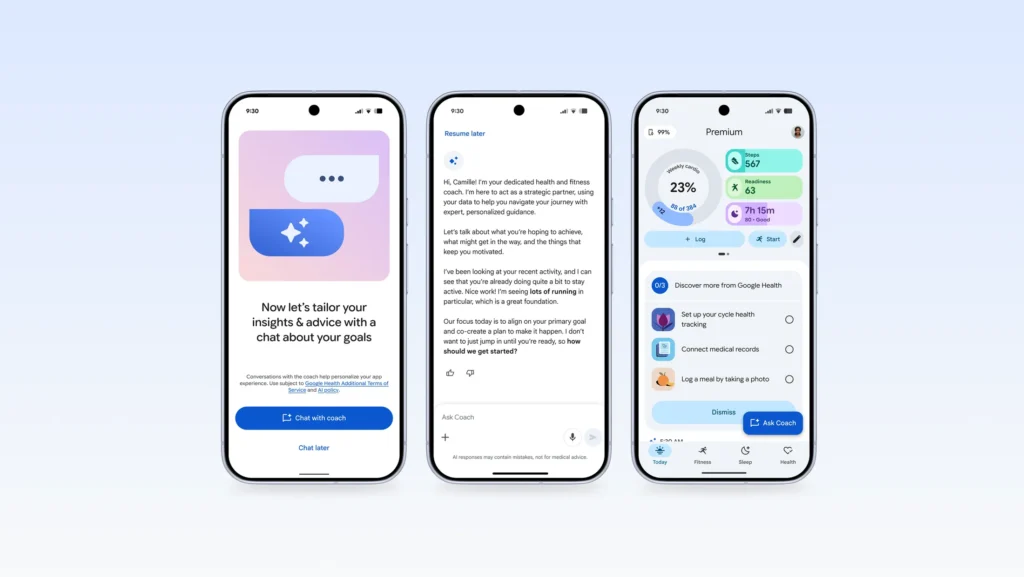
Google Health Coach: Gemini transforms Fitbit into a smart health assistant
After years of exploring the realm of connected health through Fitbit and the Pixel Watch, Google is finally taking a big leap forward. The Mountain View giant has officially unveiled the Google Health Coach, an AI-powered health assistant leveraging Gemini, aiming to become a true daily wellness companion.
Integrated into a new application called Google Health — which officially replaces Fitbit — this virtual coach promises highly personalized monitoring that encompasses physical activity, sleep, nutrition, recovery, and medical data. This ambitious vision sees artificial intelligence moving beyond merely counting your steps to understanding your lifestyle.
From Fitbit AI Coach to Google Health Coach: A Strategic Transition

The Google Health Coach doesn’t come as a surprise. Google has been laying the groundwork for months. At its Made by Google event in August 2025, the company showcased an early version of the project under the name Fitbit AI Coach. A beta phase was subsequently launched for Fitbit Premium subscribers on Android, followed by a gradual rollout on iOS.
This testing period served as a real-world laboratory. Google claims to have used user feedback to fine-tune the experience, enhance recommendations, and adjust interactions with Gemini.
The name change signifies a deeper repositioning. By gradually phasing out the Fitbit brand in favor of Google Health, the company aims to unify its health ecosystem around Google and its proprietary AI.
This evolution underscores the company’s current strategy: to transform Gemini into an intelligent layer capable of orchestrating all Google services, including health and wellness applications.

A Global Launch Scheduled for Today
The official launch of Google Health Coach coincides with the rollout of the new Google Health application on Tuesday, May 19. A gradual deployment will continue until May 26, which will also mark the release of the Fitbit Air.
Initially, the coach’s features will be exclusive to Fitbit and Pixel Watch devices. However, Google indicates that compatibility with other devices will arrive later.
Users without compatible devices will still be able to download the Google Health app to receive notifications when the service becomes available for their hardware.
A Health Assistant That Learns Your Daily Routine
The core of Google Health Coach is built on a simple concept: to create a dynamic and contextual coaching experience. Upon installation, users will need to answer a series of questions regarding their goals, habits, activity level, fitness equipment, any injuries, and overall lifestyle.
The objective is clear: enable Gemini to develop a comprehensive understanding of the user’s daily life to tailor its recommendations in real time.
The system will cross-reference multiple data sources:
- Physical activity;
- Sleep and recovery;
- Nutrition;
- Menstrual cycle tracking;
- Local weather;
- Data from connected devices;
- Medical records for users who consent to sharing.
Google aims to move beyond the basic fitness dashboard to provide genuinely intelligent support.
In the “Today” tab, the app will present contextualized tips, alerts, or routine adjustments based on your fatigue levels, recovery status, or recent habits.
A feature called “Ask Coach” will also allow direct interaction with Gemini for personalized answers regarding exercise, sleep, nutrition, or recovery.

Photos, Voice, and Medical Records: AI Becomes Omnipresent
Google is pushing the boundaries of automation in tracking. The coach will be able to record workout sessions via voice commands, analyze meal photos for nutritional estimation, and even interpret a photo of a workout log in a gym.
In the United States, users will also be able to synchronize their medical records to ask questions about their lab results, treatments, or medical history.
The ambition is clear: to minimize friction related to health tracking and make interactions with the app more natural.
While Apple appears to be transforming its AirPods into intelligent health devices, Google is leveraging Gemini to turn the smartphone into a true medical and fitness assistant.
Recommendations Tailored to Your Recovery
Google Health Coach goes beyond passive analysis. The Fitness tab will propose weekly training programs adjusted based on personal goals, energy levels, and the user’s recovery status.
It will also be possible to generate complete workouts using natural language. Simply asking for “a 30-minute cardio session without equipment” will yield a detailed workout plan.
The sleep component will follow a similar logic. Rather than merely displaying statistics, Gemini will aim to identify long-term trends: regularity of timing, quality of rest, impact of stress or hormonal cycle.

Google also indicates that it has completely revamped features related to cycle tracking, nutrition, and mental well-being.
The goal is to create correlations between these different parameters to adapt recommendations. If a poor night’s sleep impacts your recovery or a phase of the cycle affects your energy, the coach will automatically fine-tune its proposed fitness advice.
AI Guided by Health Experts
Aware of the concerns surrounding AI in the medical field, Google emphasizes that the Health Coach relies on scientific research and validated health principles.
The company states it has collaborated with a committee of experts, including physicians, clinicians, and sports specialists to oversee the recommendations generated by Gemini.
Basketball star Stephen Curry and his training team also contributed to product development, particularly regarding recovery and goal setting.
This effort reflects Google’s aim to assure users on a vital point: in a sector where AI hallucinations can have critical consequences, scientific credibility becomes a significant commercial asset.
Privacy as a Competitive Edge
Regarding personal data, Google reaffirms a commitment made during its acquisition of Fitbit. The company states that health and wellness data from users will not be used for targeted advertising by Google Ads.
This promise is strategically important at a time when tech giants are trying to persuade users to trust their platforms with increasingly sensitive information.
In connected health, trust is as crucial as the technology itself.
A Subscription Fee of 8.99 Euros Per Month
The Google Health Coach will be included in the Google Health Premium subscription, which is the new name for Fitbit Premium. The pricing remains unchanged: 8.99 euros per month and 89 euros per year. Current Fitbit Premium subscribers will automatically retain their access.
Google also introduces a strategic advantage for its AI offerings. Subscribers to Google AI Pro and Google AI Ultra will now receive Google Health Premium at no additional cost.
The Fitbit Air will also include three months of complimentary subscription.
Google Takes a Step Ahead of Apple
The timing of this announcement is not coincidental. While Apple may have recently slowed or suspended certain projects related to a smart health coach, Google appears poised to seize the opportunity.
With Gemini, the company possesses an AI infrastructure capable of natural language processing, complex data analysis, and generating contextual recommendations.
The critical question remains: will this promise of intelligent coaching survive daily usage?
For in the world of connected health, the challenge is not merely accumulating data. The true challenge lies in transforming this information into genuinely useful, reliable advice that is relevant enough to lead to lasting changes in user habits.
If Google can succeed in this endeavor, the Google Health Coach could emerge as one of the first significant real-world applications of personal AI in health.



