

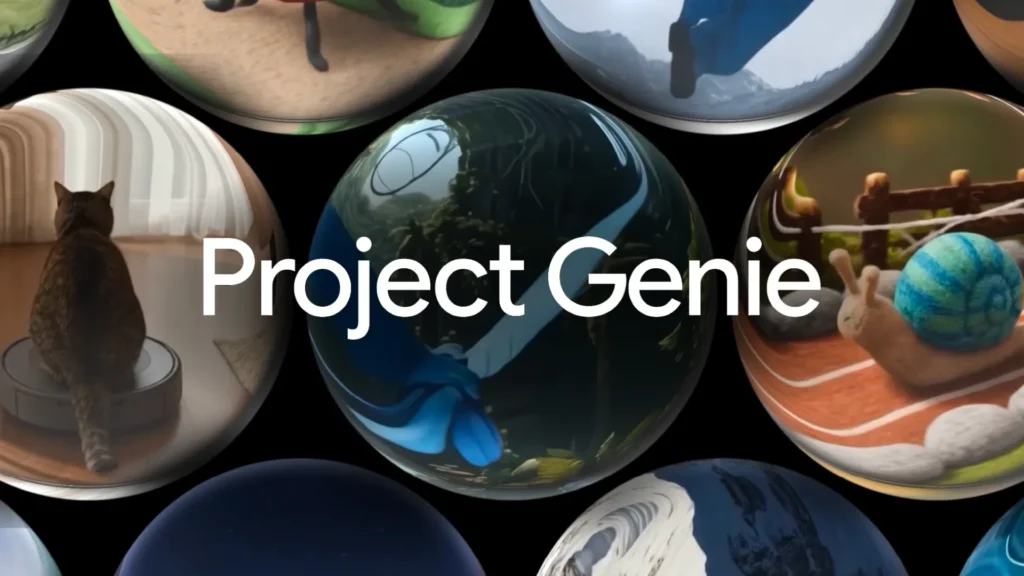
Google connects Street View to Project Genie to simulate the real world
Google may have just unveiled one of the most fascinating demonstrations of its future “world model.” At Google I/O 2026, DeepMind announced the integration of Street View into Project Genie, its AI model capable of generating interactive and simulated environments from real-world data.
The concept seems straight out of a science fiction movie: transforming Street View into a navigable, dynamic universe that can be modified in real time.
Street View Becomes an AI-Simulated World
In practical terms, Genie can now utilize the billions of images collected by Street View to recreate interactive environments. Users could revisit a street covered in snow, change the weather, explore a city during different time periods, or simulate extreme scenarios similar to The Day After Tomorrow.
However, the goal goes far beyond virtual tourism.
Google aims to create simulated worlds that can be used for robotics, autonomous vehicles, video games, education, and potentially future embodied AI assistants.
Google Has a Colossal Advantage: 20 Years of Street View
For two decades, Google has been accumulating Street View data on an unparalleled scale: over 280 billion images in 110 countries across all seven continents. This wealth of data is now the ideal fuel for generative models like the “world model.”
And unlike entirely synthetic worlds, Genie is rooted in real locations.
The system is already impressive in its spatial continuity: when rotating 360 degrees, the AI “remembers” the environment behind it and continues to construct the simulation coherently.
Waymo, Robots, and Embodied AI: The True Testing Ground
One of the most important applications involves Waymo. Google is already using Genie to train its autonomous vehicles for extremely rare events: tornadoes, unexpected behaviors, or unusual situations. With Street View, these simulations could become much richer and geographically accurate.
Moreover, the stakes go even further. DeepMind also intends to use these simulated worlds to train humanoid robots, embodied AI assistants, or systems capable of physically interacting with the world.
A robot could learn to navigate London under unusual sunshine or in rare weather conditions before ever encountering them in real life.
Still Far from Photorealism… but Impressive Already
However, Google acknowledges that the technology remains experimental. The demonstrations still resemble more video game environments than photorealistic simulations. Most importantly, Genie does not yet fully grasp physics.
During a demonstration, a character walked straight through cacti and bushes without any coherent interaction. The model understands space but has yet to perfect the cause-and-effect relationships.
Nevertheless, DeepMind believes this technology is only a few months behind video models like Veo.



