

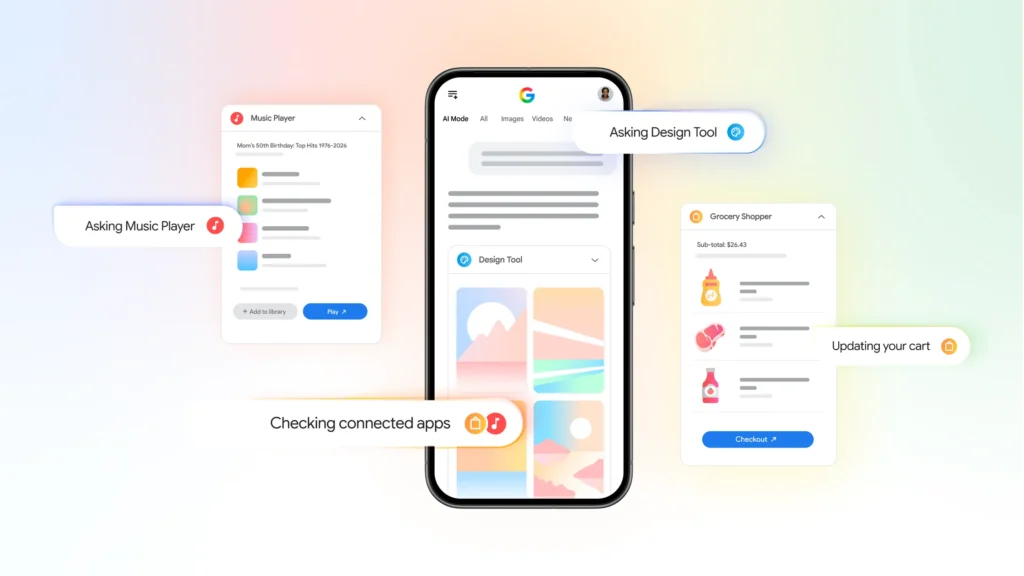
Google AI Mode can now manage your schedule thanks to Google Calendar
Google continues its transformation of Search into a true personal assistant powered by artificial intelligence. With a new update to AI Mode, the Personal Intelligence feature can now connect to Google Calendar, understand your schedule, and even automatically create events on your behalf.
This development marks a significant step in Google’s AI strategy. For the first time, Search no longer just uses your data to personalize its responses; it can now act directly within your digital ecosystem.
Google Search now considers your schedule
Previously, Personal Intelligence primarily utilized information from Gmail and Google Photos to provide more relevant and contextualized responses.
The integration of Google Calendar fundamentally changes this approach.
According to Robby Stein, Vice President in charge of Google Search, AI Mode can now analyze your calendar before responding to a query. For instance, if you search for a restaurant for dinner, Search will no longer just recommend the best-rated establishments nearby. It will also check if you have a meeting scheduled that evening, estimate the time available, and suggest an option that fits your schedule.
In another scenario, if you receive an invitation to an event or if an appointment is mentioned during a conversation, AI Mode can automatically create the corresponding event in Google Calendar without requiring you to open the app.
This feature is currently being rolled out in the United States, with plans for a gradual expansion to other markets.
Search is taking action instead of just answering questions
This new capability may seem subtle, but it reflects a deeper evolution. For decades, Google Search had a relatively simple mission: to find the most relevant information on the web.
With AI Mode, this logic is changing.
The search engine is gradually becoming an assistant capable of understanding the user’s personal context, reasoning based on their data, and now executing certain actions directly within Google services.
Google Calendar is thus the first application linked to Personal Intelligence that serves not only as a source of information but also as an execution tool.
Personalization that goes beyond simple preferences
This integration also raises a more fundamental question about the future of the search engine. Until recently, two people entering the exact same query would generally receive relatively similar results. The arrival of Personal Intelligence is gradually challenging this principle.
With Gmail, Google was already personalizing certain responses based on users’ interactions or interests. Google Calendar introduces a new dimension: time.
Two users performing the same search could now receive entirely different recommendations simply because their schedules differ.
In other words, availability, appointments, and time constraints are now fully integrated search parameters.
The initial effects are already measurable
This enhanced personalization is no longer just a hypothesis. A study conducted by the specialized firm iPullRank shows that connecting Gmail to Personal Intelligence already alters the AI-generated responses.
For identical queries, different Google accounts receive distinct ratings, recommendations, or answers based on their personal histories. With Calendar, Google adds an additional layer of context.
The AI now considers not only what you like or search for but also what you plan to do, how much time you have, and your upcoming commitments.
Toward a true Google personal assistant
This evolution hints at a much more ambitious strategy. If Google continues in this direction, other services could soon join Personal Intelligence: Google Keep, Google Tasks, Google Maps, Google Docs, and even third-party productivity platforms. In the future, AI Mode may no longer wait for users to formulate a request.
With a comprehensive view of a user’s activities, the assistant could anticipate certain needs, propose automated actions, or organize an entire day without manual input.
The search engine would then evolve into a genuine proactive assistance system.
A new generation of search… but also new questions
This extreme personalization has a downside. As answers become tailored to each individual, they become increasingly difficult to compare or verify. In the future, there may no longer be a universal answer to the same query, but dozens of variations generated from the information stored in each Google account.
This represents a major shift in the way the web operates.
For over twenty years, Google organized global information by providing relatively common results to all internet users. With AI Mode, the goal evolves. It’s no longer just about finding the best answer but providing the most relevant answer for a specific person based on their context, habits, and now… their schedule.
This transition perfectly illustrates the new direction taken by Google: gradually transforming its search engine into a personal assistant capable of not only understanding users’ needs but also acting directly on their behalf.



