

Google Calendar + Gemini: AI Finally Finds the Perfect Time Slot for Your Meetings
After simplifying appointment scheduling through email with “Help me schedule” in Gmail, Google is applying the same logic directly where decisions are made: Google Calendar.
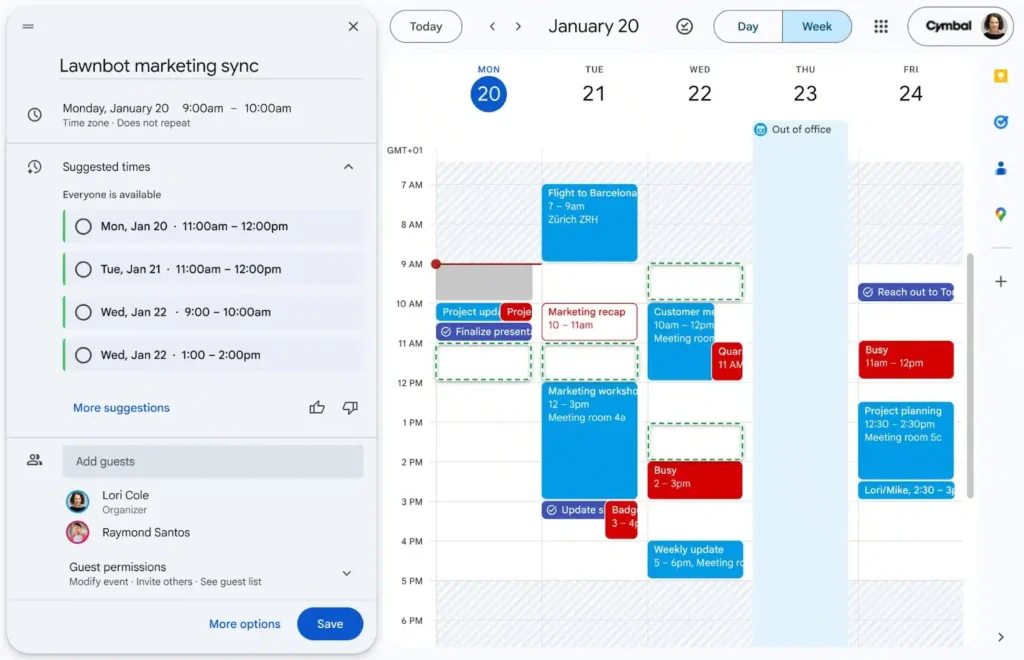
With Gemini, the application can now suggest relevant time slots based on everyone’s availability—and even recommend a new time if a meeting needs to be rescheduled.
From Gmail to Google Calendar: The Same Promise, but in the Right Place
“Help me schedule” introduced a simple concept: to stop the back-and-forth of “Tuesday at 3 PM? No, how about Thursday?” by allowing AI to propose compatible time slots and then create the event once an option is chosen.
Google Calendar takes this initiative further with a more “agenda-first” approach: when you create an event, Suggested Times analyzes the calendars of the invitees (if you have access), their working hours, and potential conflicts, then highlights the best available slots.
Here’s how it works in practice:
- Creating events (web/desktop): you click on Suggested Times, and Gemini proposes time slots.
- Rescheduling: if several invitees decline, a banner can appear at the top of the event with an alternative that “works for everyone,” which can be changed with one click.
The benefit is not just that “AI does one more thing,” but that Google Calendar becomes an arbitration tool, not just a record-keeping system.
Availability: For Whom, and With What Limits
Google is gradually rolling out the feature (starting “today”) for users of Workspace Business Standard/Plus, Workspace Enterprise Standard/Plus, and the Google AI Pro extension for Education.
As for limitations, the help page notes that Suggested Times does not appear in the Google Calendar app on Android/iOS/iPadOS (at launch), for events longer than 8 hours, if there are too many participants, or if the date range is in the past.
Google is Selling a Habit, Not Just a Feature
This initiative aligns with the vision of “Google Workspace 2026”: to make Gemini a layer of orchestration above routine actions. Every click saved strengthens the core argument of Workspace “with Gemini”: less coordination, more execution.
Importantly, it also sets the stage for a quiet shift: if AI becomes the natural interface for negotiating time (the real bottleneck for organizations), the calendar is no longer just a tool—it becomes a decision-making center.



