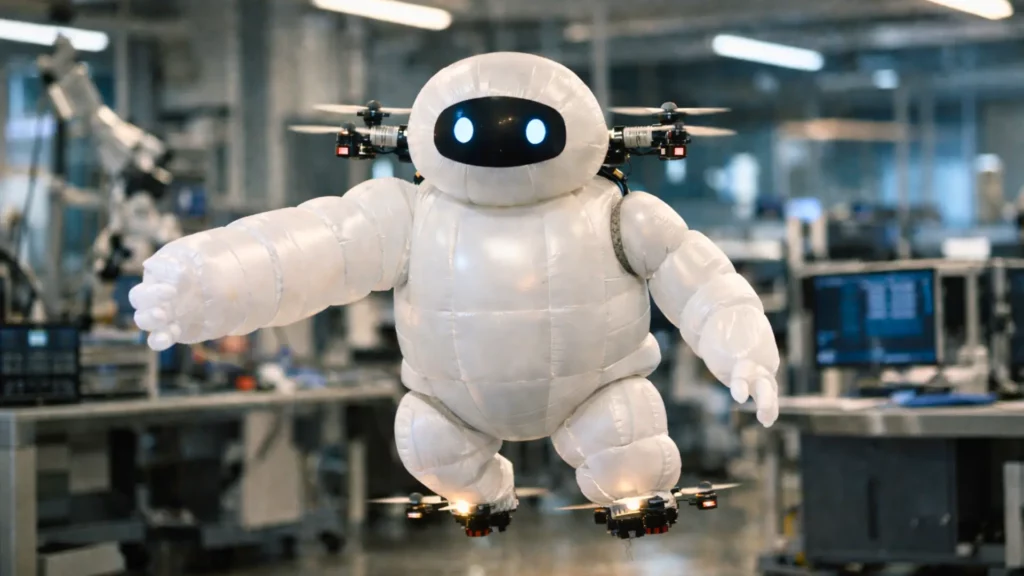
Under its playful exterior lies a feat of engineering: GrowHR, the inflatable Chinese robot, pushes the limits of humanoid robotics. Less Terminator and more ninja Michelin man, this astonishing prototype could potentially change the game in complex environments.
A Design Inspired by Human Bones for More Flexible and Safer Robotics
At first glance, GrowHR looks more like a quirky toy than a high-tech robot. However, beneath this almost childlike appearance lies a bold concept: to replicate the qualities of human bones in order to create a robot that is both robust, adaptable, and surprisingly lightweight.
Researchers in Shenzhen have designed an internal structure made of flexible air chambers, wrapped in a durable fabric. Once inflated, these structures can extend the robot’s limbs up to three times their size. They become rigid enough to support weight while remaining flexible to absorb shocks.
This seemingly simple principle enables a rare combination in robotics: strength and safety. GrowHR can withstand impacts without damage and move fluidly, far removed from traditional mechanical stiffness. This innovation paves the way for softer, safer robotics for humans.
A Robot That Changes Size at Will, Floats, Swims, and Flies
Where traditional robots are often rigid, heavy, and dangerous when they fall, GrowHR embraces intelligent flexibility. By deflating its limbs, it can reduce its size by 64%, allowing it to squeeze into tight spaces. This is particularly useful for rescue missions or urban exploration.
And that’s not all. Thanks to its inflatable and waterproof structure, it can float like a buoy, swim, and even walk on water. Better yet: equip it with small rotors, and it can take flight like a drone. At just 4.5 kilograms, it becomes a versatile terrain chameleon, capable of transitioning seamlessly from land to air.
A Bio-Inspired Architecture Designed for Safe Coexistence with Humans
The genius behind GrowHR also lies in its natural safety. Its soft structure minimizes the risk of injury in case of collision with a human. Unlike a metal robot, it doesn’t break or cause harm. This is a crucial quality if we envision it in our homes or public spaces.
Its “bones” are interconnected by tensioned cables, powered by small motors and carbon fiber guides. The result? Smooth, nearly organic movements. We are far from the stiff motions of an industrial robot. Yet, all of this is serious: the study has been published in the renowned journal Science Advances.
Still Limited but Full of Promise for Difficult-to-Reach Areas… and Our Homes Tomorrow?
Let’s not call it a miracle just yet. For now, GrowHR remains a laboratory prototype, still limited in certain situations. In water, for example, its mobility is hindered by its waterproof shell. But the concept is there, powerful and innovative.
In the future, this type of robot could explore disaster-stricken areas, intervene in inaccessible zones, or even assist in households. Its ability to change shape and mode of movement makes it a true robotic Swiss Army knife. And let’s face it: having this Michelin man at home would be much more enjoyable than a soulless humanoid with a vacant stare and a fixed smile.