

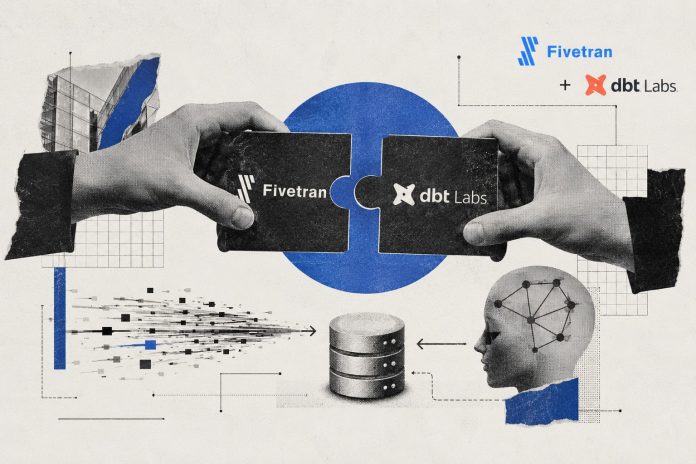
Data movement specialist Fivetran and dbt Labs, the publisher behind the dbt transformation standard, have finalized their merger announced back in October 2025. Operating under the name Fivetran + dbt Labs, the newly formed entity claims to support over 100,000 data teams and has launched its first combined products, including the open-source dbt Fusion engine and Agents Schema, a context layer standard for AI agents stored within the client’s data warehouse.
The data tools ecosystem has evolved through successive layers—ingestion, transformation, and semantic modeling—each driven by specialized vendors that data teams ended up assembling themselves. This modular stack, designed for human analysts who query data in batches and can tolerate daily refreshes, encounters a different type of consumer. AI agents continuously query systems in parallel and at machine speed, where misinterpretations lead to actionable errors rather than inaccurate reports.
As of June 1, 2026, the merger unites two of the most established layers in this stack to address these new demands. Fivetran provides continuous data synchronization from source systems, while dbt contributes governed transformations, tests, and semantic context that define the meaning behind the numbers. The transaction, conducted entirely through stock, positions the new entity against integrated platforms claiming similar foundational data roles for AI, with Snowflake and Databricks leading the charge; both remain partners of the two firms. Customers—from OpenAI to Zendesk, including organizations in health and finance—highlight the substantial user base that this merger consolidates. “The next generation of enterprise AI will be defined by the quality and reliability of the underlying data,” states George Fraser, CEO of Fivetran + dbt Labs.
Agents Schema: A Context Layer Residing with the Client
The most notable product announcement is Agents Schema, an open standard that designates a unique schema in the data warehouse or data lake as a shared context layer for agents. This component stores metric definitions, semantic models, data lineage, and business documentation in ordinary SQL tables fed from existing systems. Any agent capable of executing SQL can connect to it, regardless of the data warehouse or ingestion tool used, and the layer remains client-owned, subject to their existing security and governance policies.
This architectural choice is noteworthy because it counteracts the proprietary context layers built by agent platforms. Instead of being hosted by the vendor, the context exists within the client’s infrastructure in a universally readable format. “Trust is built at the infrastructure layer, on high-quality tools and open standards. This is the bet we are making together,” says Tristan Handy, co-founder and president of Fivetran + dbt Labs. Efficiency also comes into play, as richer context provided to the agent reduces token consumption with each query.
A Recalibrated Open Source with the Fusion Engine
The second announcement shifts the balance between free and paid offerings. The dbt Fusion execution engine, previously exclusive to the commercial offering, is now released as open source under the Apache 2.0 license and becomes dbt Core 2.0. This change allows the community to experience dbt on a faster and more efficient basis. Local distribution grants access to engine capabilities, language features, and warehouse adapters, with platform features unlocked through direct terminal connections. The model remains that of an open core, liberating the engine while moving monetization towards platform services.
Two additional components round out the common roadmap. dbt State, in preview, acts as a caching layer for pipelines by executing only necessary processes, potentially reducing infrastructure costs by 30% or more, according to the publisher. dbt Wizard, currently in beta, assists in writing, restructuring, and debugging models by leveraging the complete context of projects, including lineage, tests, contracts, and metrics, to produce governed recommendations instead of generating off-the-cuff SQL. Noted clients report shortened cycles, with “what used to take months now done in a few weeks,” states Akshay Agrawal, director of data engineering at Zendesk.
A Dual Strategic Shift for Fivetran
Beyond the new product offerings, the merger signals a profound repositioning for Fivetran. Its historical role of data movement via connectors becomes more commonplace as vendors expose their own interfaces and integration standards become widespread. By acquiring dbt, the company elevates from the layer that transports data to the one that defines its meaning—an aspect that platforms cannot commoditize since it encodes the business specificity of each client. This shift in buyer perspective aligns with the transition in data layers; whereas data stacks were sold to analytics teams for dashboard creation, they are now marketed to AI teams, placing the provider at the heart of every automated decision.
This defensive positioning completes the picture. Snowflake and Databricks are vertically integrating ingestion and transformation within their platforms, while model providers are moving closer to the data; two specialists caught in this squeeze merge to achieve critical mass. The decision to house Agents Schema within the client’s data warehouse, rather than a hosted service, stems from this position, as the entity that does not own the platform has an interest in keeping the context layer neutral and portable, counter to platforms that seek to capture it. For Chief Data Officers (CDOs) and Chief Information Officers (CIOs), this defensive openness promotes reversibility, with the transition of Fusion to Apache 2.0 serving as a guarantee. Vigilance will be needed over time, as the boundary between open core and paid platform remains the least stable variable in these models.



