

Fitbit sans écran : Le pari fou de Google pour détrôner Whoop et Oura ?
Google may soon fundamentally change what we expect from a Fitbit bracelet. According to Bloomberg, the company is working on a new screenless wearable designed to compete with players like Whoop and Oura, focusing on passive health monitoring, a mobile app, and a subscription-based business model.
At its core, this idea reflects the current phase of the market. The wearable will no longer be just a device that displays data on the wrist, but a discreet sensor whose true value lies in software, signal interpretation, and AI assistance. This marks a significant strategic shift for Fitbit and aligns well with Google’s direction over recent months.
A Fitbit That Abandons The Screen For Discretion
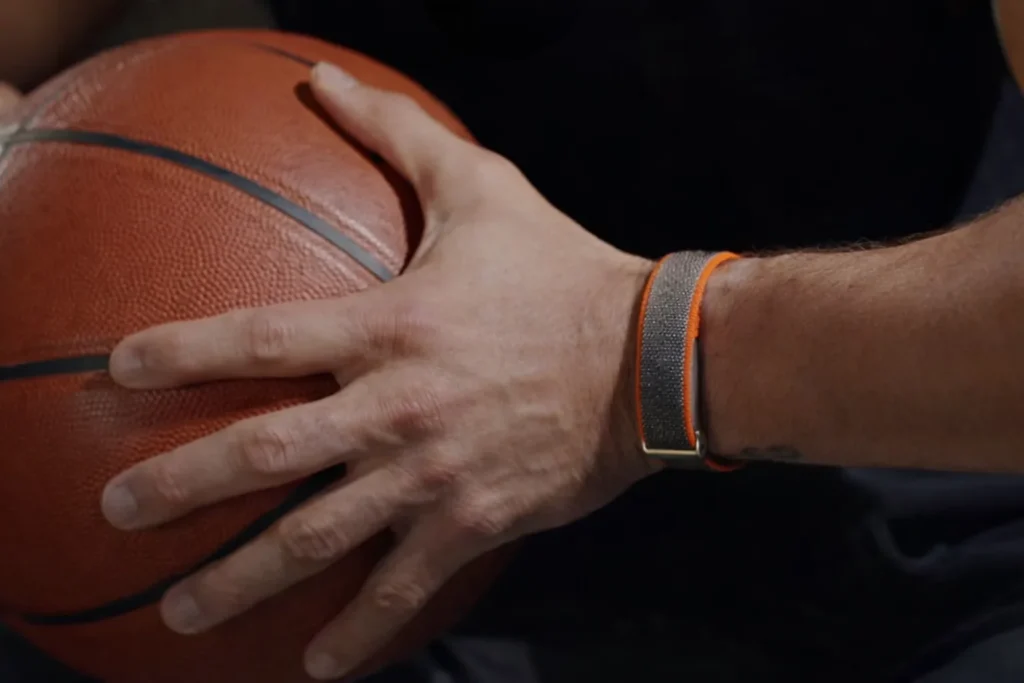
According to Bloomberg, this future bracelet will completely eliminate the built-in display. Users will check their information and statistics through the Fitbit app instead of the device itself. Early visuals show a gray fabric strap with an orange lining, resembling the screenless wearables popularized by Whoop.
This choice is anything but trivial. Removing the screen also redefines the product: it becomes less of a traditional watch or tracker and more of a subtle sensor, designed to be forgotten while continuously collecting data. For Google, this allows for a shift in focus from the device to the software analysis, where much of the differentiation now resides.
An Hybrid Model Like Whoop, Where Subscription Becomes Nearly As Important As The Bracelet
Bloomberg also reports that Google is testing a model similar to Whoop’s: purchase the hardware, then unlock certain advanced features via a paid subscription. At this stage, no pricing has been announced for this potential model, and Google hasn’t officially unveiled the product.
This is likely the most sensitive aspect of the situation. Fitbit has long been associated with a simpler, clearer logic, where the device remained at the core of its value proposition. By shifting to a model where intelligence, recommendations, and some premium features exist behind a recurring payment, Google could position Fitbit more toward a service economy rather than just hardware.
Gemini Becoming The True Engine Of The Experience
This future bracelet will also be one of the first Fitbit wearables to rely heavily on Gemini. Google recently detailed new features of its Personal Health Coach built with Gemini, presented as a 24/7 guide capable of assisting users with fitness, sleep, and overall health.
Bloomberg directly links this future bracelet to the AI layer, stating that the experience will focus heavily on insights regarding recovery, nutrition, hydration, mental health, and menstruation cycles. In other words, the wearable will transform from a dashboard into a gateway to personalized health coaching.
Stephen Curry Is Already Preparing The Ground
The name Stephen Curry also surfaces in this discussion. Bloomberg mentions that the NBA player has already teased the device on social media, framing it around a “new relationship with your health.” Additionally, Google officially confirmed a multi-year partnership with Curry in 2025, focusing on Google Health and Fitbit products, appointing him as a “performance adviser” for the division.
View this post on Instagram
While this does not guarantee an immediate launch, it suggests that Google is beginning to construct the public narrative around this product. In the world of consumer hardware, this kind of pre-launch teasing rarely accompanies a project that is still far from fruition.
Google Seems To Want To Transform Fitbit Into An AI-Assisted Health Platform
What is emerging here is broader than just a new bracelet. Google appears to be repositioning Fitbit as a connected health layer where the hardware becomes more discreet, while value shifts towards the app, intelligent coaching, and subscription services. This transition aligns perfectly with the company’s current strategy: making Gemini not just an additional gadget, but a cross-functional layer capable of reinterpreting daily usage.
Now, the real question remains: do Fitbit users want a more discreet and intelligent bracelet, or will they find it hard to accept paying more for features that previously came with the product itself? If this wearable hits the market in 2026 or 2027, it could provide a very clear answer—while also redefining what it means to “wear a Fitbit” in the era of AI.



