
Firefox adds ‘anti-AI’ button: Mozilla announces AI-free mode in version 148
After weeks of discussions, Mozilla is taking a rare step in the industry: acknowledging that some users simply do not want AI in their browser. Starting from the next major update, Firefox will introduce a global switch to hide and block current and future AI functions.
Indeed, Mozilla has announced the arrival of a new AI control section in the settings of the desktop version, starting with Firefox 148, which is slated for deployment on February 24, 2026.
The concept is clear: to provide a single space to disable AI or, conversely, to selectively choose what to keep. It is also a political message: “AI is changing the web, and people want very different things from it,” Mozilla stated, explaining that they have listened to both those who “want nothing to do with AI” and those who expect genuinely useful tools.
What changes in Firefox 148: An ‘AI kill switch’ and precise settings
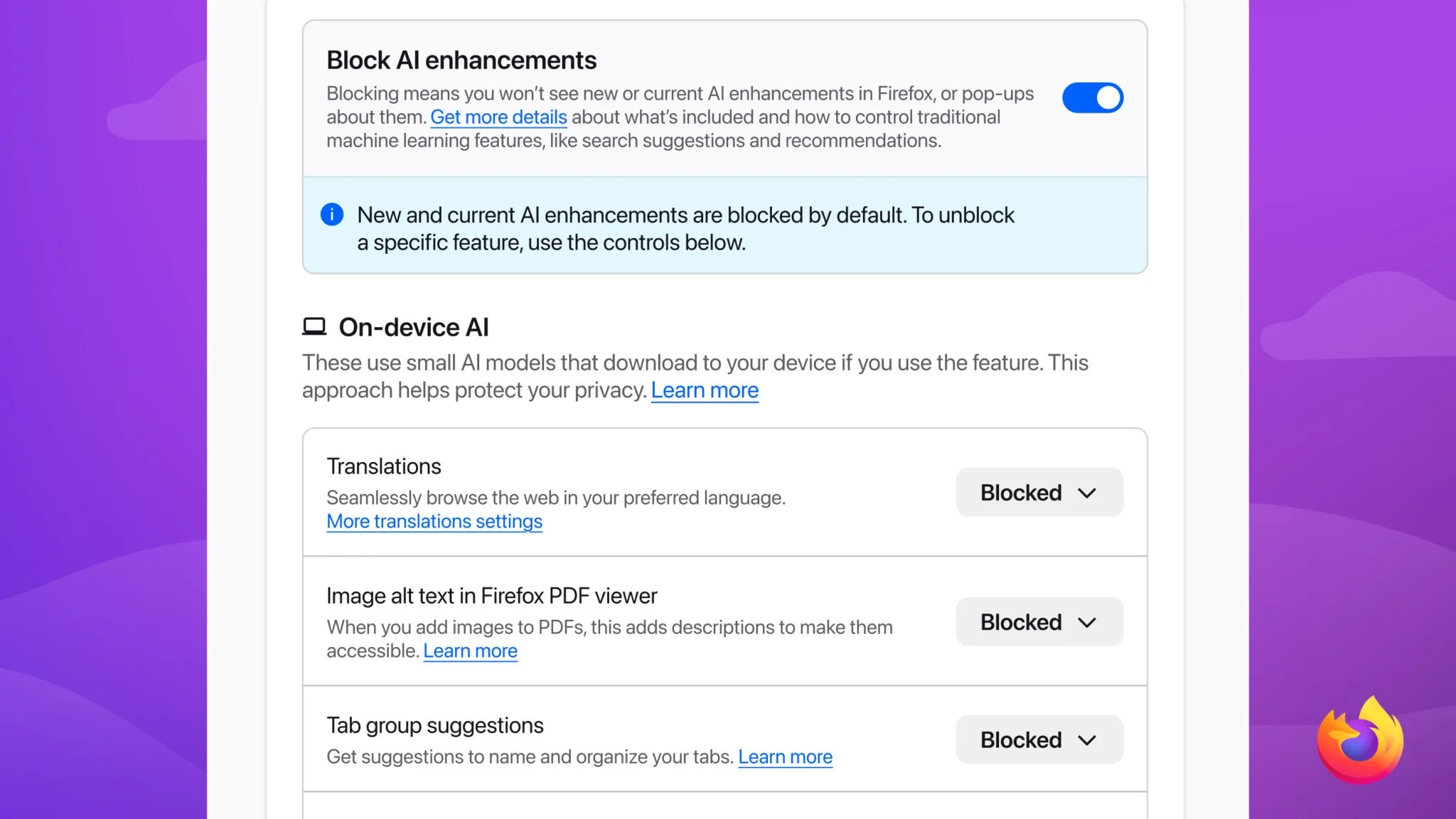
In the settings, an option titled “Block AI enhancements” will allow users to block all existing and future AI improvements. Once activated, users will no longer see pop-ups, suggestions, or reminders related to these functionalities.
However, Mozilla isn’t stopping at a simple red button: users will also be able to manage each feature individually. Among those mentioned are:
- Translations (webpage translation)
- Alt text in PDFs (generation of alternative text in PDFs)
- AI-enhanced tab grouping (assisted tab grouping)
- Link previews
- The sidebar chatbot, which allows users to engage with a service of choice while browsing: Anthropic Claude, OpenAI ChatGPT, Microsoft Copilot, Google Gemini, and Mistral AI Le Chat Mistral.
Mozilla turns controversy into product promise
This announcement does not come out of nowhere. Since Anthony Enzor-DeMeo was appointed head of Mozilla (announced in December 2025), the official line has been as follows: AI will be part of the strategy but must remain optional, understandable, and controllable.
In other words, Mozilla is trying to make “optional AI” a signature feature as the browser market is shifting with new entrants and usage patterns (conversational search, integrated assistants, guided browsing), with players like Perplexity, The Browser Company Arc, and Opera all vying for their place.
The bet is interesting: instead of selling AI as a given, Mozilla is selling the freedom to say no — and, in doing so, addresses a need that had become almost invisible in the roadmaps of Silicon Valley.
Transparency and ‘rebel alliance’: Mozilla’s other battle
Meanwhile, Mozilla is trying to reposition itself within the broader AI ecosystem. Various outlets report that Mark Surman aims to build a “rebel alliance” uniting startups, developers, and public-interest technologists, with the goal of making AI more open, reliable, and auditable.
According to these sources, Mozilla plans to deploy over $1.4 billion in reserves to support initiatives and organizations aligned with this vision.
This dual approach (optional AI in the browser + funding for “trustworthy” alternatives) illustrates a strategy: Mozilla is not only looking to “add features,” but wants to reclaim control over the most sensitive question of 2026 — who controls AI, and how.