Exynos 1680: Samsung’s New Chip Bringing Local AI to the Galaxy A57
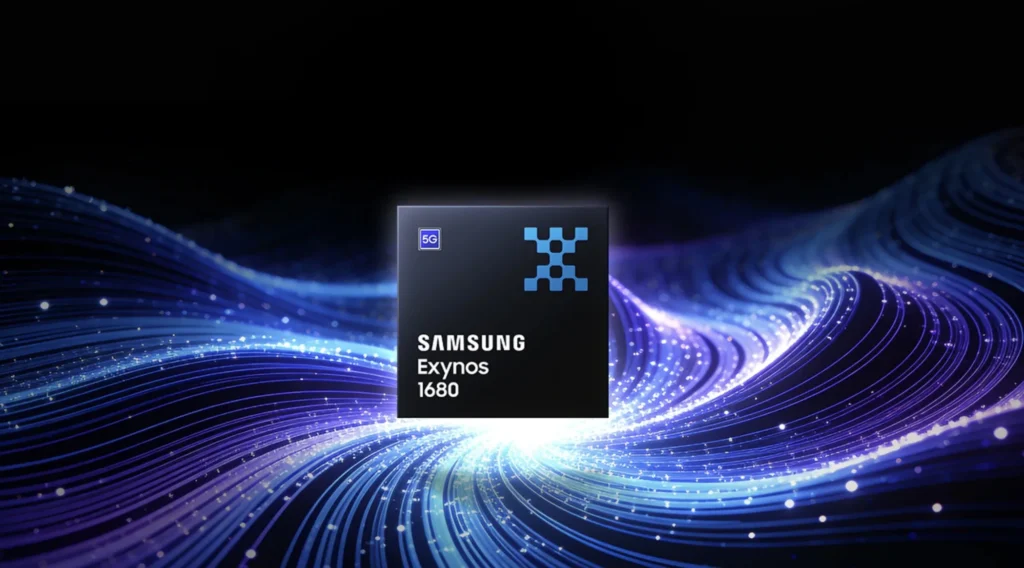
Samsung has unveiled the Exynos 1680, its new mobile platform designed to succeed the Exynos 1580. The focus is clear: rather than competing with ultra-premium chips, the aim is to enhance key features for mid-range smartphones in 2026—perceived smoothness, local AI, graphical stability, and overall responsiveness.
In simpler terms, Samsung is not primarily interested in benchmarks but in delivering a more compelling daily experience for its upcoming Galaxy A devices.
Exynos 1680: A Smarter CPU Architecture Than It Appears
The Exynos 1680 is fabricated using 4 nm EUV technology and features a 1+4+3 octa-core configuration. Samsung highlights a straightforward yet significant structural change: one of the “little” cores from the previous generation is replaced by a “middle” core, shifting the chip from a conservative approach to a more aggressive balance between power and efficiency.
The company explicitly states that this evolution aims to enhance multitasking and maintain performance continuity under load.
The official specifications reveal a main Cortex-A720 clocked at 2.9 GHz, accompanied by four Cortex-A720 cores at 2.6 GHz and three Cortex-A520 cores at 1.95 GHz. On paper, this isn’t revolutionary. However, in this product category, such adjustments often matter more than a drastic increase in frequency: they can lead to smoother transitions, more consistent app performance, and less jarring simultaneous task execution.
The Xclipse 550 GPU Confirms a Move to Higher Graphics Performance

On the graphics front, Samsung continues its technological partnership with AMD. The Exynos 1680 includes an Xclipse 550 based on the RDNA 3 architecture, boasting an expected performance increase of about 15% to 16%, based on sources citing Samsung’s information. The chip also supports full HD+ displays up to 144 Hz, making it an increasingly credible option in the upper mid-range sector.
This gain should not be overstated. We’re not talking about a dramatic leap that would transform a Galaxy A into a high-performance gaming machine. However, it may be enough to stabilize popular games, smooth out animations, and provide a more consistent experience, especially if Samsung carefully manages thermal conditions and software tuning in the devices featuring this chip.
This is a reasonable interpretation based on the official figures.
On-Device AI Becomes the Central Focus
Samsung prominently positions the Exynos 1680 as a chip designed for a smoother on-device AI experience. Its NPU reaches 19.6 TOPS, representing an approximately 33% increase compared to the Exynos 1580, according to specialized sources based on Samsung’s documentation. The brand also emphasizes a dedicated vector engine intended to enhance the responsiveness of locally executed AI functions on the smartphone.

In practical terms, this primarily strengthens the features already visible in One UI: photo processing, scene optimization, intelligent selection, object removal, transcription, and other local assistance functions. The key takeaway here is that Samsung now treats AI as a core requirement, rather than just a perk for Galaxy S devices.
Memory, Storage, and Photography: More Ambitious Choices for the Category
The Exynos 1680 supports LPDDR5X RAM and UFS 4.1 storage, two standards previously associated mainly with more expensive devices. Samsung also mentions compatibility with photo sensors up to 200 megapixels and 4K recording at 60 fps, along with HDR 10-bit support in various technical descriptions from the launch.
Regarding connectivity, the platform includes 5G, Wi-Fi 6E, Bluetooth 6.1, and major GNSS systems. Again, Samsung seems more focused on upgrading its mid-range devices with essential bricks that enhance the overall experience, rather than surprising users.
The Galaxy A57 Will Be Its Real Public Test
Samsung has just officially introduced its Galaxy A57 in the new A 2026 lineup, and the specifications confirm that it will include the new processor!
This is where the real stakes lie. A chip might look good on paper but can fall short in real-world performance if thermal optimization, computational photography, or memory management do not keep pace. Conversely, the Exynos 1680 could become a pleasant surprise if it enables the Galaxy A57 to be simply more stable, responsive, and consistent than its predecessor.
Samsung Seeks Credibility Over Just Showcasing Features
The Exynos 1680 reflects a contemporary understanding of mid-range smartphones. The competition is not solely about raw power anymore, but about overall quality: app startup times, durability, useful AI, decent photography, modern connectivity, and fast storage. Samsung seems to have grasped this. With this chip, the brand does not promise a breakthrough; instead, it aims to address the historical pain points of its mid-range devices.
In essence, the Exynos 1680 might not be an “exciting” chipset in a spectacular sense. However, it could be even more significant: the chip that finally helps Samsung make its mid-range offerings more mature, consistent, and credible in everyday use.