

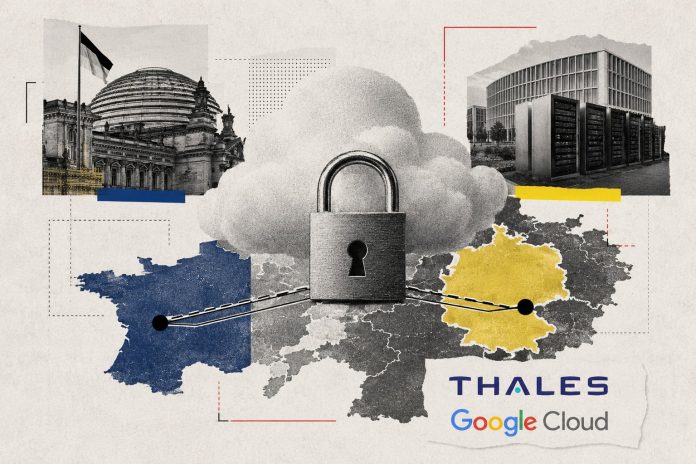
The partnership between Thales and Google is replicating the S3NS model in Germany. A new entity that is 100% German, legally independent, and locally operated complements the S3NS/PREMI3NS infrastructure established in France. This unprecedented model of two sovereign regions that adhere to C5/C3A criteria offers German and European organizations unique assurances of isolation from the Cloud Act.
Germany, as the leading economy in Europe, has been eagerly awaiting a cloud solution that combines the technological prowess of hyperscalers with the sovereignty guarantees mandated by law. The recently announced partnership between Thales and Google Cloud addresses this critical need. Rather than transferring Google Cloud to a clearly competitive German entity, Thales is offering an asymmetric model: Google’s technology (infrastructure, services, AI) will be integrated with complete operational and legal control managed in Germany. “This partnership directly meets the expectations of German companies and public organizations that wish to leverage Google Cloud’s technological power while maintaining full German oversight,” states Christoph Ruffner, managing director of Thales in Germany.
The German entity will be staffed and managed entirely by German personnel. It will operate on a segregated infrastructure located within Germany, governed by European law, and will be entirely independent of Google Cloud. No third parties, including non-European entities, will have access to the data stored or processed within this framework. This assurance directly tackles the growing reluctance among sensitive sectors in Germany to comply with the Cloud Act.
Ensuring Cross-Border Business Continuity
Thales has been operating S3NS, its sovereign cloud subsidiary in France, since late 2025, which has achieved SecNumCloud 3.2 certification. This new German region expands the model to encompass two complementary regions—France and Germany—equipped with identical technological and operational infrastructure, ensuring seamless cross-border business continuity without compromising sovereignty.
Hélène Bringer, president of S3NS, describes this expansion as a “European first”: “By simultaneously targeting SecNumCloud certification and the C5–C3A framework across both regions, we are establishing a cloud model that aims for diverse local certifications for the first time.” This dual certification presents a significant operational advantage for multinational clients: a unified cloud architecture that complies with both French (SecNumCloud) and German (C3A) requirements. Critical organizations operating in both countries will now benefit from cross-border backup capabilities and service continuity without the need to multiply contracts and certifications.
The availability is expected for immediate Early Access, with a wider rollout slated for the end of 2026, adhering to C5 (trust, protection, quality) and C3A (critical infrastructure certification in Germany) criteria. This timeline sets a high bar: Google Cloud is committing to a rarely seen fragmented and localized infrastructure level.
Asymmetric Model: US Technology, German Governance
This partnership represents a new strategy for Europe: embracing American technological innovation, provided it is channeled through a trustworthy European intermediary. Marianne Janik, Vice President EMEA North at Google Cloud, emphasizes this synergy: “Our partnership with Thales in Germany marks a significant milestone in our commitment to digital sovereignty. By marrying the power and scale of Google Cloud with Thales’s deep expertise in cybersecurity and local operational control, we enable German organizations, even in the most sensitive sectors, to innovate with confidence.”
This arrangement highlights the limits of the collaboration. Google supplies the technology (hyperscale infrastructure, cloud services, Gemini AI models, development tools), while Thales provides governance, isolation, and legal control. However, Google retains ownership of the code, models, and updates. The operational independence is genuine; yet, technological dependence lingers. Should Google alter its licensing terms or innovation strategies, Thales would be left with only German law as leverage—a less-than-ideal assurance in the evolving tech geopolitical landscape.
Nevertheless, this model publicly acknowledges a critical reality: European critical sectors are increasingly unwilling to host their data on cloud infrastructures where operational and legal control slips outside of Europe. Thales Deutschland employs 2,300 individuals across nine sites in the country, having deep expertise in defense systems, security, aerospace, and digital identity. This historical and industrial foundation positions Thales as a natural partner to operate sensitive cloud infrastructure in Germany.
When Sovereignty Becomes Essential
This partnership fits into a broader movement to establish a sovereign European cloud space. At the same time, the recent announcement of the Aion consortium (including Anthropic, OVH, Mistral AI, and other French/European players) aims to build a fully European and independent AI infrastructure. These two initiatives—one based on US-Europe collaboration (Thales + Google) and the other on complete European independence (Aion)—converge on the same conclusion: critical AI can only function on localized and politically controlled infrastructures.
European public decision-makers, whether in defense ministries, health agencies, or tax administrations, are now resolutely opposed to outsourcing sensitive workloads to clouds without regional or national anchors. Organizations in Germany and France dealing with sovereign data (defense, intelligence, health, identity) are no longer willing to negotiate on this point. Thales and Google agree to fragment the infrastructure. OVH, Mistral, and Anthropic are constructing a wholly French and European chain. Both paths lead to the same outcome: regionalized and sovereign cloud architectures.
The extent to which this trend is adopted by the end of 2026 will determine if the Thales-Google model can extend beyond Germany or if the sovereignty demands will push other European countries toward 100% independent solutions.



