

Enreach Launches UP 3.0: A Next-Gen Communication Platform Designed for SMEs
Enreach for Service Providers has unveiled Enreach UP 3.0, the latest iteration of its communication platform tailored for service providers. Exclusively available in a white-label format to operators and integrators, this version integrates an AI assistant for call handling, offers an open marketplace for partners, and allows operators to choose their preferred hosting solutions.
Described as the foundation of an AI-driven communication platform, Enreach UP 3.0 is built around three key pillars: enhanced customer interaction, improved employee performance, and a simplified mobile experience. The platform primarily targets very small and medium-sized enterprises (SMEs), where versatile employees often juggle customer relations alongside core business functions. Notably, Enreach UP 3.0 will continue to be distributed indirectly via partner operators and integrators, who will oversee the final deployment for their clients.
This announcement signifies a broader shift among professional communication providers, moving away from per-minute billing towards valuing the insights generated from conversations that are captured and entered into customer relationship management (CRM) systems. Reflecting trends in the European digital market, this approach promotes a flow-based architecture rather than a binary choice between fully sovereign stacks and foreign ones, allowing operators to determine their AI model and hosting solutions.
A Voice Assistant Integrated within the Platform
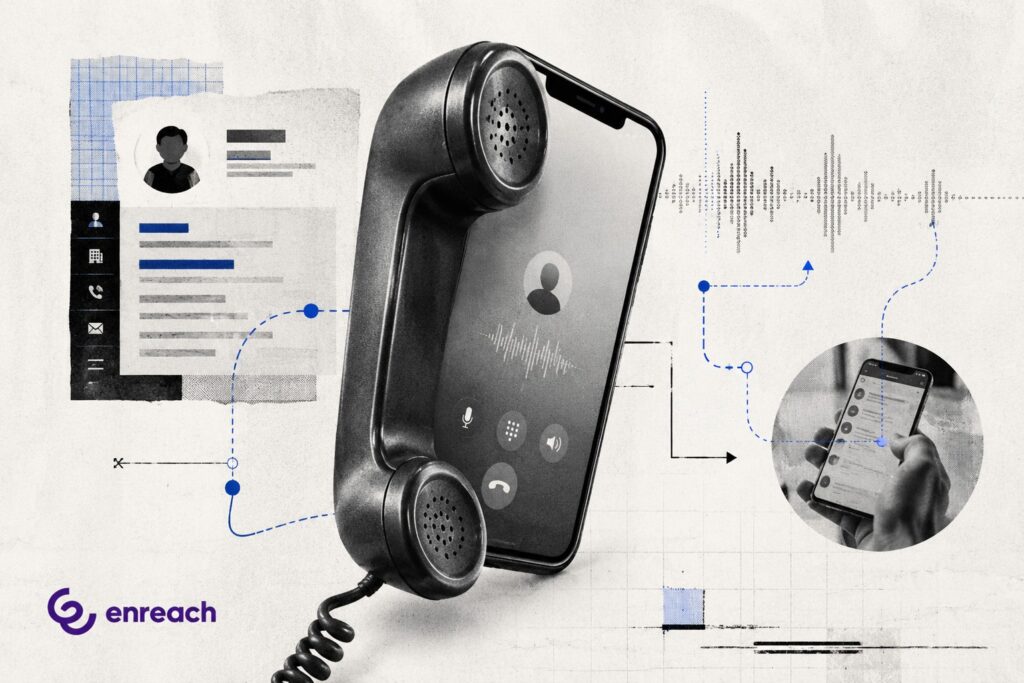
The first pillar addresses accessibility challenges for smaller organizations. When clients reach out during off-hours or through unconventional channels like WhatsApp, SMS, or chat, the platform sidesteps traditional voicemail. Instead, an AI assistant answers the call, assesses the inquiry, resolves simple issues autonomously, schedules appointments, and escalates more complex situations to human agents. Before engaging, it consults the CRM using the caller’s phone number and, after the interaction, automatically logs a summary, action points, and sentiment analysis into the CRM.
This framework is referred to as the AI Terminal. The assistant functions as an additional phone line connected to the user and manages the entire interaction cycle within the platform’s ecosystem, distinguishing it from a fully autonomous agent that merely takes over the call. “The key aspect of our architecture is that the AI is integrated as a participant in the communication flows, rather than as an independent agent. The platform can engage the AI at different stages of the conversation, in various forms—voice, chat, analysis, or automation—tailored to the business process needs,” explains Outman Haytoumi, head of product strategy at Enreach for Service Providers.
This distinction is significant for IT departments assessing conversational AI solutions, as a supervised assistant does not carry the same accountability as a system that assigns tasks without intermediate validation.
Enhancing Employee Performance
The second pillar focuses on boosting employee performance. Call routing becomes dynamic, with the platform utilizing context provided by the CRM (such as region, client status, and relevant product) to direct calls to the appropriate contact rather than a static queue. Automation is driven by event triggers (webhooks) and includes a dedicated node for n8n, a workflow automation tool that connects Enreach UP 3.0 with other business systems without heavy development overhead.
Mobile as the Primary Real-Time Assistance Tool
The third pillar acknowledges that mobile devices have become the primary work terminal in many sectors. During conversations, the mobile platform assists employees in real-time, providing context reminders and access to documentation. “We are transitioning to a new reality. Yesterday, we focused on conversation minutes; tomorrow, we will discuss conversation intelligence, and our value will hinge on the level of intelligence we offer our clients,” asserts Jean-François Catz, head of mobility and innovation at Enreach for Service Providers. Mobile users can delegate calls to their assistant with a simple gesture, monitor conversations in real-time, and reclaim control when they choose.
Flexible Hosting and An Open Marketplace for Partners
The platform remains agnostic to AI models. Operators can select their preferred model through their API key and determine the hosting environment—whether in the cloud, at their data center, or directly on the terminal. Enreach positions this option as a means to ensure data sovereignty, although this claim warrants further nuances. True sovereignty in deployment depends on the entire chain: the operator, chosen hosting solution, and the AI model in use, rather than just the hosting option itself. This architecture enables the necessary granularity for a hybrid load strategy, allowing sensitive exchanges to bypass foreign jurisdictions while standard transactions can occur on more conventional platforms.
Enreach has also introduced a marketplace called PICapp (Point In Communication Apps), where apps from Enreach and third-party developers can be installed without requiring upgrades, featuring three applications available at launch, including VoiceData. Additionally, the platform supports fixed-mobile convergence and is compatible with mobile devices, softphones, IP phones, DECT, and Microsoft Teams.
Enreach UP 3.0 is slated for release at the end of July 2026, with exclusive distribution by partner operators and integrators under a white-label arrangement. The company envisions this platform as a foundation for future supervisory agents in subsequent releases, extending the range of autonomy currently offered by the supervised assistant. For IT leaders of SMEs assessing this offering through their operators, a pressing question arises: what model and hosting solution will the partner actually implement for communications that need to remain outside foreign jurisdiction?



