

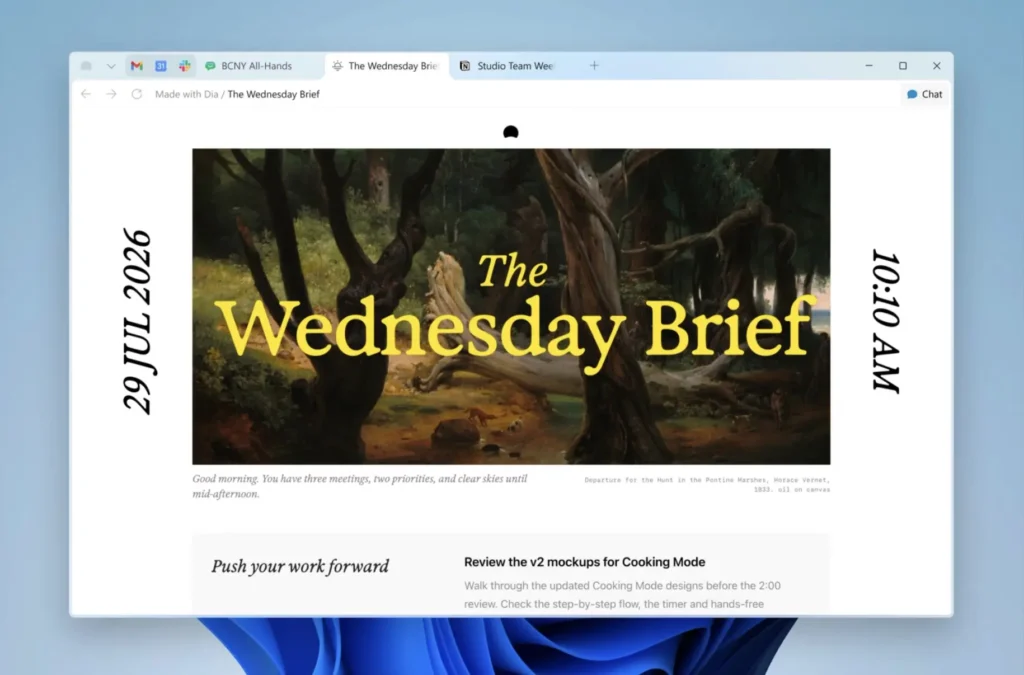
Dia arrives on Windows: The AI browser from The Browser Company prepares for launch
After several months of exclusivity on macOS, Dia is ready to take an important step in its development. The Browser Company has confirmed that its AI-focused browser Dia will be available in beta version on Windows this fall. This announcement is highly anticipated by PC users, as Dia gradually establishes itself as one of the most ambitious projects in the new generation of AI browsers.
While no specific date has been provided yet, registration for the waiting list is now open, marking the beginning of Dia’s expansion beyond the Apple ecosystem.
The Successor to Arc Continues Its Rollout
Initially launched on macOS, Dia emerged from the remains of Arc, a browser that shook up browsing habits with its innovative interface and a more modern web approach. This time, The Browser Company is not just looking to rethink tab organization or user experience. The company places artificial intelligence at the very core of the browser.
Built on Chromium, the engine used by Google Chrome and Microsoft Edge, Dia maintains compatibility with web standards while incorporating AI functions directly into the interface.
This approach allows the browser to transform into a true assistant, capable of accompanying users throughout their browsing experience.
Dia for Windows is coming (this fall!) pic.twitter.com/S9sSqycQKO
— Dia (@diabrowser) July 29, 2026
An AI That Understands the Context of Your Browsing
Unlike traditional conversational assistants, Dia does not function as a mere chat window. The browser analyzes the context of the open pages to offer much more relevant assistance.
It can summarize the content of multiple tabs, answer questions based on the currently viewed pages, automatically compare products from different sites, and provide additional information on an article without requiring new searches.
The goal is to minimize constant back-and-forth between tabs and search engines while reducing interruptions in the workflow.
Why Dia Is So Appealing to Users
Since its launch on macOS, Dia has received particularly positive feedback. Users primarily praise two aspects: the minimalist interface that retains the simplicity of a traditional browser and the AI that integrates naturally into the navigation experience.
This seamless integration is one of Dia’s main advantages compared to competitors that just add a chatbot to their browser.
Here, AI becomes a native part of the user experience rather than an added feature.
What We Know About the Windows Version
Currently, The Browser Company remains relatively tight-lipped about the details of this version. The company has only confirmed a beta launch this fall, with registration available through an official waiting list and invitations being sent out progressively.
The exact features available at launch have yet to be specified.
It also remains to be seen if all the AI capabilities present on macOS will be immediately accessible to Windows users or if some will roll out gradually through updates.
A Well-Defined Economic Model
Currently, Dia operates on a freemium model. Users can access limited AI features for free, while a Pro plan, priced at $20 per month, removes these restrictions.
The Browser Company has not yet confirmed whether this same offer will apply with the opening of the Windows beta.
This approach reflects a trend now widely adopted by AI service providers, who are looking to balance accessibility and control over costs related to AI models.
Privacy Concerns Remain at the Forefront
Like most AI-enhanced browsers, Dia raises several questions regarding data protection. To provide contextualized responses, the browser must analyze the content of the visited pages and understand user interactions with the web.
While this capability is one of its main strengths, it also necessitates exemplary transparency regarding how this information is processed, stored, and potentially used.
User trust could thus become as critical as the quality of the functionalities offered.
The Battle of AI Browsers Heats Up
The arrival of Dia on Windows comes at a particularly dynamic time. Following an initial generation focused on conversational search engines, next-generation browsers are now evolving into assistants capable of interpreting context, automating tasks, and supporting users in their daily work.
Against competitors like Microsoft, Google, Perplexity, and OpenAI, The Browser Company is betting on a more seamless integration of artificial intelligence directly into the browsing experience.
If the Windows version replicates the qualities that made the macOS edition successful, Dia could quickly become one of the main competitors to traditional browsers on PC. More than just software for accessing the web, it represents a new vision where the browser becomes a true intelligent assistant, able to understand what the user is viewing and act accordingly. An evolution that could permanently redefine the way we interact with the internet.



