The rise of AI has brought to light a long-overlooked cost: water. Cooling servers, producing electricity, manufacturing chips, and site locations all play a critical role. Now, one question prevails: Can we do better without stifling innovation?
Behind Every AI Response, Servers Heat Up and Water Often Evaporates Before Your Click
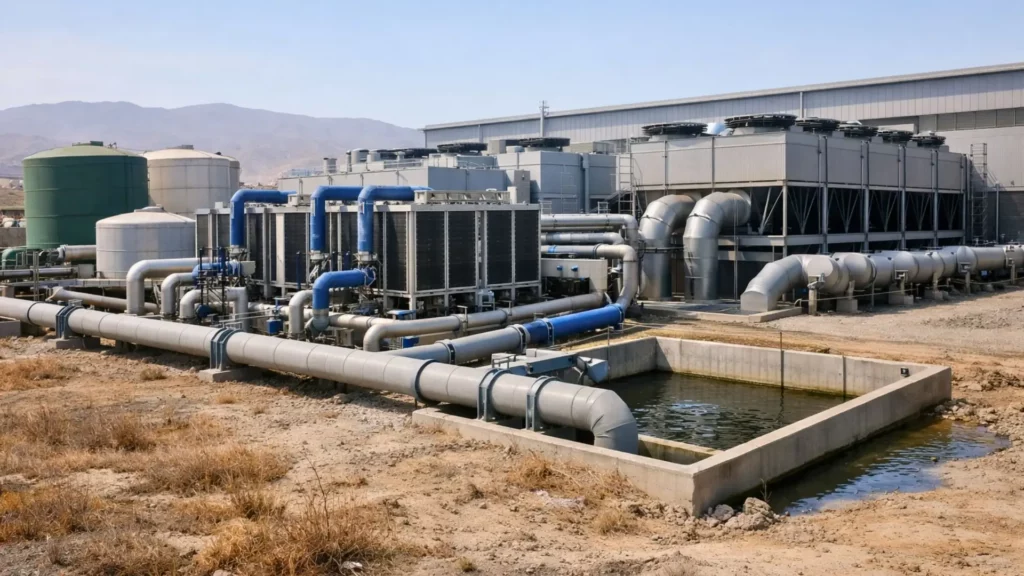
When you launch a request, clusters of servers compute, heat up, and then require cooling. The hidden cost emerges here. Water circulates through cooling towers, evaporates, or is indirectly used to generate the electricity that powers these machines.
Moreover, the issue extends beyond mere cooling. Three primary factors come into play: the water used on-site, that consumed by certain power plants, and the water required for chip production. By 2027, global AI water needs could reach up to 6.6 billion cubic meters.
The Real Shock Happens Near Data Centers, Where Heat, Drought, and Energy Peaks Combine
The topic becomes critical when a data center is established in an already stressed area. Local water stress and heat spikes compound the situation. Consequently, a single building competes with agriculture, domestic usage, and sometimes even fire safety.
Then, the debate gets more complex. Evaporative cooling systems are highly effective but consume more water. The water-energy trade-off thus shapes the entire sector. Conversely, drier solutions reduce water usage but may consume more electricity or incur higher costs.
Liquid Cooling, Outside Air, Recycled Water: Solutions Are Advancing, But Compromises Remain Tough
To relieve the pressure, operators are first tackling heat as close to the chips as possible. Liquid cooling is necessary, with fluid circulating in closed loops. As a result, control improves, and evaporation losses can significantly decrease.
Other sites rely on outside air when the climate permits. However, free cooling doesn’t work everywhere. Furthermore, several groups are experimenting with recycled or non-potable water, as cooling does not require drinking-quality water.
Finally, some new centers aim for nearly zero evaporation. Microsoft is already implementing a water-free cooling design, reusing water in a closed-loop system that could conserve 125 million liters annually on-site.
The Challenge Goes Beyond Technology: Without Public Measurement, Water-Saving AI Will Remain a Difficult Promise to Keep
The major barrier, however, lies in measurement. Site transparency and comparable data are still lacking. As a result, it’s impossible to compare two infrastructures or isolate the exact contribution of AI and make informed decisions.
Europe has already initiated reporting requirements for large data centers, focusing on energy and water metrics. Environmental reporting is thus becoming an industrial tool. Simultaneously, American investors are demanding more precise figures, site by site, to evaluate local risks.
This presents a paradox. The same AI can also track leaks, manage irrigation, or optimize wastewater. A dual useful face indeed. However, its ecological promise will only hold true if the industry curbs waste, chooses site locations wisely, and finally publishes its metrics.