Caution! The ClickFix Malware Hides in a Fake Full-Screen Update Page
A new variant of the ClickFix malware is currently circulating, targeting what Windows users trust most: the update screen.
Researchers from Huntress have discovered a fake full-screen Windows update that is so convincing that many victims truly believe their system is stuck at 95%. In reality, the screen is a trap designed to trick the user into executing a command thus installing the malware without their knowledge.
The most alarming part? The attack relies solely on social engineering and a simple copy-paste.
How Does the ClickFix Infection Start?
The scenario is almost always the same:
- visiting a suspicious website
- primarily adult streaming pages
- clicking on a pop-up, a fake “age test,” or a “continue” button
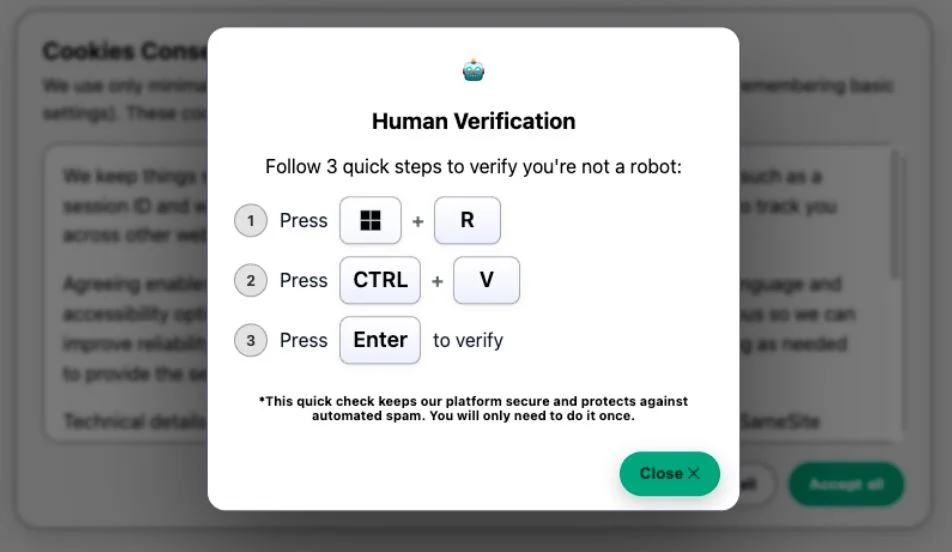
In an instant, the browser goes full screen, displaying a counterfeit Windows update page complete with a progress bar, blue background, and icons… it has it all. Then, a message prompts the user to press Win + R and paste a command to “complete the installation.”
Of course, this command is the entry point for the malware.
What the Command Actually Does
Once pasted into the “Run” box, the command silently executes:
mshta, a legitimate Windows tool that is often exploited by malware.- Downloads a malicious script from a remote server.
- Disguises itself under layers of useless commands to deceive antivirus software.
- Retrieves code hidden within the pixels of a PNG image, a technique meant to conceal the payload.
- Injects itself into .NET processes to blend into the system.
Next comes the second stage: the installation of notorious credential stealers like Rhadamanthys and LummaC2.
These tools steal passwords, browser cookies, banking credentials, and crypto wallet data, all sent directly to the attackers’ servers.
Deliberately Messy Code to Slow Down Analysts
Researchers also found meaningless and useless text strings in the code: ghost commands, off-topic phrases, and even a reference to an old UN speech.
The aim? To waste analysts’ time and complicate the reverse engineering of the malware.
An Ongoing Campaign
This operation has been active since early October, and several clone domains continue to host the fake update page. It’s a 100% manipulation attack: no downloads, no antivirus pop-ups, and no exploited vulnerabilities.
Just a site that urges you to launch its command on its behalf.
Key Takeaway: A Real Windows Update Never Asks You to Use Win + R
Microsoft never requires users to execute a manual command to complete an update.
If any website—regardless of what it is—asks you to open Run, paste a command, or launch PowerShell to “repair an update,” close the tab immediately.
This is currently one of the most dangerous attacks precisely because it appears completely legitimate.