

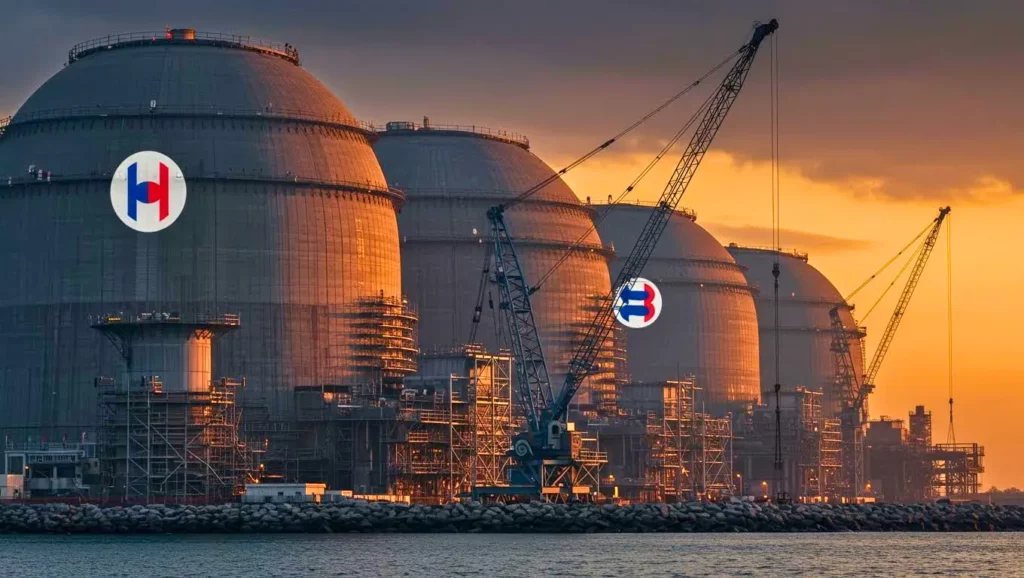
Nuclear power has become one of the major battlegrounds of the 21st century. India is where one of the fiercest contests is taking place. Leveraging its historical ties, Russia defends its leadership position with its proven VVER reactors, while France, through Framatome, aims for an ambitious breakthrough in a market projected to exceed €172 billion by 2047.
Russia Advances Its Game: Technical Cooperation, Ambitious Projects, and a Strong Comeback
Russia is actively engaging with India to expand its nuclear projects. In addition to the VVER reactors already constructed or under construction at Kudankulam, Rosatom is now offering two new VVER-1200 reactors. This expansion aims to capitalize on a well-established logistics system, solid partnerships, and, most importantly, a long-term vision.
Meanwhile, unit 3 at the site is entering a critical testing phase, exemplifying the technical trust between the two countries. Rosatom aims to increase its export capabilities and relies on a reliable and reproducible supply chain.
India Seeks More Than Just Reactors: Emphasis on SMRs, Floating Plants, and Technological Sovereignty
Recent discussions in Mumbai have opened new avenues for small modular reactors (SMRs) and floating nuclear power plants. This innovative format, already tested by Russia with the Akademik Lomonosov, aims to provide quick energy solutions for isolated industrial or port areas.
In this context, New Delhi insists on localizing expertise. The era of simple imports is over. India demands skill transfers, co-construction projects, and a genuine enhancement of its nuclear industry, which is essential for achieving energy autonomy.
France Discreetly Strikes Back: Strategic Establishment of Framatome and Focus on SMRs
France is not sitting idly by; it has recently opened Framatome offices in Navi Mumbai. This facility goes beyond being a commercial showcase; it symbolizes a sustainable local presence focused on training, recruitment, and collaboration.
Framatome is also targeting the SMR market while maintaining a position on the six EPRs at Jaitapur. The company is offering maintenance services to extend the lifespan of existing reactors, a sector experiencing significant growth.
An Explosive Electrical Growth Making Nuclear Power a Strategic Necessity
With over 1.4 billion inhabitants, India is becoming increasingly energy-intensive. Millions of new households are joining the middle class. The International Energy Agency forecasts that consumption will triple by 2050.
Nuclear energy currently accounts for only 3% of India’s energy mix. However, New Delhi aims to increase this to 9% by 2047, which necessitates tripling the installed capacity to reach 100 GW. This goal will involve both national players, like NTPC, and foreign suppliers.
The strategy relies on multiple partnerships, projects involving both large reactors and SMRs, and a market valuation exceeding $200 billion. Thus, the economic and technological battle has only just begun.
Indian Nuclear Power: A Tool for Geopolitical Empowerment and Regional Showcase
For India, nuclear energy is not just about power generation; it is a lever of influence. By diversifying its partnerships – with Russia, France, and the United States – it enhances its autonomy over the fuel cycle, develops exportable skills, and asserts its role in the Indo-Pacific region.
Each project is evaluated based on its potential to build technological independence. India no longer signs contracts for turnkey installations but instead for strategic alliances lasting several decades. This explains the caution and demands expressed toward each proposal.
Summary of the Indian Nuclear Sector (2025)
| Indicator | Value |
|---|---|
| Reactors in operation | 24 |
| Installed nuclear capacity | 7,943 MW |
| Reactors under construction | 6 (4,768 MW) |
| Proposed reactors (pre-project) | 10 (approximately 7,000 MW) |
| Goal for 2031 | 22 GW |
| Goal for 2047 | 100 GW |
| Share of nuclear in electricity production | Approximately 3.1% |
| Share of self-designed reactors (PHWR) | Approximately 65% |
| Share of imported reactors (Russian, French, etc.) | Approximately 35% |
| Types of SMRs under development (BARC) | BSMR-200 (200 MWe), SMR-55 (55 MWe), HTGR 5 MWt (H2 production) |



