

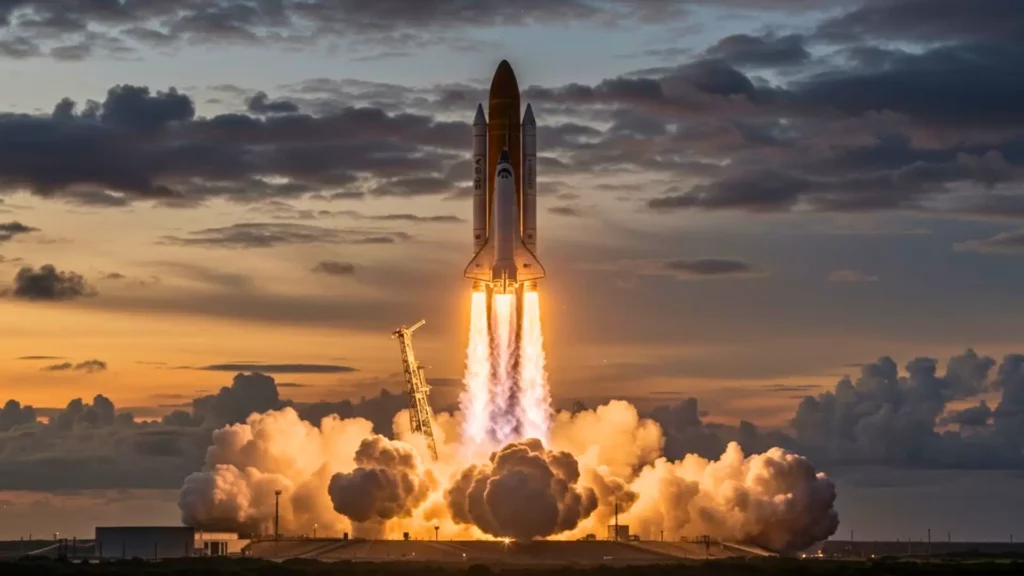
The most powerful version of the European rocket Ariane 6 is soon set to launch Amazon’s satellites. This strategic yet unexpected alliance is subtly and surely reshaping the global balance of space exploration. A transatlantic partnership that speaks volumes about Europe’s renewed ambitions in space.
Ariane 64: A credible European response to American dominance in space
Let’s be honest: Europe hasn’t exactly shone in the space race over the past few years. While SpaceX was breaking records, Europeans seemed stuck on the ground. However, Ariane 6 is finally taking the stage with solid arguments. After a few successful flights in “light” configuration (two boosters), the upper stage comes into play with the Ariane 64 version.
This new model, equipped with four solid boosters, can carry up to 10 tons of payload. This is double what its smaller sibling can handle. More importantly, it marks a symbolic threshold that enables competition with the heavy launchers on the global market. This anticipated upgrade is long overdue.
A historic contract: Why Amazon chooses Europe to launch its Kuiper constellation
A surprising twist: the first client to trust Ariane 64 is none other than… Amazon. Yes, the e-commerce giant has become a space player driven by Jeff Bezos‘ ambitions. The goal? Deploy 32 satellites for the Kuiper project, a constellation designed to provide internet from low orbit, directly competing with Starlink.
Imagine this: Amazon satellites launched from French Guiana by a European rocket. Ten years ago, no one would have wagered on such a scenario. Yet that’s set to happen in early 2026. For ArianeGroup, this represents a fantastic opportunity to validate its launcher. Meanwhile, Amazon views it as a welcome strategy for diversification, especially since its own launches have been delayed.
Objective cadence: How Europe plans to increase Ariane 6 flights and regain significance
The launch of Ariane 64 won’t be a one-off event. In 2026, eight flights of Ariane 6 are already scheduled. Furthermore, the cadence could reach nine to ten launches per year in subsequent years. Thus, Europe is showing a true ramp-up in activity, with a clear objective: to reclaim a prominent position in the global space launch market.
To achieve this, Europe is relying on a modular rocket capable of adapting to various mission types: commercial satellites, scientific payloads, government projects. Additionally, if logistics align, French Guiana could once again emerge as a premier space center. However, a challenge remains: to meet deadlines, avoid overpromising, and demonstrate reliability against giants like SpaceX or Blue Origin.
A win-win partnership: What the Ariane–Amazon deal reveals about emerging space dynamics
Beneath this contract lies an industrial and strategic comeback. For Europe, it’s proof that it can still matter in the space landscape. For Amazon, it’s a way to reduce reliance on Blue Origin, Jeff Bezos’ other space venture, which has been too slow in delivering. Consequently, this partnership rebalances the forces. Moreover, it shows that Europe can offer credible and competitive solutions, even against sector heavyweights.
We are witnessing a well-timed convergence of interests, almost political. Amazon secures its future deployments while diversifying its partners. Europe, on its part, gains credibility and mission volume. Thus, this collaboration demonstrates that space is no longer just a matter of prestige. It has become a concrete and measurable industrial strategy.
This rapprochement also reveals a wider trend: space has become a genuine global marketplace. Alliances no longer strictly follow borders but rather capabilities. By betting on Ariane 64, Amazon acknowledges European technological maturity and sends a strong signal to the global industry. Ultimately, the sky serves as a stage for high-altitude economic influence games.



