

Apple revises its chip roadmap: high-end Macs will go straight to M7
Apple is preparing for an unexpected shift in the development of its in-house processors. While the arrival of the M6 chip seemed like the next logical step in the Apple Silicon lineup, a new report from Bloomberg reveals a different strategy: the Pro, Max, and Ultra variants will be dropped for this generation.
This decision reflects a clear priority: to accelerate the development of Macs optimized for artificial intelligence.
Apple reserves the M6 for entry-level models
According to Bloomberg journalist Mark Gurman, who has provided particularly reliable information on Apple products in recent years, the Cupertino company is making significant changes to its M-series chip roadmap.
The M6 chip is indeed set to launch by the end of the year, but only in its standard version. The M6 Pro, M6 Max, and M6 Ultra variants will never hit the market.
Instead, Apple is moving directly to the professional range with M7 Pro, M7 Max, and M7 Ultra expected in 2027. This unusual decision breaks away from the rhythm established since the introduction of Apple Silicon.
The first touchscreen MacBook Pro will not feature the M6
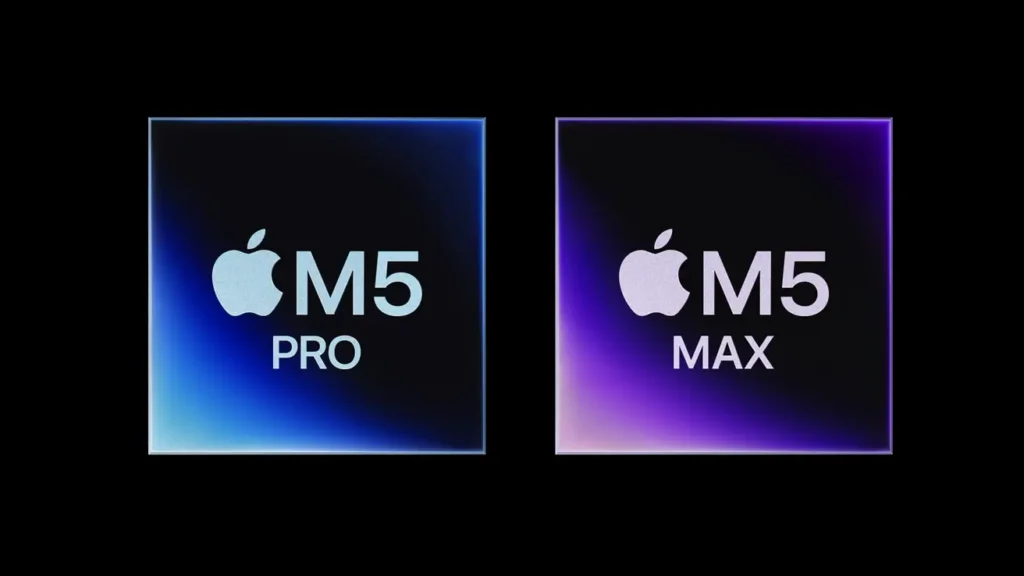
This new strategy will also impact the highly anticipated touchscreen MacBook Pro. Previously, rumors suggested it would launch with M6 processors. Now, Bloomberg reports that this new generation will instead use the M5 Pro and M5 Max chips.
In other words, the main upgrade will not come from processing power, but rather from design and user experience, including an OLED screen, touch support, a slimmer design, and a major chassis evolution.
A version powered by the future M7 Pro and M7 Max is already in preparation for a later generation.
Artificial intelligence becomes the new focus of Apple Silicon strategy
Beyond a mere change in nomenclature, this reorganization seems to address a much deeper evolution. Apple is accelerating the development of AI features that run directly on devices, bypassing the cloud.
These local processing tasks require more memory bandwidth, more powerful Neural Engines, improved thermal management, and highly efficient power consumption. Rather than increasing the number of intermediate chip generations, Apple appears to be concentrating its efforts on an M7 architecture that can sustainably support this new wave of Apple Intelligence-related uses.
The Mac Studio remains a priority
The Mac Studio exemplifies this new direction. According to Bloomberg, Apple is still preparing a version equipped with the M5 Ultra before the end of the year. The real advance will come later with the M7 Ultra variant, currently anticipated for 2028.
The company is also working on a redesign of the internal cooling system to better handle intensive workloads, especially those associated with AI, graphics rendering, and locally executed generative models.
A strategy in a more complex context
This new roadmap arrives at a time when the entire industry is facing a significant increase in memory component costs. Apple has already passed these pressures onto several products, recently raising prices on numerous Macs and iPads.
In this context, limiting the number of processor variants could also simplify production and optimize resources, while focusing investments on generations that offer the most significant technological gains.
Apple is preparing a new generation of Macs centered on AI
This reorganization indicates that the race for sheer performance is no longer Apple’s sole priority. The company is now seeking to adapt its entire hardware platform to the needs of embedded artificial intelligence. Memory bandwidth, thermal architecture, Neural Engines, and power efficiency are becoming as important as CPU or GPU performance.
If these reports are confirmed, the direct shift to M7 chips for professional configurations could mark one of the most significant shifts in Apple Silicon strategy since its launch in 2020.



