

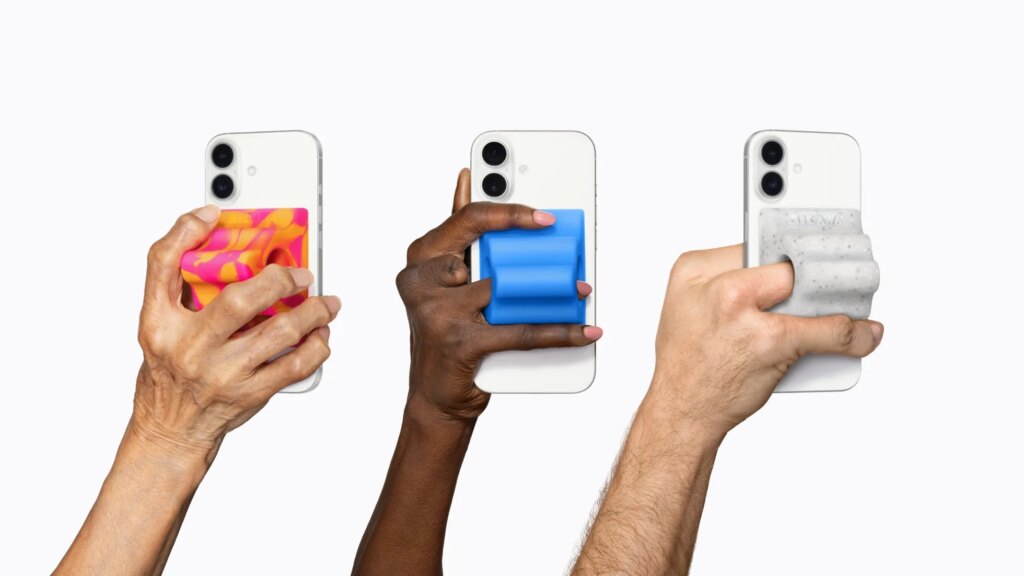
Apple reintroduces the Hikawa Grip & Stand: the MagSafe accessory designed for accessibility is back
Apple highlights a MagSafe accessory that disappeared from shelves almost as quickly as it arrived. The Hikawa Grip & Stand, designed by California-based designer Bailey Hikawa, is officially back on the Apple Store for a price of 55 euros with a clear ambition: to make accessibility a visible pillar of the iPhone ecosystem.
This return is significant. It aligns with a broader strategy around iOS 27, where Apple appears to be aiming to integrate hardware design, artificial intelligence, and inclusive usage.
A MagSafe accessory designed for comfort and ergonomics
The Hikawa Grip & Stand was first introduced last fall as part of Apple’s 40-year accessibility initiatives. Quickly selling out, the accessory established itself as a unique item in the MagSafe landscape: seen more as an ergonomic tool than a gimmick.
Created by industrial designer Bailey Hikawa, based in Los Angeles, this premium silicone grip magnetically attaches to the backs of MagSafe-compatible iPhones. Its goal is straightforward: to make handling more natural and less tiring, particularly for individuals with muscle limitations, dexterity issues, or motor control challenges.

Apple also notes that the product was developed with direct input from individuals with disabilities to adapt its shape to real-life daily usage.

In addition to improving grip, the Hikawa Grip can also serve as a horizontal or vertical stand for propping the iPhone on a table, turning a simple magnetic accessory into a hybrid solution for comfort, accessibility, and mobile productivity.
Apple expands global availability
One of the major criticisms at the time of the initial launch was the extremely limited availability of the product. This time, Apple seems to have anticipated the demand.
The Hikawa Grip & Stand will now be available internationally through a partnership with PopSockets, a well-known player in the mobile accessory market. This global rollout also signals an interesting shift in Apple’s strategy: accessories dedicated to accessibility are no longer treated as niche products but as integral components of the iPhone experience.
The accessory comes in three colors—blue, orange, and stone—priced at $54.95.
iOS 27 aims to use AI for accessibility
The return of the Hikawa Grip coincides with Apple preparing a version of iOS that is heavily focused on accessibility enhanced by artificial intelligence.
Among the new features mentioned:
- VoiceOver and Magnifier will see AI-powered improvements to help visually impaired users better understand on-screen content.
- Voice Control is expected to evolve towards natural language understanding, eliminating the need to memorize specific commands.
- Videos will automatically offer enriched captions.
- Users of compatible wheelchairs with the Apple Vision Pro headset will be able to control certain movements with their gaze.
In this way, Apple seems to be pursuing an idea that has become central in its product narrative: artificial intelligence should not only produce content or automate tasks but also reduce usability barriers.

A broader strategy than just the accessory
The return of the Hikawa Grip reveals a deeper story about Apple’s current trajectory. While the tech industry showcases spectacular generative AI demonstrations, Cupertino continues to focus on a more understated yet tangible approach: enhancing daily experiences through useful and integrated functions.
The Hikawa Grip & Stand exemplifies this philosophy. It is not a product designed to impress technically but to solve a real problem with minimal and universal design.
In a market flooded with MagSafe accessories that are interchangeable or gimmicky, Apple manages to transform a simple grip into a statement of inclusive design.
This evolution highlights how technology is now redefining innovation: shifting away from the “wow” factor and focusing more on adapting to human usage.



