

Apple Intelligence: Is your keyboard about to write for you?
Apple appears to be venturing into a new realm of everyday AI: writing. According to reports by Mark Gurman, the company is testing a new writing assistance tool integrated into the keyboard, capable of providing real-time suggestions for grammar, tone, and clarity corrections.
This initiative is part of a broader overhaul of Siri and the Apple Intelligence ecosystem, with expectations for its launch within the iOS 27 cycle later in 2026.
At first glance, this idea may seem modest compared to the grand promises of generative AI. However, it is likely one of the most strategic applications for Apple. Enhancing what users type, continuously, on the system keyboard effectively integrates AI into one of the most common actions in mobile life.
More Intelligent Keyboard, a Logical Continuation of Apple Intelligence
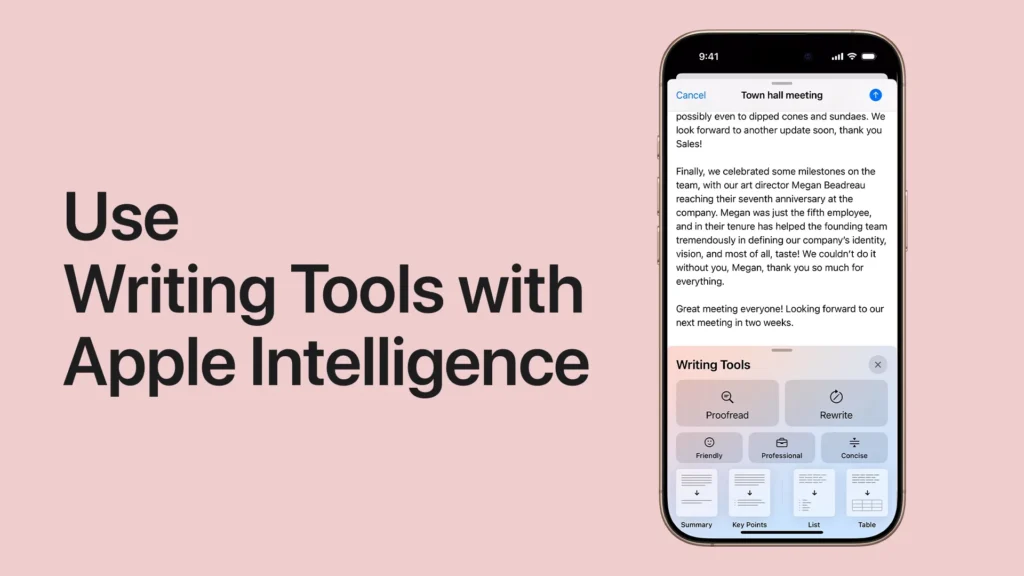
Apple is not starting from scratch on this front. Official iPhone documentation demonstrates that Writing Tools already allow for editing, rephrasing, adjusting tone, and summarizing text across various writing contexts, including in third-party apps and on the web. Apple describes these tools as available “in most places where you write.”
The innovation mentioned by Gurman would likely focus less on creating a completely new feature and more on making this assistance much more immediate and integrated into the typing flow, similar to Grammarly. In other words, Apple seeks to transition its writing AI from a revision tool to a real-time support layer.
Siri Is Also Undergoing Transformation
The keyboard would be just one part of a larger revamp. Apple is also testing a new version of Siri capable of managing multiple requests in a single command, bringing the assistant closer to a more modern and conversational logic.
The report also discusses planned integration within iOS 27, iPadOS 27, and macOS 27, with a potential unveiling at WWDC starting June 8, 2026.
Additional sources suggest that Apple is preparing for an even deeper overhaul, including the possible opening of Siri to third-party chatbots via a system of “Extensions,” as well as a dedicated Siri app in some testing scenarios.
Why Is Apple Focusing on Writing So Much?
This choice has a very clear logic. In the face of competition from Google, OpenAI, and Grammarly, Apple can no longer settle for spectacular but peripheral AI. The decisive battleground is in everyday usage: writing an email, correcting a message, rephrasing a note, clarifying a document. By integrating this layer directly into the keyboard, Apple would reduce dependency on third-party services while enhancing the perceived value of its ecosystem.
This also serves as a response to a recurring critique: its perceived lag in AI. While some competitors pile on visible assistants, Apple seems to bet on a more integrated, less showy AI that is more deeply ingrained in daily gestures.
What This Could Mean for Users
If Apple executes this idea effectively, the main benefit will likely be increased fluidity. Rather than copying and pasting text into a dedicated app or relying on an external extension, users could access contextual assistance directly within the system keyboard, spanning messages, emails, notes, or documents.
This could make the iPhone much more credible as a lightweight productivity tool, particularly for students, professionals, or anyone doing a lot of writing on mobile devices.
However, it is essential to remain cautious: nothing has been officially confirmed by Apple. At this point, we are discussing features in testing, reported by sources close to the situation, with a probable showcase at WWDC 2026, but with no firm guarantees regarding the exact timeline or the final product form.



