

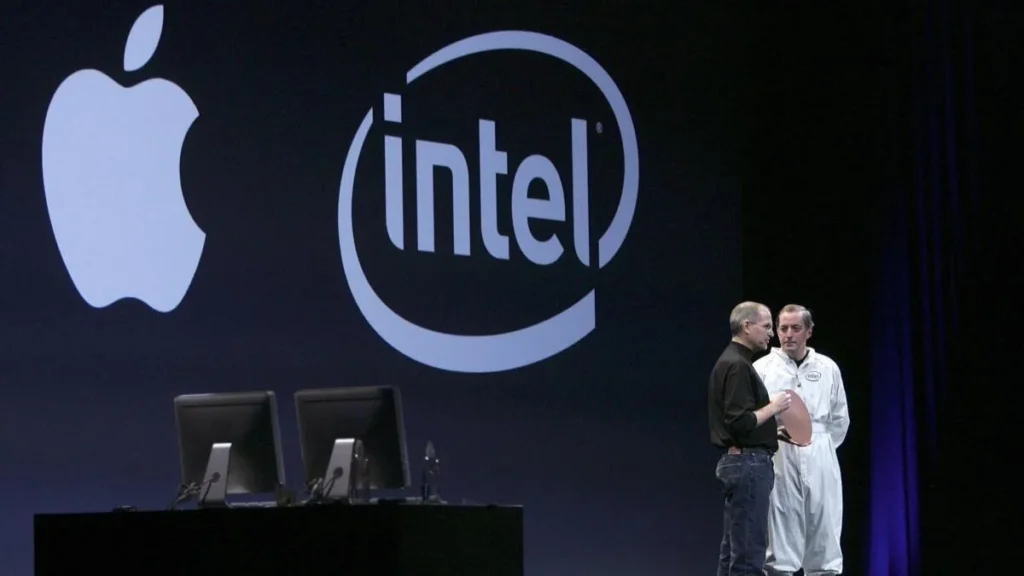
Apple could entrust Intel with M-series chip production as early as 2027
A significant turn of events: after moving away from Intel processors in 2020 to adopt its own Apple Silicon chips manufactured by TSMC, Apple is now considering entrusting part of the production of its future M-series chips to Intel starting in 2027.
This information comes from analyst Ming-Chi Kuo, who reports that Intel has made substantial advancements in negotiations thanks to rapid progress on its new 18A process technology, touted as the first sub-2nm node available in North America.
No, Apple Is Not Returning to Intel Processors, But Intel Would Manufacture Apple Processors
This isn’t a “step back” to when Apple used Intel x86 CPUs. The distinction is crucial: Apple will continue designing its M-series chips (ARM), with Intel merely becoming one of the foundries, alongside TSMC.
Intel would thus supply some of the entry-level Apple M6 or M7 processors, likely to be used in the MacBook Air, the iPad Air, and the non-Pro versions of the iPad Pro.
The Pro, Max, and Ultra versions would remain exclusively with TSMC, just as all A-series chips for iPhone do.
Intel expected to begin shipping Apple’s lowest-end M processor as early as 2027
There have long been market rumors that Intel could become an advanced-node foundry supplier to Apple, but visibility around this had remained low. My latest industry surveys, however, indicate that…
— 郭明錤 (Ming-Chi Kuo) (@mingchikuo) November 28, 2025
Why Would Apple Turn to Intel?
Several strategic reasons converge:
- Diversifying its production chain: Total dependence on TSMC — located in Taiwan, amidst a fragile geopolitical context — poses a significant risk for Apple.
- Addressing American political pressure: According to Kuo, Apple aims to demonstrate to a future Trump administration that it supports local production. Indeed, Intel manufactures in the United States, adhering to the “Made in America” standard.
- Intel Needs a Premium Client: Landing Apple would signal that Intel’s toughest times are behind it.
The success of the 18A node could potentially open the door to future 14A nodes and large client markets like Apple, Qualcomm, or Nvidia.
What Is Intel Currently Doing?
Kuo states that Apple has signed a non-disclosure agreement with Intel, that Apple has already received an initial PDK 0.9.1GA (process development kit for designing chips), and that Intel is expected to deliver the PDK 1.0/1.1 in the first quarter of 2026. If all goes well, production could commence mid-2027.
While it isn’t guaranteed, Intel is making progress faster than expected.
What Would This Change for Future Macs and iPads?
Probably… not much at first glance. The chips manufactured by Intel would still be considered Apple Silicon, based on ARM architecture, and 100% designed by Apple, maintaining performance and efficiency levels expected to match those of TSMC, as Apple will accept nothing less.
However, the idea of a “MacBook Air with an Intel-made chip” might provoke some allergic reactions among fans still traumatized by the Core Intel years and their noisy fans.
Can Intel Really Keep Up with TSMC?
This is the real question. TSMC remains significantly ahead in terms of yield, stability, and production volume. Meanwhile, Intel has faced chronic delays in recent years, having to manufacture its own Arc GPUs… at TSMC, and needs to demonstrate the industrial viability of the 18A process.
Apple will not accept any compromises regarding performance. If Intel fails to meet the required standards, the contract will not happen.
The MacBook Air and iPads of 2027 could thus be the first Apple devices to feature an M-series chip designed in Cupertino… but physically produced in Intel’s factories.
It remains to be seen if Intel can regain its status as a foundry giant, and whether users will accept this unexpected partnership.



